
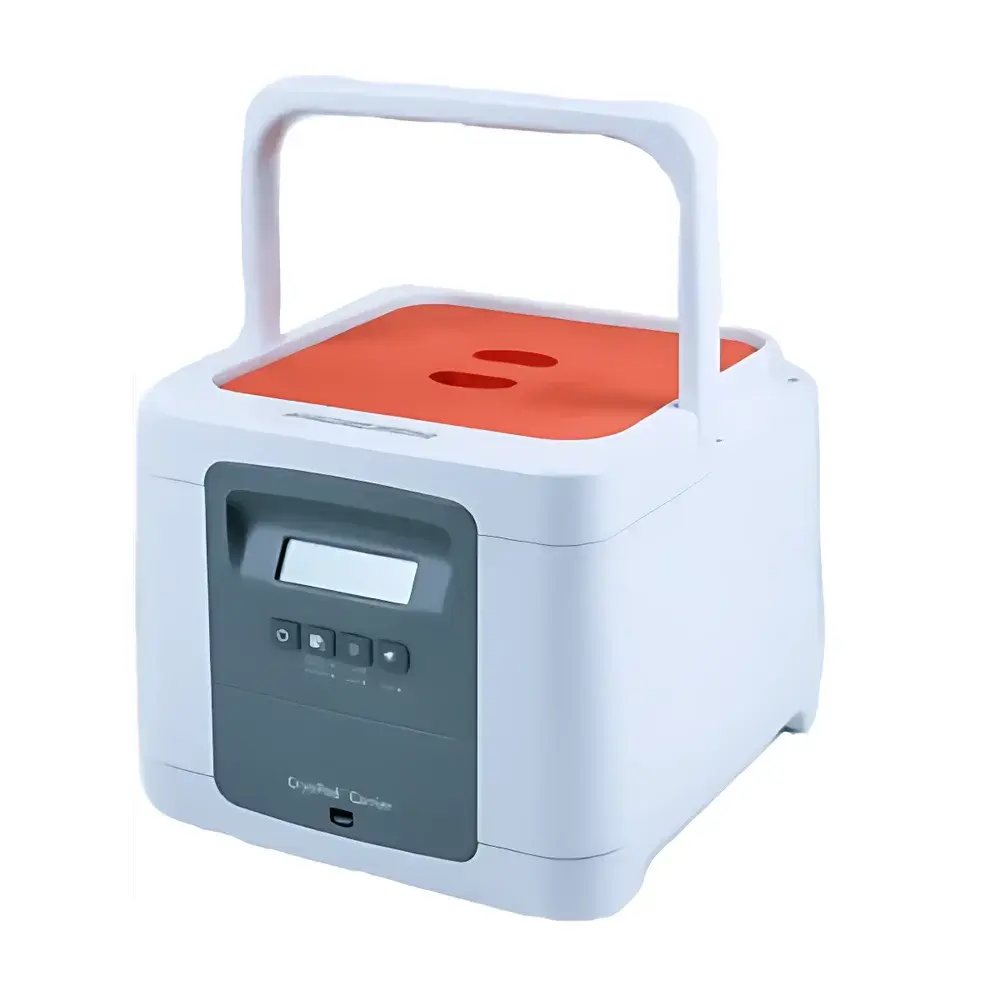
CryoPod™ Portable Cryogenic Transport Container by AZENTA
| Brand | AZENTA |
|---|---|
| Origin | USA |
| Model | CryoPod™ Portable Cryogenic Transport Container |
| Temperature Range | ≤ −150 °C (LN₂ vapor phase) |
| Hold Time | > 3 hours at ≤ −150 °C |
| Sample Capacity | Up to two SBS-format cryoboxes (e.g., 250 mL standard boxes) or equivalent trays |
| Data Logging | Timestamped temperature logging with USB data export |
| Alarms | Visual and audible alerts for temperature excursions |
| Weight | < 10 kg |
| Compatibility | Standalone use or integrated with BioStore™ automated sample management system |
| Regulatory Context | Designed for GLP-compliant sample transport |
Overview
The CryoPod™ Portable Cryogenic Transport Container is an engineered solution for the safe, traceable, and temperature-stable transit of ultra-low-temperature biological specimens—including viable cells, primary tissues, stem cell lines, and cryopreserved biospecimens—within laboratory campuses, between core facilities, or during short-haul off-site transfers. Operating exclusively in liquid nitrogen (LN₂) vapor phase, the CryoPod™ maintains a stable thermal environment at or below −150 °C for over three continuous hours without external power. Its passive cooling architecture eliminates reliance on mechanical refrigeration, thereby removing risks associated with compressor failure, electrical dependency, or condensation-induced contamination. The device is purpose-built for applications where thermal integrity directly impacts sample viability, genomic stability, and downstream assay reproducibility—particularly in biobanking, translational research, and clinical trial specimen logistics.
Key Features
- Passive LN₂ vapor-phase cooling ensures consistent ≤ −150 °C operation without electricity or moving parts.
- Integrated digital temperature sensor with real-time monitoring, high-resolution time-stamping (date, hour, minute, second), and non-volatile memory storage for full thermal history.
- Dual-mode alarm system: red LED indicator plus audible tone triggers upon deviation beyond user-defined thresholds (configurable via firmware).
- Lightweight composite construction (< 10 kg empty) with ergonomic handle and impact-resistant outer shell for repeated handling and transport compliance.
- Modular internal geometry accommodates standard cryogenic labware: compatible with two full-size SBS-format cryoboxes (e.g., 250 mL Nunc™ or Corning™ boxes) or equivalent trays; also supports individual cryovials and straws when used with optional inserts.
- Flexible LN₂ replenishment: manual top-off via standard dewar funnel or automated refilling using the dedicated CryoPod™ Fill Station (sold separately), enabling repeatable, operator-independent charging protocols.
Sample Compatibility & Compliance
The CryoPod™ is validated for transport of human and animal-derived biospecimens under conditions aligned with ISO 20387:2018 (Biobanking — General requirements for biobanking), and supports adherence to CAP/CLIA pre-analytical standards for specimen integrity. Its vapor-phase operation avoids direct LN₂ contact, eliminating cross-contamination risk and preserving sample sterility—critical for GMP-aligned cell therapy workflows. Temperature logs are stored in CSV format and exportable via USB interface, supporting 21 CFR Part 11–compliant audit trails when paired with validated software (e.g., AZENTA BioStore™ LIMS integration). All materials contacting the cold zone meet USP Class VI biocompatibility requirements and are free of leachables affecting nucleic acid or protein stability.
Software & Data Management
Temperature and event data are recorded continuously at configurable intervals (default: 30-second sampling) into internal flash memory. Data files include ambient temperature, setpoint deviation status, alarm activation timestamps, and battery voltage. Export is performed via standard USB-A connection; no proprietary drivers required. Raw logs integrate natively with AZENTA’s BioStore™ ecosystem for automatic ingestion into electronic lab notebooks (ELNs) or LIMS, enabling chain-of-custody mapping, automated QC flagging, and retrospective thermal deviation analysis. Firmware updates and configuration changes are performed through a secure, password-protected interface compliant with IEC 62304 medical device software lifecycle standards.
Applications
- Inter-facility transfer of cryopreserved PBMCs, CAR-T cells, or iPSC lines between processing labs and infusion centers.
- On-campus movement of frozen tissue blocks from pathology archives to genomics cores while maintaining RNA integrity.
- Transport of quality control reference standards between validation laboratories under ISO/IEC 17025 traceability frameworks.
- Backup cold chain support during scheduled maintenance of ultra-low temperature freezers (−80 °C) or cryostorage tanks.
- Field-deployable cryo-handling station for mobile biorepositories or clinical trial satellite sites lacking permanent LN₂ infrastructure.
FAQ
What temperature stability does the CryoPod™ guarantee during transport?
The CryoPod™ maintains ≤ −150 °C for ≥ 180 minutes under ISO 22044-1 environmental test conditions (23 °C ambient, 50% RH, no wind). Actual hold time varies with fill level, ambient temperature, and lid-open frequency.
Is the CryoPod™ certified for air transport?
It is not IATA-certified as shipped; users must comply with IATA Dangerous Goods Regulations (DGR) Section 2.8 for Class 2.2 non-pressurized cryogenic liquids when transporting filled units. Empty units may be carried unregulated.
Can temperature logs be password-protected or encrypted?
Yes—data export requires physical USB access, and firmware supports role-based authentication for configuration changes. Full encryption is available via BioStore™ LIMS-level policy enforcement.
Does it require annual calibration?
The embedded PT100 sensor is factory-calibrated to NIST-traceable standards; no routine recalibration is needed. Users may perform field verification using certified dry-well calibrators per SOP-TR-023.
How is compatibility verified with non-standard cryoboxes?
AZENTA provides dimensional specifications and tolerance envelopes in the Technical Datasheet Rev. 4.2; third-party boxes must conform to ANSI/SBS 1.1–2022 footprint and height limits (≤ 135 mm).
Related Products



