
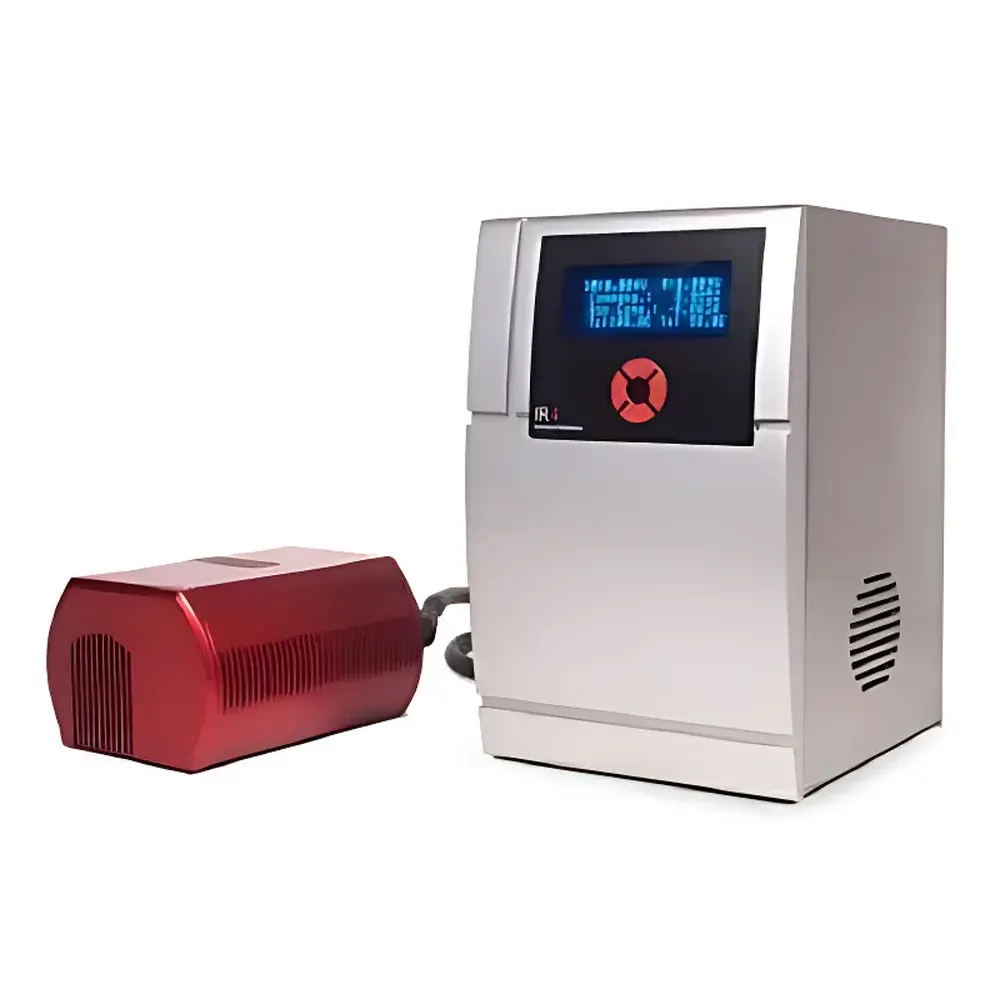
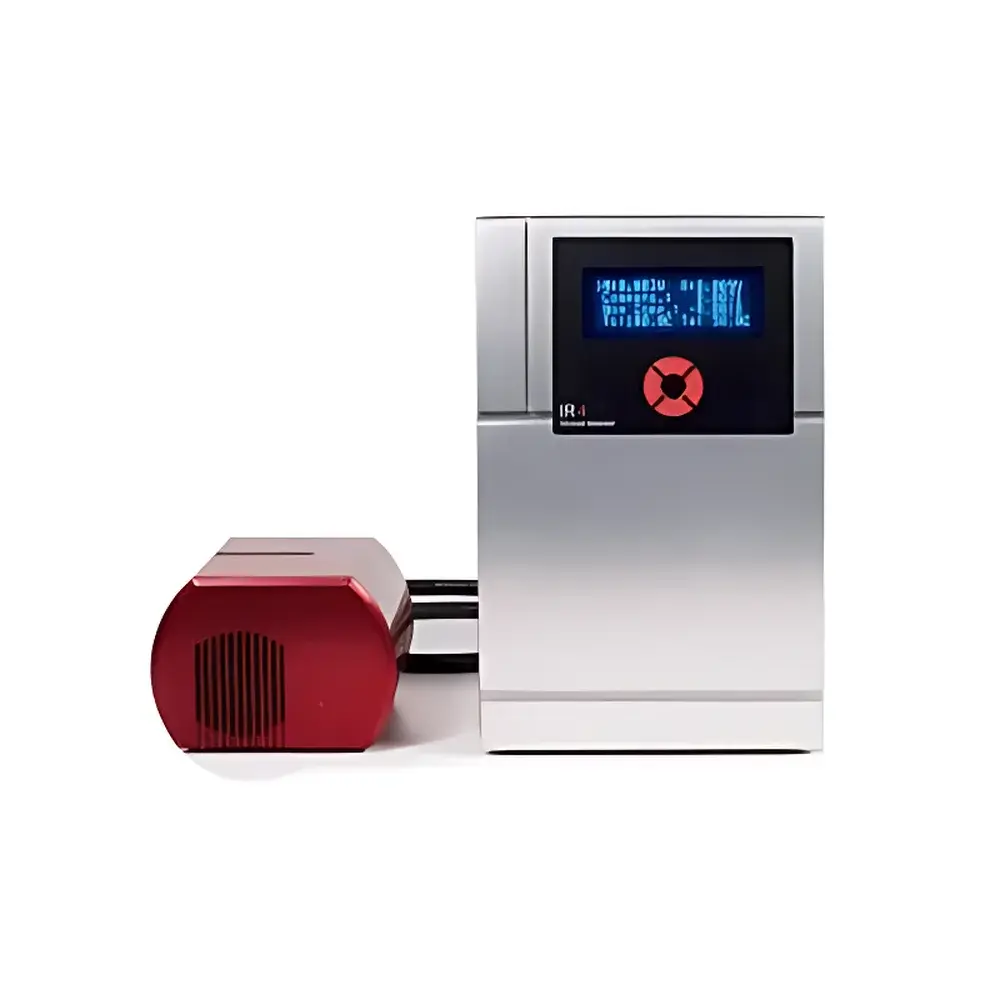
Polymer Char IR4 Enhanced Infrared Detector
| Brand | Polymer Char |
|---|---|
| Origin | Spain |
| Model | IR4 |
| Instrument Type | Laboratory-Scale Infrared Auxiliary Detector |
| Wavenumber Range | 3500–2500 cm⁻¹ |
| Resolution | 1 cm⁻¹ |
| Scan Speed | 12 scans/sec |
| Signal-to-Noise Ratio | 1000 |
| Flow Cell Volume | 13 µL |
| Maximum Pressure | 50 bar |
| Operating Temperature (Flow Cell & Transfer Line) | Up to 170 °C |
| Detection Modes | Concentration, Reference, Compositional (CH₃/1000C), Carbonyl (C=O/1000C) |
| Sensitivity (Concentration) | >0.3 AU·mL/mg |
| Compositional LOD | 5 CH₃/1000TC |
| Carbonyl LOD | 5 C=O/1000TC |
| Detector Noise | <1×10⁻³ AU |
| Analog Output | Four single-ended, 16-bit, 0–2.5 V / 0–10 V |
| Digital Input | TTL |
| Communication Interface | RS-232 |
| Power Supply | 90–260 VAC, 50–60 Hz |
| Control Unit Dimensions (W×H×D) | 19×6×25 cm, 4 kg |
| Spectral Unit Dimensions (W×H×D) | 15×12×9 cm, 2 kg |
Overview
The Polymer Char IR4 Enhanced Infrared Detector is a dual-wavelength, laboratory-grade mid-infrared (MIR) absorption detector engineered for quantitative compositional analysis of polyolefins in solution-phase separation techniques. It operates on the principle of Beer–Lambert law-based absorbance measurement at two discrete wavenumbers within the 3500–2500 cm⁻¹ spectral window—optimized for C–H stretching (e.g., methyl and methylene groups) and C=O vibrational modes. Unlike conventional refractive index (RI) detectors, the IR4 delivers chemically specific, calibration-free concentration and compositional data without reliance on reference standards or carrier gas. Its integrated heated flow cell (up to 170 °C) and temperature-stabilized transfer line (0.5 mm ID, 30 cm length) ensure compatibility with high-temperature gel permeation chromatography (HT-GPC), crystallization analysis fractionation (CRYSTAF), temperature rising elution fractionation (TREF), and high-performance liquid chromatography (HPLC) platforms. The detector’s optical architecture features fixed-filter photodiode detection, eliminating moving parts and enabling long-term baseline stability (<1×10⁻³ AU noise) and reproducible response across extended run times.
Key Features
- Dual-channel, fixed-wavelength infrared detection with independent signal acquisition for concentration and compositional metrics (e.g., CH₃/1000C or C=O/1000C)
- Integrated heated flow cell (13 µL volume, rated to 50 bar and 170 °C) and thermostatically controlled capillary transfer line (0.5 mm ID)
- Modular optical head design: spectral unit (optics + detector) and control unit (electronics + firmware) are physically decoupled for flexible system integration
- Built-in leak sensor and thermal cut-off protection aligned with IEC 61010-1 safety requirements for laboratory instrumentation
- No external purge gas, zero-calibration drift, and minimal maintenance due to solid-state optical path and absence of hygroscopic KBr windows
- RS-232 serial interface for instrument control and real-time data streaming; simultaneous analog output (four 16-bit channels, 0–10 V range) for legacy DAQ systems
Sample Compatibility & Compliance
The IR4 is validated for use with common polyolefin solvents including 1,2,4-trichlorobenzene (TCB), ortho-dichlorobenzene (o-DCB), and xylene at elevated temperatures (up to 170 °C). It supports direct coupling to HT-GPC systems from major vendors (e.g., Agilent, Waters, Malvern Panalytical) and has been deployed operationally at Beijing Research Institute of Chemical Industry and Shanghai Research Institute of Chemical Industry as a drop-in replacement for differential refractometers. Its measurement methodology complies with ASTM D6474 (Standard Test Method for Determination of Ethylene Content in Ethylene–Propylene Copolymers by FTIR) and ISO 18737 (Plastics — Polyolefins — Determination of compositional distribution by TREF/IR). Data integrity meets GLP/GMP expectations through time-stamped audit trails in optional GPC One software and supports 21 CFR Part 11 compliance when configured with electronic signatures and user access controls.
Software & Data Management
The IR4 is fully supported by Polymer Char’s GPC One data processing suite (optional), which enables automated calculation of molecular weight distribution (MWD), short-chain branching (SCB) content, and composition distribution curves (e.g., ethylene content vs. elution volume). Raw absorbance signals are timestamped and stored in HDF5 format for traceability. The software integrates with LIMS via ODBC drivers and allows custom report generation using the “My Own Report” module—exporting results to Excel (.xlsx), PDF, or CSV. All calibration coefficients, instrument configuration files, and method parameters are version-controlled and exportable. For OEM integration, SDK documentation and DLL libraries are provided for third-party software development under NDA.
Applications
- Quantification of ethylene content in ethylene–propylene copolymers (EPR, EPDM) during HT-GPC analysis
- Determination of vinyl acetate (VA) content in ethylene–vinyl acetate (EVA) copolymers via carbonyl band (1740 cm⁻¹) absorbance
- Measurement of methyl group density (CH₃/1000C) as a proxy for short-chain branching (SCB) in linear low-density polyethylene (LLDPE)
- Real-time monitoring of compositional heterogeneity in TREF and CRYSTAF fractions
- Replacement of RI detectors in multi-detector GPC systems where chemical specificity and temperature robustness are required
FAQ
Can the IR4 be used with non-polyolefin samples?
Yes—provided the analyte exhibits characteristic absorbance in the 3500–2500 cm⁻¹ range and is soluble in compatible high-boiling solvents. Validation is required for each new sample class.
Is temperature control of the flow cell mandatory?
Yes—precise thermal stabilization (±0.1 °C) is essential to minimize solvent refractive index drift and ensure spectral reproducibility. The IR4 includes embedded PID control and factory-calibrated thermistors.
Does the IR4 require daily recalibration?
No—its fixed-filter photodiode design eliminates wavelength drift. Baseline correction is performed automatically at system startup using solvent-only eluent segments.
How is data synchronization achieved with GPC pumps and columns?
Via hardware-triggered acquisition: the IR4 accepts TTL start/stop pulses from the chromatography controller and timestamps all analog outputs relative to the pump’s injection signal.
What safety certifications does the IR4 hold?
The control unit carries CE marking per EU Directive 2014/30/EU (EMC) and 2014/35/EU (LVD); full IEC 61010-1:2010 compliance documentation is available upon request.




