
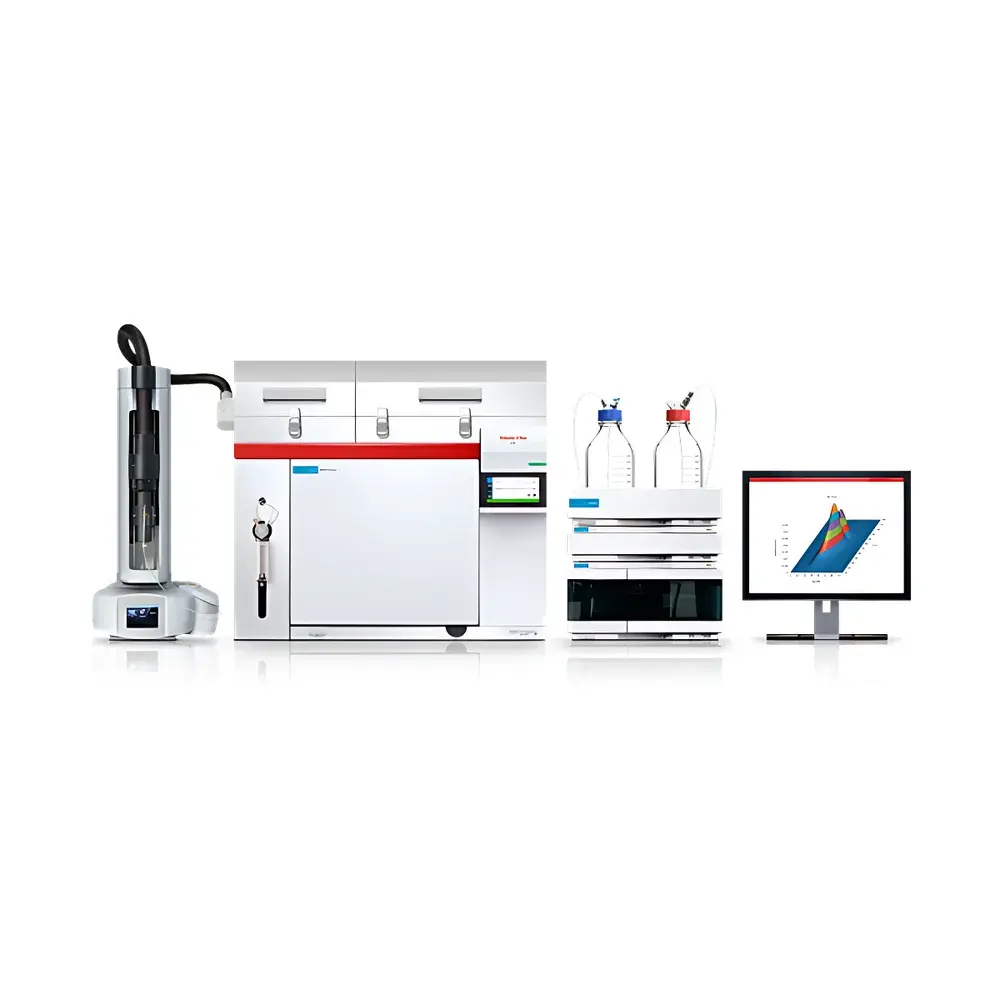
Polymer Char CFC Multifunctional Polyolefin Characterization Analyzer
| Brand | Polymer Char |
|---|---|
| Origin | Spain |
| Manufacturer Type | Authorized Distributor |
| Origin Category | Imported |
| Model | CFC |
| Pricing | Upon Request |
Overview
The Polymer Char CFC Multifunctional Polyolefin Characterization Analyzer is an integrated, benchtop analytical platform engineered for comprehensive structural characterization of polyolefins—including homopolymers, copolymers, and complex blends—by combining two orthogonal separation principles in a single automated workflow: Temperature Rising Elution Fractionation (TREF) and Gel Permeation Chromatography (GPC). TREF separates polymer chains based on crystallizability—correlating directly with comonomer content and branching density—while GPC resolves species by hydrodynamic volume, providing molecular weight distribution (MWD). The CFC synchronizes both techniques to generate correlated, three-dimensional data sets mapping temperature (TREF elution), molecular weight (GPC retention), and chemical composition distribution (CCD)—enabling simultaneous quantification of MWD, CCD, and branching architecture (e.g., methyl groups per 1000 carbons) without method compromise or sample splitting. This orthogonal coupling eliminates the need for sequential offline analyses, reducing total analysis time from multiple days to under 24 hours for full structural profiling.
Key Features
- Fully automated, walk-away operation with 42-position autosampler—enabling unattended batch analysis of diverse polyolefin samples including PP, PE, EPDM, plastomers, and wax-contaminated industrial resins.
- Integrated dual-detection architecture: infrared (IR) or refractive index (RI) detection for universal response, plus optional CH3/1000C-specific detector for direct quantification of short-chain branching density.
- Temperature-controlled TREF oven with extended low-temperature capability (down to –20 °C) via optional cryogenic accessory—essential for resolving low-crystallinity ethylene–octene copolymers or highly branched metallocene-catalyzed materials.
- HSE-compliant solvent handling system: closed-loop solvent delivery, minimal solvent consumption (<250 mL per full TREF–GPC run), and zero operator exposure to hazardous organics (e.g., 1,2,4-trichlorobenzene).
- Gentle sample introduction via programmable orbital shaking—minimizing shear-induced chain scission during dissolution and injection, preserving native molecular architecture.
- Remote monitoring and diagnostic support via secure Ethernet interface, compatible with enterprise IT infrastructure and audit-ready logging.
- Optional nitrogen purging module to suppress thermal oxidation during high-temperature dissolution and chromatographic runs—critical for stabilizing sensitive Ziegler–Natta or post-metallocene catalyst-derived polymers.
Sample Compatibility & Compliance
The CFC accommodates solid polyolefin powders, granules, and films (0.5–20 mg per injection), including filled systems (e.g., talc-, CaCO3-, or pigment-loaded grades) and multi-phase blends containing polyethylene, polypropylene, ethylene–propylene rubber (EPR), and paraffinic waxes. Method development adheres to ASTM D6474 (TREF), ASTM D5296 (GPC), and ISO 16014-4 (determination of MWD by SEC). Data acquisition and processing comply with GLP and GMP requirements: electronic signatures, full audit trail, version-controlled methods, and 21 CFR Part 11–ready software architecture (when deployed with validated LIMS integration).
Software & Data Management
The CFC is operated via Polymer Char’s proprietary CFC Control & Analysis Suite—a Windows-based application supporting intuitive method setup, real-time chromatogram visualization, and multidimensional deconvolution algorithms. Raw TREF–GPC hyphenated data are processed into interactive 3D contour plots (temperature × log Mw × CH3/1000C), 2D cross-sections (e.g., CCD vs. temperature at fixed Mw bins), and quantitative reports exportable to CSV, PDF, or XML. All raw data files are timestamped, digitally signed, and stored with metadata (instrument ID, user, calibration history, solvent lot). Software validation documentation (IQ/OQ/PQ protocols) and change control logs are provided for regulated environments.
Applications
- Quality control of catalytic polyolefin grades: correlating reactor conditions (e.g., hydrogen concentration, comonomer feed ratio) with final MWD/CCD fingerprints.
- Failure analysis of extrusion or molding defects—identifying low-MW fractions causing die drool or high-MW tails inducing melt fracture.
- Reverse engineering of competitor resins: deconvoluting blend ratios in multi-polymer packaging films or automotive thermoplastic elastomers.
- Development of new metallocene or constrained geometry catalyst (CGC) systems—quantifying branching heterogeneity and comonomer incorporation efficiency.
- Stability assessment of recycled polyolefin streams: detecting oxidative degradation products, crosslinked gels, or contaminant signatures (e.g., EVA, PS).
FAQ
What separation mechanisms does the CFC employ simultaneously?
It couples Temperature Rising Elution Fractionation (TREF) for chemical composition distribution and Gel Permeation Chromatography (GPC) for molecular weight distribution in a single, synchronized run.
Can the CFC analyze samples containing fillers or additives?
Yes—robust filtration and column protection strategies enable reliable analysis of talc-filled PP, CaCO3-loaded PE, and pigment-stabilized resins without column clogging.
Is method transfer possible between different CFC instruments?
Yes—standardized hardware configurations, calibrated temperature gradients, and traceable NIST-traceable polystyrene standards ensure inter-instrument reproducibility within ±3% for Mw and ±5% for CH3/1000C.
Does the system support regulatory compliance for pharmaceutical-grade polymer excipients?
While not intended for direct USP <857> or Ph. Eur. 2.2.58 applications, its 21 CFR Part 11–ready software architecture and full audit trail meet baseline requirements for polymer characterization in drug delivery device development.
What solvent is used for dissolution and elution?
1,2,4-Trichlorobenzene (TCB) is the standard solvent; all fluidic pathways are chemically resistant to TCB up to 160 °C, with optional stainless-steel or Hastelloy wetted parts available for extended service life.




