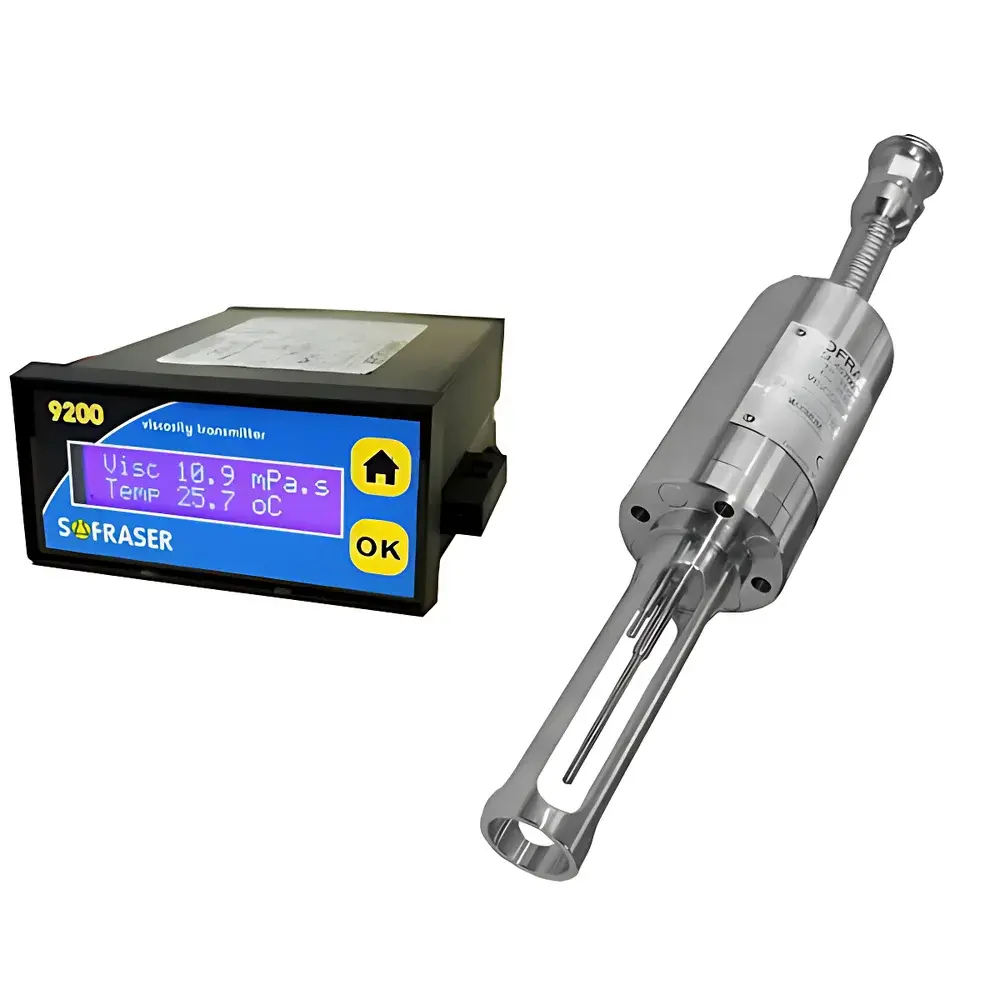
Sofraser MIVI9100 Online Viscometer for Coatings and Industrial Process Control
| Brand | Sofraser |
|---|---|
| Origin | France |
| Model | MIVI9100 |
| Viscosity Range | 0–1,000,000 mPa·s |
| Temperature Range | −20 to 300 °C (standard up to 200 °C, extended option) |
| Pressure Rating | 60 bar (up to 500 bar optional) |
| Repeatability | ±0.2% |
| Reproducibility | ±0.5% |
| Construction Material | 316L stainless steel (Hastelloy®, PTFE, or enamel coating options available) |
| Certifications | ATEX EEx ia IIC T3–T6, FM, JIS, 3A |
| Output Signals | 4–20 mA (±0.1%, 12-bit resolution, 750 Ω load), RS485/RS422 (Modbus RTU, 300–19200 baud), relay (1 A / 250 VAC or 30 VDC) |
| Power Supply | 80–265 VAC / 100–380 VDC |
| Built-in Sensor | PT100 temperature sensor |
| Display | Dual LED — red 4-digit (viscosity/temperature), green 6-digit (unit), 5 status LEDs (4 alarm + 1 communication) |
Overview
The Sofraser MIVI9100 Online Viscometer is an intrinsically safe, vibration-based rheometric instrument engineered for continuous, real-time viscosity monitoring in demanding industrial process environments—particularly within coatings formulation, polymer synthesis, and chemical reaction control. Unlike rotational or capillary viscometers, the MIVI9100 employs a resonant vibrating rod principle: a precisely tuned stainless-steel probe vibrates at its natural frequency when energized by a low-power AC signal. As process fluid contacts the rod, viscous damping alters both amplitude and phase shift of the oscillation; these changes are linearly correlated to dynamic viscosity via factory-calibrated transfer functions traceable to NIST-traceable reference oils. This non-rotating, wear-free architecture eliminates mechanical drift, bearing failure, and seal degradation—making it uniquely suited for high-pressure (up to 500 bar), high-temperature (up to 300 °C), and explosive atmospheres (ATEX Zone 0/1, FM Class I Div 1). The system delivers true inline measurement without sample extraction, bypass loops, or flow conditioning—enabling closed-loop feedback for automated reactor dosing, solvent adjustment, or dispersion endpoint detection.
Key Features
- Vibration-based sensing with no moving parts—zero maintenance, no calibration drift over time
- Intrinsically safe design certified to ATEX EEx ia IIC T3–T6, FM, JIS, and 3A sanitary standards
- Wide dynamic range: 0–1,000,000 mPa·s—covers thin solvents, latex emulsions, epoxy resins, and highly filled pigment pastes
- Integrated PT100 temperature sensor with automatic temperature compensation (ATC) and pressure compensation algorithms
- Robust 316L stainless-steel wetted parts; optional Hastelloy C-276, PTFE-lined, or vitreous enamel coatings for aggressive chemistries
- Dual LED display: 4-digit red (real-time viscosity/temperature), 6-digit green (unit designation), plus five status LEDs for alarm and communication states
- Configurable analog output (4–20 mA, ±0.1% accuracy, 12-bit resolution) with user-defined scaling and span adjustment
- Industrial-grade digital interface: RS485/RS422 Modbus RTU (300–19200 baud), supporting integration into DCS, SCADA, and MES platforms
Sample Compatibility & Compliance
The MIVI9100 is validated for direct installation in pipelines, reactors, and mixing vessels across heterogeneous fluid categories—including water-based acrylic dispersions, solvent-borne alkyd resins, UV-curable oligomers, and high-solids polyurethane systems. Its vibration principle remains insensitive to particle loading (≤50 vol%), air entrainment, or minor flow turbulence—critical for pigment-rich coatings where sedimentation or shear thinning would compromise rotational sensor reliability. Compliance extends beyond safety: the device supports GLP/GMP data integrity requirements through optional WISC80 software, which logs timestamped viscosity/temperature records with operator ID, audit trail, and electronic signature capability per FDA 21 CFR Part 11. All materials meet EU Regulation (EC) No. 1935/2004 for food-contact applications and 3A Sanitary Standards for beverage and cosmetic lines.
Software & Data Management
WISC80 configuration and monitoring software (optional) provides full parameter setup, real-time trending, historical data export (CSV/Excel), and alarm threshold management via USB or RS232 connection. It enables batch-level viscosity profiling synchronized with temperature and pressure inputs—supporting statistical process control (SPC) charting and Cp/Cpk analysis. When integrated with plant historians (e.g., OSIsoft PI, Emerson DeltaV), the MIVI9100 feeds validated, compensated viscosity values directly into quality dashboards and predictive maintenance models. All firmware updates are delivered via signed binary packages to ensure cryptographic integrity and version traceability.
Applications
- Real-time viscosity control during resin synthesis and crosslinking reactions in paint manufacturing
- Endpoint detection in pigment grinding and dispersion processes to prevent over-milling or re-agglomeration
- Batch-to-batch consistency verification in architectural coatings, automotive basecoats, and coil coating lines
- Monitoring thermal stability of UV-curable formulations during curing oven residence time
- In-line QC for adhesives, sealants, and inkjet inks where Newtonian/non-Newtonian transitions impact jetting performance
- Process validation support for ISO 9001, ISO 14001, and IATF 16949 audits through documented measurement uncertainty and traceability
FAQ
How does the MIVI9100 handle non-Newtonian fluids commonly found in coatings?
It measures apparent viscosity at the probe’s characteristic shear rate (~10–100 s⁻¹), which correlates strongly with application-relevant behavior (e.g., spray atomization, roller spreadability). While not a full rheogram generator, its stability under variable shear makes it more representative than capillary devices for process control.
Can the sensor be installed in vertical or horizontal pipe sections?
Yes—orientation-independent mounting is supported via standard DN25–DN100 flange connections (DIN/ANSI/JIS); flow velocity should remain ≥0.3 m/s to ensure consistent wetting.
Is recalibration required after installation?
No field recalibration is needed. Factory calibration is performed using certified reference oils across the full range; long-term stability is verified per ISO 17025 accredited procedures.
What diagnostic capabilities does the embedded electronics provide?
Continuous self-diagnostics monitor probe resonance frequency, signal-to-noise ratio, temperature sensor integrity, and power supply stability—reporting faults via Modbus register or local LED alarms.
Does the system support HART or Profibus protocols?
Not natively—but HART-to-Modbus gateways or third-party protocol converters may be deployed at the DCS interface level without compromising measurement fidelity.
Related Products