
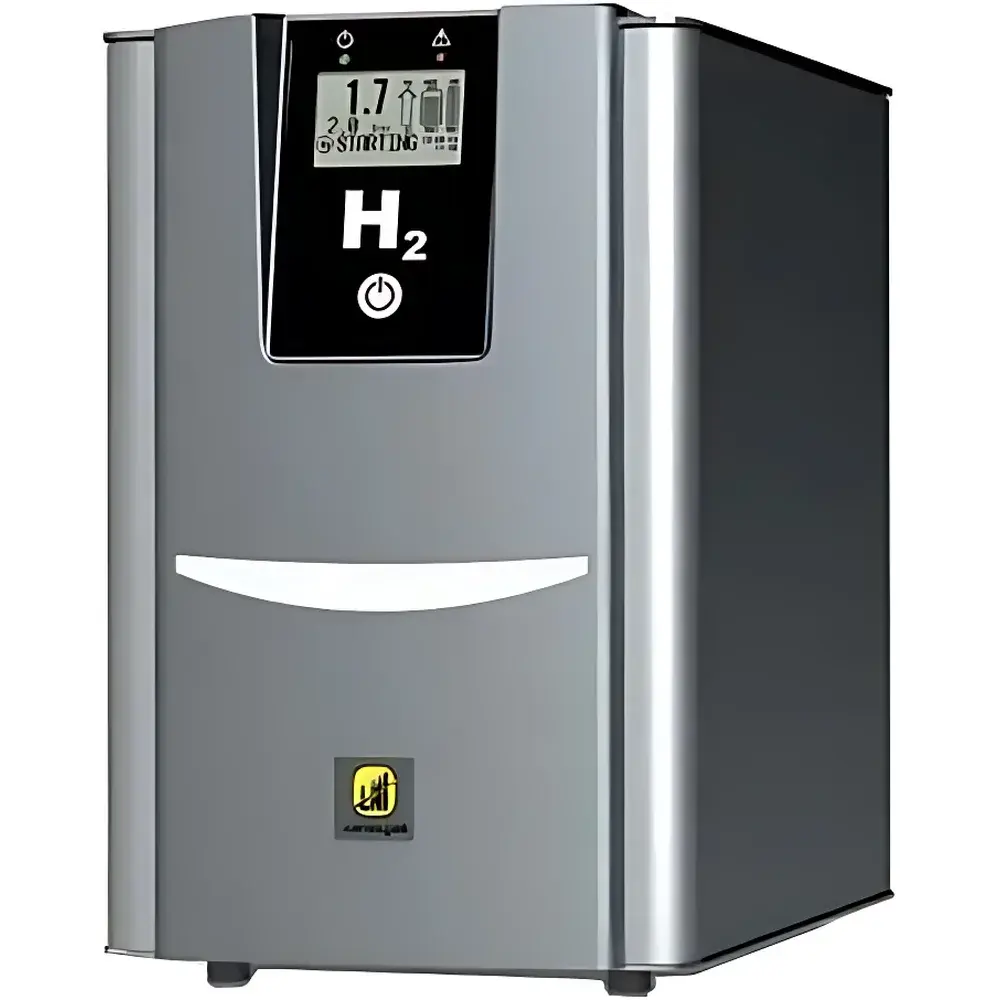
English Product Name
| Brand | JKRD |
|---|---|
| Origin | USA |
| Model | CGH2-160 |
| Hydrogen Production Principle | Pure-water electrolysis |
| Output Flow Rate | 160 mL/min (up to 1300 mL/min customizable) |
| Output Pressure | 11.9 bar (0–100 psi) |
| Hydrogen Purity | 99.999995% |
| Dimensions | 40 × 40 × 45 cm |
| Weight | 23 kg |
| Power Supply | 220 V, 50 Hz |
| Certifications | CSA, UL, IEC 61010, CE |
Overview
The JKRD CGH2-160 Ultra-High-Purity Hydrogen Generator is an engineered solution for laboratories requiring continuous, on-demand hydrogen gas at analytical-grade purity—99.999995% (7N5)—without reliance on high-pressure cylinders. It employs membrane-separated pure-water electrolysis: deionized water is electrolyzed within a PEM (Proton Exchange Membrane) cell, generating hydrogen gas at the cathode. The nascent H₂ then diffuses through a palladium-alloy diffusion membrane, which selectively permits only molecular hydrogen and its isotopes while rejecting all contaminants—including O₂, N₂, Ar, CO, CO₂, moisture, and total hydrocarbons—to yield ultra-pure output. This principle ensures intrinsic purity without post-generation adsorption or catalytic purification stages, eliminating baseline drift, consumable degradation, and maintenance-induced downtime common in desiccant- or getter-based systems. Designed for 24/7 operation in regulated laboratory environments, the CGH2-160 delivers stable flow and pressure control across variable demand, making it suitable for both benchtop GC systems and industrial-scale CVD process lines.
Key Features
- PEM-based electrolysis with integrated palladium-alloy diffusion membrane for intrinsic 99.999995% H₂ purity—no external purifiers required
- Intelligent auto-fill system maintains optimal water level using conductivity-sensing electrodes; compatible exclusively with ASTM D1193 Type I (18.2 MΩ·cm) ultrapure water
- Digital front-panel interface with real-time monitoring of pressure, flow, electrolyte status, membrane temperature, and system fault codes
- Pressure-regulated output up to 11.9 bar (173 psi), programmable via analog 0–10 V or RS-232/Modbus RTU for integration into automated GC or reactor control networks
- Passive safety architecture compliant with OSHA 1910.103, NFPA 50A, and IEC 60079-10-1 for Class I, Division 2 hazardous locations
- No moving parts beyond solenoid valves; zero consumables, zero scheduled maintenance, and no baseline interference in FID or TCD detectors
Sample Compatibility & Compliance
The CGH2-160 is validated for use with gas chromatography systems (including Agilent, Thermo Fisher, Shimadzu, and PerkinElmer platforms), CVD reactors requiring carrier or reactant H₂, and trace-level hydrocarbon analyzers where background suppression is critical. Its output meets ASTM D6866-22 (for isotopic purity verification), ISO 8573-1:2010 Class 1 compressed air purity equivalency for gaseous contaminants, and USP requirements for pharmaceutical-grade excipient gases. All electrical and mechanical designs conform to IEC 61010-1 for laboratory equipment safety, with full traceability documentation supporting GLP and GMP audit readiness. The unit carries CSA C22.2 No. 61010-1, UL 61010-1, and CE marking under the EU Machinery Directive 2006/42/EC and Electromagnetic Compatibility Directive 2014/30/EU.
Software & Data Management
Remote monitoring and configuration are supported via optional Ethernet or USB-to-RS232 interface. The embedded firmware logs operational parameters—including cumulative runtime, total H₂ volume produced, pressure deviation events, and water consumption—at 1-minute intervals for ≥30 days. Audit trails comply with FDA 21 CFR Part 11 requirements when paired with validated LIMS or ELN software, including electronic signatures, user access controls, and immutable record retention. Firmware updates are delivered via signed binary packages with SHA-256 checksum validation to ensure integrity and prevent unauthorized modification.
Applications
- Carrier and fuel gas for GC-FID, GC-TCD, and GC-MS systems—particularly fast-GC and microbore column applications requiring high flow stability and low noise floor
- Reaction gas in catalytic hydrogenation studies, fuel cell testing, and semiconductor epitaxy (e.g., SiGe growth via UHV-CVD)
- Zero-air generator purge gas and calibration standard diluent in ambient air monitoring systems (EPA Method TO-15, TO-17)
- Alternative to helium in GC carrier applications where cost, supply chain reliability, or regulatory constraints limit He availability
- On-site hydrogen supply for mobile emission analyzers used in automotive R&D and roadside NOₓ/H₂O/CO testing
FAQ
What water quality is required for optimal operation?
Type I ultrapure water per ASTM D1193 (resistivity ≥18.2 MΩ·cm, TOC <5 ppb, silica <0.05 ppb) is mandatory. Tap water, distilled water, or low-grade deionized water will cause rapid membrane fouling and irreversible performance loss.
Can the CGH2-160 replace helium in GC carrier applications?
Yes—when method validation confirms equivalent resolution, retention time reproducibility, and detector response. Its 11.9 bar maximum pressure supports high-efficiency capillary columns and short-cycle analyses.
Is hydrogen purity verified in real time?
No continuous in-line purity sensor is installed; however, the palladium-membrane separation mechanism provides inherent, physics-based purity assurance. Optional third-party validation via GC-TCD or residual gas analyzer (RGA) is recommended during initial commissioning and annually thereafter.
Does the unit require ventilation or hydrogen leak detection?
While not mandated by NFPA 50A for this class of low-capacity (<200 mL/min), installation in a well-ventilated area or integration with room-level H₂ sensors (e.g., electrochemical or catalytic bead) is strongly advised for labs operating multiple generators or in confined spaces.
What is the expected service life of the PEM stack and diffusion membrane?
Under specified water quality and ambient conditions (15–30°C, <80% RH), the PEM stack is rated for ≥20,000 hours of continuous operation; the palladium membrane has no defined wear-out mechanism and remains functional for the lifetime of the instrument if protected from halide or sulfur contamination.



