
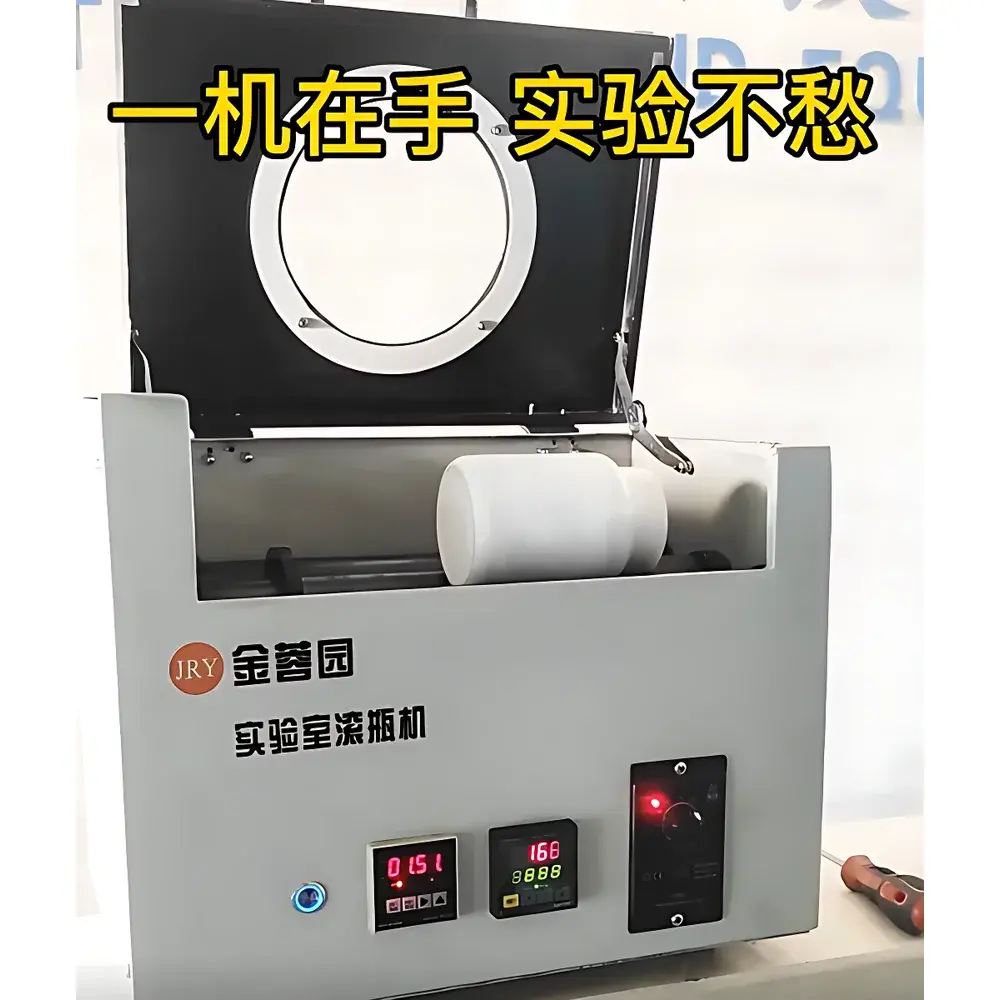
JRY-GP Horizontal Roller Bottle Mill
| Brand | JRY |
|---|---|
| Origin | Hunan, China |
| Manufacturer Type | Direct Manufacturer |
| Product Category | Domestic |
| Model | JRY-GP |
| Instrument Type | Ball Mill |
| Sample Suitability | Hard Materials |
| Final Particle Size | < 0.01 mm |
Overview
The JRY-GP Horizontal Roller Bottle Mill is an integrated laboratory processing system engineered for controlled mechanical attrition, homogenization, and surface conditioning of solid and semi-solid samples. Unlike conventional vertical ball mills relying on gravitational impact, this unit operates on a horizontal rotary principle—rotating sealed cylindrical bottles (rollers) at precisely regulated speeds to induce cascading motion of grinding media (e.g., stainless steel, zirconia, or agate beads) against the sample matrix. This mechanism delivers consistent shear, compression, and abrasion forces ideal for particle size reduction, dispersion stabilization, and surface activation in powder metallurgy, battery electrode slurry preparation, ceramic precursor blending, and environmental soil extraction protocols. Its fully enclosed architecture eliminates airborne particulate release and volatile solvent exposure—critical for occupational safety compliance (OSHA 29 CFR 1910.1200) and GLP-aligned sample integrity.
Key Features
- Horizontal roller configuration with dual-axis synchronous drive ensures uniform rotational torque distribution and minimizes mechanical resonance during extended operation.
- Sealed bottle system compatible with disposable polypropylene, borosilicate glass, and PTFE-lined rollers—eliminating cross-contamination and reducing cleaning validation burden.
- Digital PID-controlled speed regulation (0–60 rpm range, ±0.5 rpm accuracy) enables reproducible energy input across batch sizes from 10 mL to 500 mL per bottle.
- Temperature-compensated motor housing maintains thermal stability under continuous load; optional ambient-temperature jacketing supports low-heat-sensitive formulations (e.g., polymer dispersions).
- Interlocked safety lid with position-sensing switch halts rotation immediately upon opening—meeting IEC 61000-6-2 EMC and EN 60204-1 machinery safety standards.
- Modular sample rack design accommodates up to 8 standard bottles (Ø50 × 150 mm) or customizable fixtures for irregular geometries (e.g., vials, centrifuge tubes).
Sample Compatibility & Compliance
The JRY-GP handles brittle, fibrous, and moderately ductile materials—including metal oxides, geological aggregates, pharmaceutical excipients, and composite precursors—without requiring pre-drying or cryogenic pretreatment. Its non-contact mixing action preserves crystallinity and avoids amorphization artifacts common in high-energy planetary mills. All wet-processing configurations comply with ISO 17025 clause 5.4.2 (sample handling traceability) and support USP particulate matter testing workflows when used with certified cleanroom-grade rollers. The absence of internal shafts or magnetic couplings eliminates metallic leaching—validated via ICP-MS analysis (<0.1 ng/mL Cr/Ni/Fe background in aqueous slurries).
Software & Data Management
While the base model features analog speed/timer controls, the optional JRY-Link firmware upgrade (v2.3+) provides USB-C connectivity and Windows-compatible configuration software. This enables audit-trail logging per FDA 21 CFR Part 11 requirements—including user ID stamping, parameter change timestamps, and electronic signature capture for SOP adherence. Batch records export as CSV or PDF with embedded metadata (bottle ID, duration, RPM setpoint, ambient temperature). Firmware supports scheduled shutdown, ramp-up profiles, and error-code diagnostics (e.g., overload detection, lid-open event history).
Applications
- Battery R&D: Homogenizing NMC/LFP cathode slurries with conductive carbon additives while maintaining binder molecular weight integrity.
- Geochemical Analysis: Grinding certified reference materials (CRMs) like GBW07312 for XRF fusion pellet preparation without elemental fractionation.
- Nanomaterial Synthesis: Exfoliating graphite to few-layer graphene in NMP via shear-dominated rolling—superior to ultrasonication in defect control.
- Pharmaceutical QA: Dry-blending API-excipient mixtures for content uniformity testing (USP ) with ≤3% RSD across 10 g batches.
- Environmental Testing: Extracting heavy metals from contaminated soils using EPA Method 3050B-compliant acid digestion vessels mounted in roller racks.
FAQ
What bottle materials are certified for trace-metal analysis?
Certified low-background polypropylene (ASTM D4101 Class 1) and quartz rollers are available—both tested per ISO 14644-1 Class 5 cleanroom specifications.
Can the unit operate under inert atmosphere?
Yes—customizable gas-purged bottle caps with Swagelok fittings support N₂/Ar purging; pressure-rated up to 0.3 MPa gauge.
Is maintenance documentation provided in English?
Full bilingual (EN/CN) technical manuals, spare parts schematics, and calibration certificates are included with shipment.
How is speed calibration verified?
Factory calibration uses NIST-traceable optical tachometry; users may perform field verification using the included handheld laser tachometer (±0.2% accuracy).
Does the system meet CE marking requirements?
Yes—certified to EU Machinery Directive 2006/42/EC and EMC Directive 2014/30/EU; Declaration of Conformity supplied with each unit.



