
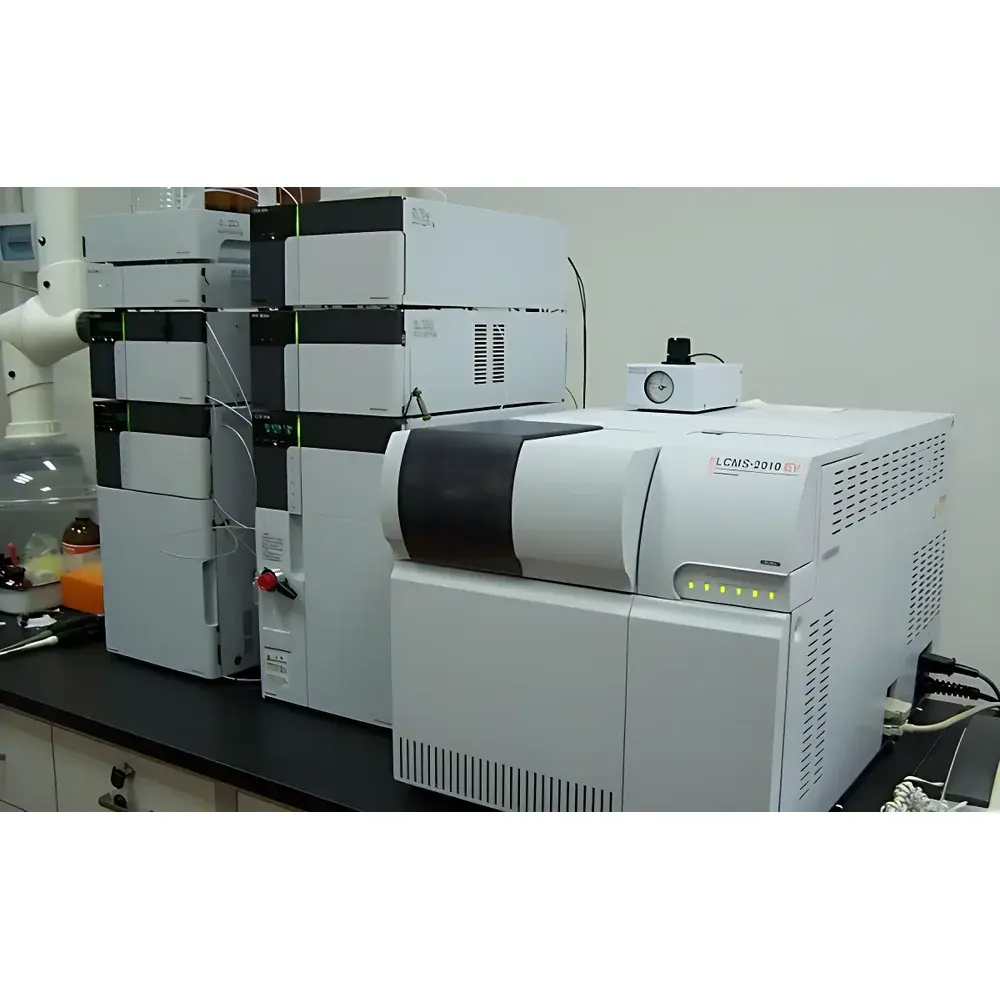
Shimadzu LCMS-2010EV Used Single Quadrupole Liquid Chromatography Mass Spectrometer
| Brand | Shimadzu |
|---|---|
| Origin | USA |
| Manufacturer Type | Authorized Distributor |
| Origin Category | Imported |
| Model | LCMS-2010EV |
| Instrument Type | Single Quadrupole |
| Mass Range | 10–3000 m/z |
| Sensitivity | S/N ≥ 100:1 (1 pg reserpine, ESI+) |
| Resolution | 0.5–0.7 m/z (FWHM) |
| Mass Accuracy | ±0.1 Da |
| Scan Speed | Up to 6000 amu/sec |
| Ionization Modes | ESI±, APCI± (optional) |
| Polarity Switching | Simultaneous positive/negative ion acquisition |
| Acquisition Modes | Full Scan, SIM, CID, Multi-Sequential Analysis (up to 64 methods per run) |
Overview
The Shimadzu LCMS-2010EV is a high-performance, single quadrupole liquid chromatography mass spectrometer engineered for robust quantitative and qualitative analysis in regulated and research laboratory environments. Built upon Shimadzu’s proven LC/MS platform architecture, the LCMS-2010EV integrates an advanced atmospheric pressure ionization (API) interface—including electrospray ionization (ESI) and optional atmospheric pressure chemical ionization (APCI)—with a high-transmission ion optical system and a precision-machined quadrupole mass analyzer. Its core measurement principle relies on mass-selective filtering of ions generated from LC eluent via radiofrequency (RF) and direct current (DC) voltage modulation across the quadrupole rods, enabling unit-mass resolution and stable detection across the 10–3000 m/z range. Designed for compatibility with standard HPLC and UHPLC systems, the instrument supports flow rates up to 2.0 mL/min in ESI mode without splitting, making it suitable for conventional reversed-phase, HILIC, and ion-pairing separations. The LCMS-2010EV is widely deployed in pharmaceutical QC/QA, environmental residue testing, food safety screening, and academic metabolomics workflows where reproducible single-stage MS data are required under GLP or ISO/IEC 17025 frameworks.
Key Features
- Optimized API source with angled spray geometry and heated desolvation line—enhances droplet desolvation efficiency and reduces adduct formation
- Modular heater design surrounding the capillary inlet and curved desolvation tube—improves thermal stability and signal continuity during gradient elution
- Q-Array ion guide combined with an octopole-based collision cell and hyperbolic quadrupole mass filter—maximizes ion transmission and duty cycle across wide mass ranges
- Real-time observation window integrated into the ion source housing—enables visual monitoring of nebulization status and plasma stability without venting
- High-speed scanning electronics supporting up to 6000 amu/sec scan rate—ensures sufficient data points across narrow UHPLC peaks (≥12 points/peak at 0.5 min width)
- Multi-sequential acquisition capability—permits up to 64 independent scan/SIM/CID events within a single LC run, facilitating multi-analyte quantitation and structural confirmation
Sample Compatibility & Compliance
The LCMS-2010EV accommodates diverse sample matrices including biological fluids (plasma, urine), environmental extracts (soil, water), food homogenates, and synthetic reaction mixtures. Its ESI source operates effectively with aqueous/organic mobile phases containing common additives (e.g., 0.1% formic acid, 5 mM ammonium acetate), while its robust ion optics tolerate moderate levels of non-volatile salts and surfactants when coupled with appropriate sample cleanup (SPE, protein precipitation). From a regulatory standpoint, the system complies with key analytical validation requirements outlined in ICH Q2(R2), USP , and FDA Guidance for Bioanalytical Method Validation. When operated with Shimadzu’s LabSolutions software configured for audit trail, electronic signatures, and user access control, the platform supports 21 CFR Part 11 compliance for GxP environments. Routine performance verification follows ASTM D7599 (for pesticide residue analysis) and ISO 17025 clause 5.9 (method validation).
Software & Data Management
Controlled exclusively via Shimadzu LabSolutions LCMS software (v5.8 or later), the LCMS-2010EV provides integrated instrument control, real-time data acquisition, peak integration, calibration curve generation, and report export in PDF, CSV, and XML formats. The software includes built-in tools for mass calibration (using sodium formate or caffeine standards), retention time alignment, and spectral deconvolution for co-eluting components. All raw data files (.qgd) are stored with embedded metadata—including method parameters, sequence logs, and hardware status flags—ensuring full traceability. Audit trails record every user action (method edit, data reprocessing, report generation) with timestamp, operator ID, and IP address. Data backups follow NIST SP 800-88 Rev. 1 guidelines, and archived datasets remain accessible for retrospective reanalysis without format migration.
Applications
- Pharmaceutical impurity profiling and stability-indicating assays per ICH Q3B
- Residue analysis of veterinary drugs and pesticides in animal tissues and crops (EU MRLs, EPA 1694)
- Quantitative bioanalysis of small-molecule therapeutics in plasma using stable isotope-labeled internal standards
- Screening of mycotoxins and marine biotoxins in food commodities (AOAC 2012.01, EN 15662)
- Environmental monitoring of PFAS, pharmaceuticals, and endocrine disruptors in wastewater influent/effluent
- Metabolite identification support via post-acquisition extraction of diagnostic fragment ions (e.g., m/z 107 for tyrosine, m/z 136 for dopamine)
FAQ
Is the LCMS-2010EV compatible with modern UHPLC systems operating at 1000 bar?
Yes—the instrument’s low-dead-volume interface and fast scan capabilities enable seamless coupling with sub-2-µm particle columns and high-pressure gradients; optimal dwell volume matching is achieved using Shimadzu’s DGU-20A³ degasser and SIL-30ACMP autosampler.
Does the system support automated method development for polarity switching?
Yes—LabSolutions allows pre-defined polarity-switching schedules within a single method, with independent optimization of source voltages, cone potentials, and detector gain for both ESI+ and ESI− modes.
What maintenance intervals are recommended for routine operation?
Ion source cleaning every 2–4 weeks depending on matrix load; quadrupole and detector calibration quarterly; vacuum pump oil replacement every 6 months; annual preventive maintenance by Shimadzu-certified service engineers.
Can raw data be exported for third-party processing (e.g., XCMS, MS-DIAL)?
Yes—.qgd files can be converted to open formats (mzML, mzXML) using Shimadzu’s Q1 Converter utility, preserving all acquisition metadata required for reproducible reprocessing.
Is remote diagnostics supported for troubleshooting?
Yes—when connected to a secure corporate network, the instrument supports encrypted remote access via Shimadzu Remote Service (SRS), enabling real-time log review, parameter adjustment, and firmware updates under IT policy compliance.





