
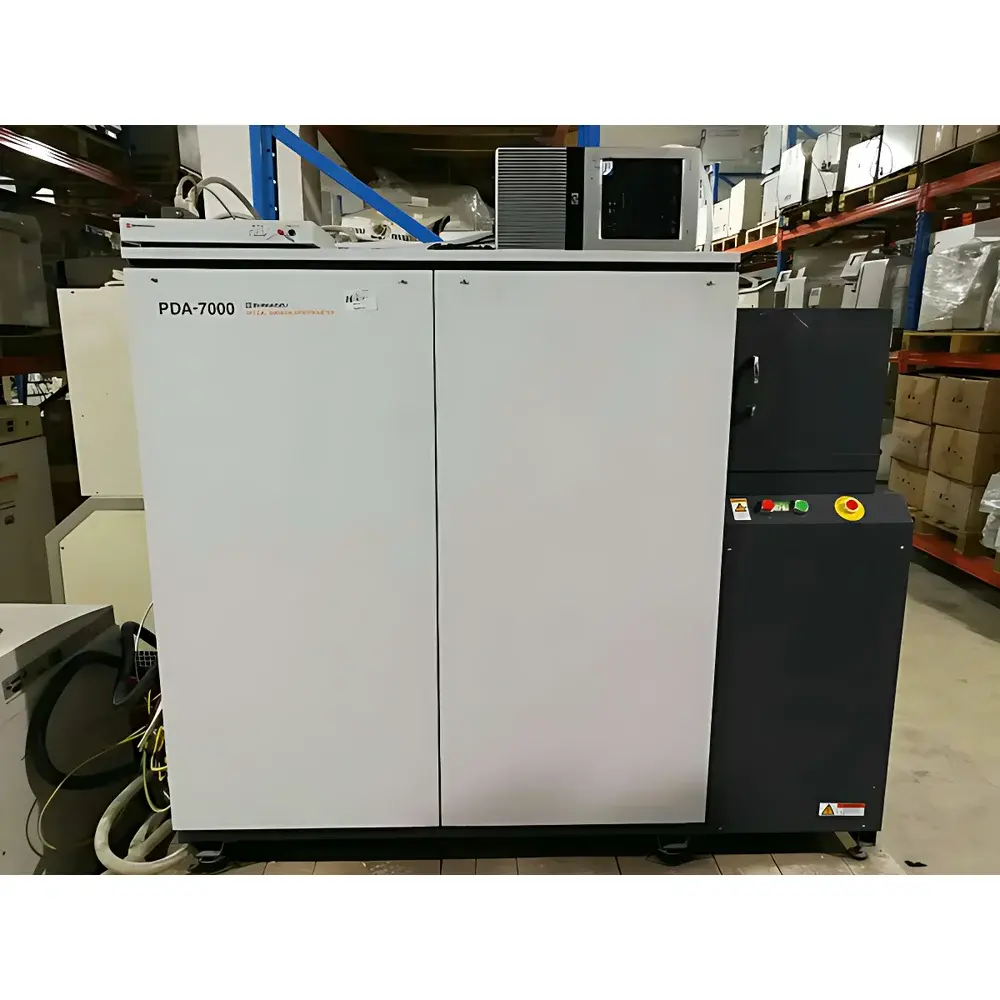
Shimadzu PDA-7000 Used Direct-Reading Optical Emission Spectrometer (OES)
| Brand | Shimadzu |
|---|---|
| Origin | Japan |
| Instrument Type | Floor-standing |
| Excitation Source | Arc/Spark |
| Detector Type | Photomultiplier Tube (PMT) |
| Optical Configuration | Paschen-Runge Mount |
| Focal Length | 750 mm (typical for PDA-series) |
| Grating Groove Density | 1200–2400 lines/mm (model-dependent) |
| Wavelength Range | 130–800 nm |
| Number of Fixed Channels | Up to 60 analytical channels |
| Nitrogen Detection Limit | ≤5 ppm in steel matrix |
| Compliance | ASTM E415, ISO 11577, JIS G 1253 |
Overview
The Shimadzu PDA-7000 is a floor-standing direct-reading optical emission spectrometer (OES) engineered for high-precision elemental analysis of solid metallic samples in industrial metallurgical laboratories. Based on the Paschen-Runge optical layout with fixed multi-channel photomultiplier tube (PMT) detection, the system employs time-resolved pulse discrimination—Shimadzu’s proprietary Pulse Distribution Analysis (PDA) methodology—to isolate and statistically evaluate discrete spark or arc emission pulses under controlled argon purge. This approach minimizes matrix-induced spectral interferences and thermal drift effects, delivering enhanced short- and long-term reproducibility for routine QC/QA workflows in foundries, rolling mills, and alloy production facilities. The instrument is optimized for rapid, simultaneous quantification of major, minor, and trace elements—including nitrogen at sub-10 ppm levels in carbon steels—without requiring vacuum pumping or dynamic wavelength scanning.
Key Features
- Robust Paschen-Runge monochromator with 750 mm focal length and thermally stabilized optical bench, ensuring mechanical and thermal rigidity across extended operation cycles.
- Dual-mode excitation capability: configurable for high-energy arc (for refractory metals and low-conductivity alloys) or precision spark discharge (for steel and aluminum), each with independently adjustable current, voltage, and pre-spark conditioning parameters.
- Up to 60 fixed PMT channels, each equipped with individual high-voltage power supplies and analog-to-digital converters calibrated for linear response over 6 orders of magnitude intensity range.
- Time-gated signal acquisition synchronized to spark pulse train, enabling background subtraction, plasma decay profiling, and pulse-height discrimination to suppress continuum radiation and stray light artifacts.
- Integrated argon flow control system with real-time pressure monitoring and automatic purging sequence prior to analysis—ensuring stable plasma conditions and minimizing atmospheric nitrogen/oxygen interference in UV spectral regions (e.g., N I 149.26 nm, C I 193.09 nm).
- Reinforced spark stand with precision sample clamping, electrode alignment mechanism, and wear-resistant tungsten or copper electrodes—designed for >100,000 analyses per consumable set under GLP-compliant maintenance schedules.
Sample Compatibility & Compliance
The PDA-7000 supports flat, polished solid metal samples (diameter ≥20 mm, thickness ≥5 mm) across ferrous and non-ferrous matrices, including carbon/microalloyed steels, stainless steels, cast irons, aluminum alloys (e.g., 1xxx–8xxx series), magnesium, copper, zinc, titanium, nickel, and cobalt-based superalloys. Sample preparation follows standardized grinding/polishing protocols per ASTM E1184 and ISO 11577. Analytical performance complies with ISO 11577 (determination of elements in steel by OES), ASTM E415 (standard test method for analysis of steel by spark OES), and JIS G 1253 (Japanese Industrial Standard for steel analysis). Full audit trail logging, user access control, and electronic signature support align with FDA 21 CFR Part 11 requirements when deployed in regulated manufacturing environments.
Software & Data Management
The system operates with Shimadzu’s dedicated PDA-7000 Control & Analysis Software (v4.x), providing intuitive method setup, calibration curve management (linear, quadratic, and multi-point standardization), interference correction (e.g., Fe II 238.204 nm for Mn I 257.610 nm), and statistical process control (SPC) charting. Raw spectral data (pulse count histograms per channel) are stored in vendor-neutral binary format with embedded metadata (operator ID, timestamp, sample ID, argon pressure, spark energy). Export options include CSV, XML, and LIMS-compatible ASTM E1382-compliant output. Software validation documentation (IQ/OQ/PQ templates) and change control logs are available upon request for GMP/GLP audits.
Applications
- Real-time melt shop analysis for ladle-to-tap composition verification in integrated steel plants.
- Alloy grade identification and scrap sorting in recycling facilities using multivariate classification algorithms.
- Trace element certification (e.g., Sn, As, Sb, Pb) in pipeline steels per API 5L Annex A requirements.
- Nitrogen specification verification in austenitic stainless steels and nitrided tool steels—replacing standalone inert gas fusion analyzers for routine screening.
- Quality gate inspection for automotive aluminum die-castings (e.g., A380, ADC12) per SAE J452 and EN 1706.
- Research-grade quantitative mapping of segregation profiles in homogenized ingot cross-sections via sequential point analysis.
FAQ
Is the PDA-7000 compatible with modern LIMS and ERP systems?
Yes—the instrument supports ASTM E1382 and ASTM E1489 data exchange formats, and optional OPC UA connectivity enables bidirectional integration with laboratory information management systems and plant-level MES platforms.
What maintenance intervals are recommended for PMT detectors and optics?
PMT gain calibration is advised every 200 operating hours; optical chamber purging and vacuum seal inspection every 6 months; full optical alignment verification annually or after relocation.
Can the system be upgraded with additional analytical channels post-purchase?
No—channel configuration is hardware-defined at manufacture. However, unused PMT sockets may be activated via firmware license key if physically populated during initial installation.
Does the PDA-7000 meet ISO/IEC 17025 accreditation requirements for testing laboratories?
Yes—when operated with documented calibration procedures, certified reference materials (CRMs) traceable to NIST or BAM, and validated uncertainty budgets, the system satisfies clause 6.4.10 (equipment verification) and 7.7 (result reporting) of ISO/IEC 17025:2017.




