
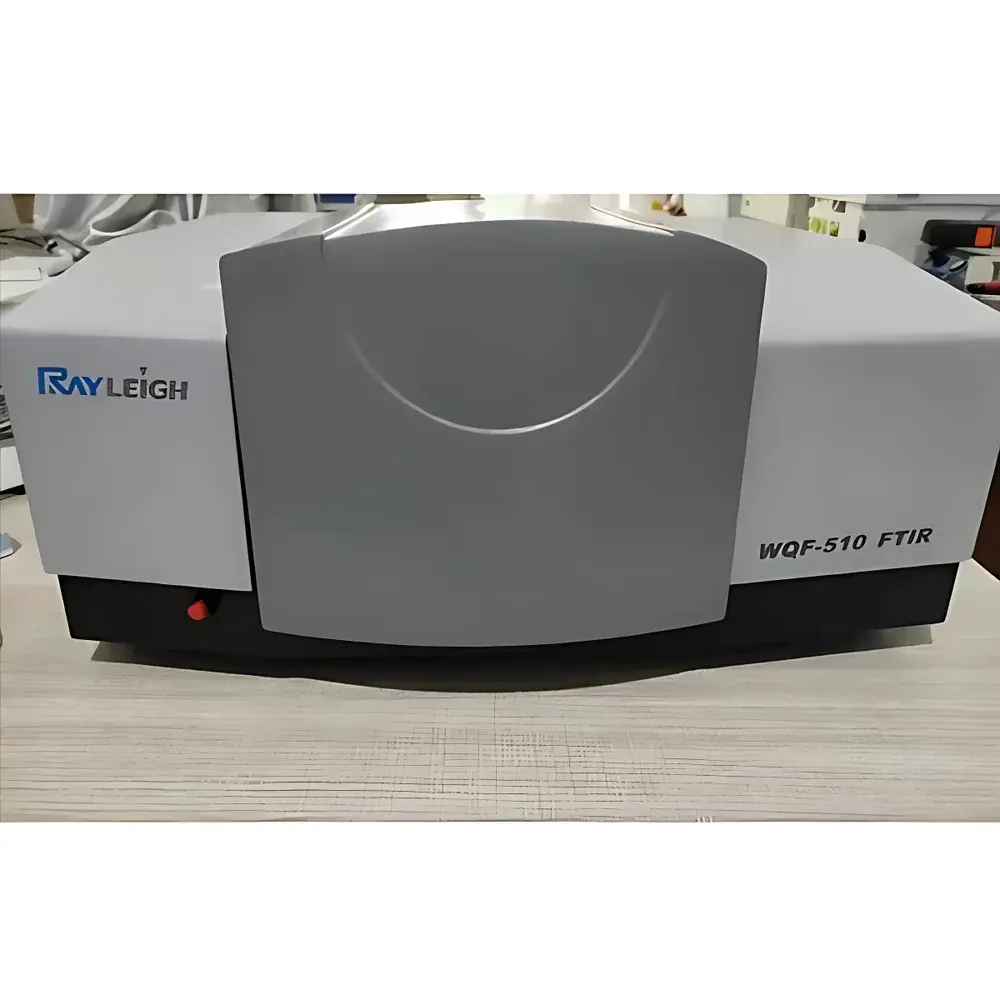
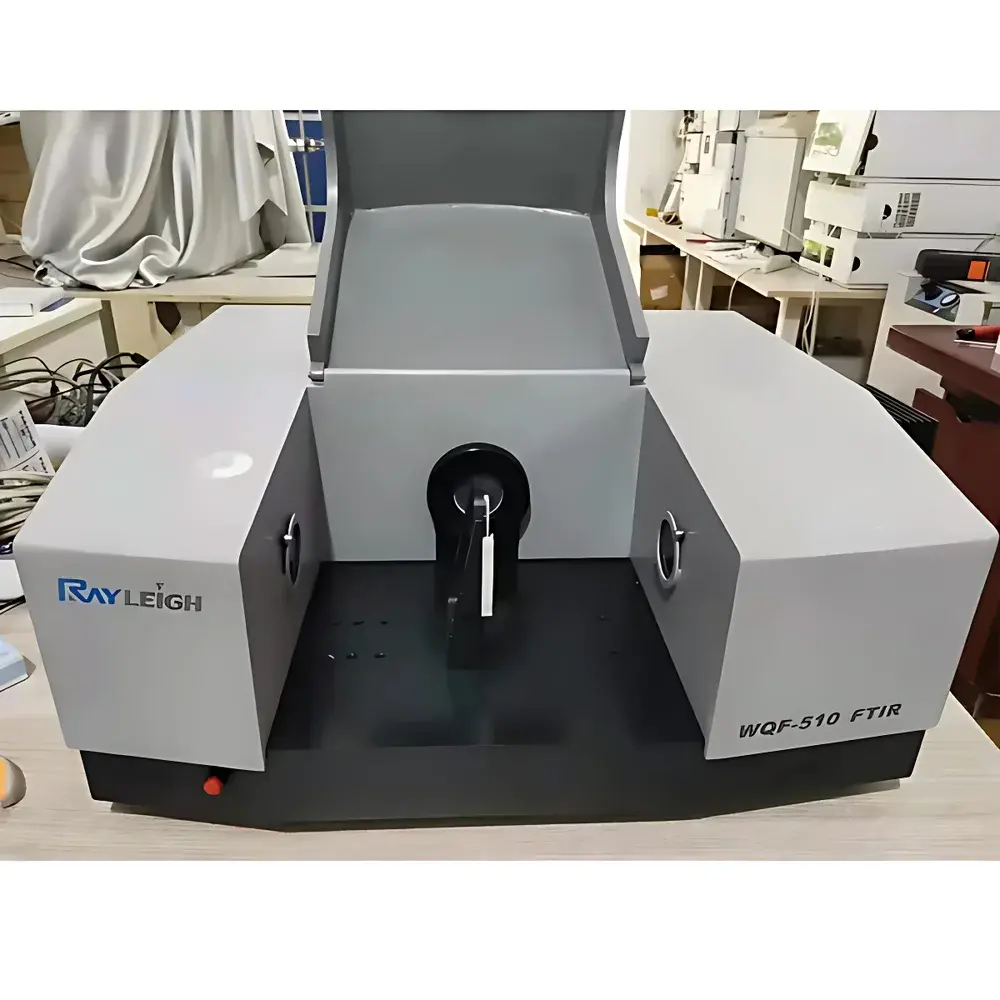
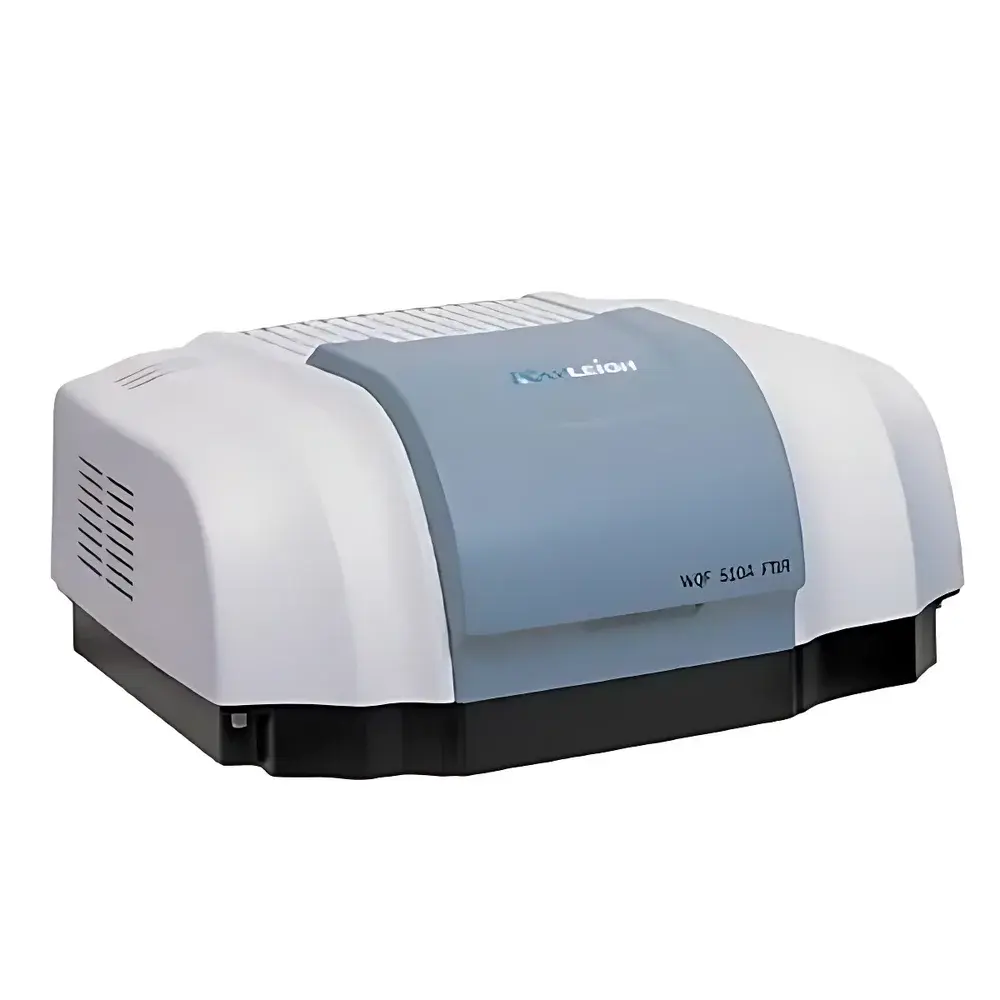
Beifen Ruili WQF-510 Fourier Transform Infrared (FTIR) Spectrometer – Refurbished Laboratory System
| Brand | Beifen Ruili |
|---|---|
| Origin | Beijing, China |
| Model | WQF-510 |
| Instrument Type | Laboratory FTIR Spectrometer |
| Wavenumber Range | 7800–400 cm⁻¹ |
| Spectral Resolution | 0.85 cm⁻¹ |
| Scan Velocity | 0.2–2.5 cm/s |
| Signal-to-Noise Ratio (S/N) | 15,000:1 |
Overview
The Beifen Ruili WQF-510 is a laboratory-grade Fourier Transform Infrared (FTIR) spectrometer engineered for high-fidelity molecular fingerprinting across research, quality control, and regulatory-compliant environments. Based on Michelson interferometry, the system acquires full-spectrum interferograms via a precision-machined moving mirror assembly and a broadband KBr-beam splitter, enabling rapid, mathematically rigorous Fourier transformation to generate absorbance/transmittance spectra with inherent wavelength accuracy and photometric linearity. Designed for routine mid-infrared analysis in pharmaceutical QC labs, polymer characterization facilities, environmental testing centers, and academic spectroscopy teaching laboratories, the WQF-510 delivers reproducible spectral data within the standard analytical window of 7800–400 cm⁻¹ — fully covering functional group vibrations from O–H stretching (~3600 cm⁻¹) to C–Cl bending (~600 cm⁻¹) and skeletal modes below 500 cm⁻¹.
Key Features
- Optimized optical architecture featuring a sealed, purged interferometer housing to minimize atmospheric CO₂ and H₂O vapor interference — critical for baseline stability during long-term acquisition or hygroscopic sample analysis.
- High-stability globar source coupled with a thermoelectrically cooled deuterated triglycine sulfate (DTGS) detector, delivering consistent responsivity and low thermal drift over extended scan sessions.
- Adjustable scan velocity (0.2–2.5 cm/s) enables trade-off optimization between spectral resolution, acquisition time, and signal averaging depth — supporting both rapid screening and high-S/N quantitative work.
- Fixed spectral resolution of 0.85 cm⁻¹ meets or exceeds requirements for USP , ASTM E1421, and ISO 18389 for identification and qualitative comparison of organic compounds, excipients, and contaminants.
- Robust mechanical design with vibration-damped baseplate and rigid optical bench ensures operational reliability under typical laboratory conditions without active isolation.
Sample Compatibility & Compliance
The WQF-510 supports standard FTIR sampling modalities including transmission (KBr pellets, solution cells), attenuated total reflectance (ATR), and diffuse reflectance (DRIFTS), accommodating solids, liquids, pastes, and thin films. Its spectral fidelity and wavenumber accuracy are validated per NIST-traceable polystyrene film standards (e.g., SRM 1921b). The instrument complies with general laboratory safety and electromagnetic compatibility (EMC) directives applicable to Class I electrical equipment (IEC 61010-1). While not pre-certified for 21 CFR Part 11, its data acquisition architecture permits integration with validated third-party software platforms that support audit trails, electronic signatures, and role-based access control — enabling alignment with GLP and GMP documentation workflows when deployed in regulated settings.
Software & Data Management
The system operates with native Windows-compatible acquisition and processing software supporting real-time interferogram monitoring, apodization selection (e.g., Happ-Genzel, Blackman-Harris), phase correction, zero-filling, and baseline correction algorithms. Spectral libraries (e.g., SDBS, Hummel Polymer) can be imported for automated peak matching and identification. Raw interferogram (.ifg) and processed spectrum (.spa, .jdx) files adhere to JCAMP-DX v5.0 format, ensuring interoperability with third-party chemometrics tools (e.g., Unscrambler, MATLAB, Python SciPy). Metadata embedding includes date/time stamp, operator ID, instrument serial number, and acquisition parameters — facilitating traceability and retrospective data review.
Applications
- Pharmaceutical: Excipient verification, polymorph screening, degradation product identification, and raw material release testing per ICH Q5A/Q5D guidelines.
- Polymers & Materials: Additive quantification, copolymer composition analysis, oxidation index calculation (carbonyl band at ~1710 cm⁻¹), and crosslink density assessment.
- Environmental: Microplastic identification in water/sediment matrices, pesticide residue screening in soil extracts, and VOC adsorption studies on activated carbon.
- Academic Research: Reaction monitoring (in situ/operando), hydrogen bonding analysis, and surface functionalization validation on nanomaterials.
- Food Safety: Adulterant detection (e.g., melamine in dairy, starch substitution in honey), authenticity verification (geographic origin, species), and thermal processing impact evaluation.
FAQ
Is this unit factory-refurbished or dealer-refurbished?
This WQF-510 system has undergone comprehensive technical refurbishment by an ISO 9001-certified service provider specializing in legacy analytical instrumentation. All optical components were cleaned, aligned, and verified using NIST-traceable reference materials; electronics were stress-tested and calibrated per manufacturer specifications.
Does the system include ATR accessories?
ATR accessories are available as optional add-ons and must be specified at time of quotation. Standard configuration includes a sample compartment with holder for KBr pellets and liquid cells.
What operating system and PC requirements are needed?
The native software supports Windows 10 (64-bit) and requires a minimum of 8 GB RAM, Intel Core i5 or equivalent, and 500 MB free disk space. USB 2.0 connectivity is required for instrument interface.
Can the instrument be validated for GMP use?
Yes — though the hardware itself does not carry formal GMP certification, it supports IQ/OQ protocols through documented performance tests (wavenumber accuracy, photometric linearity, S/N verification) and is compatible with validated software extensions that meet 21 CFR Part 11 requirements.
What warranty and post-purchase support is provided?
A 12-month limited hardware warranty is included, covering defects in materials and workmanship. Remote technical support and application consultation are available for the duration of ownership. On-site service may be arranged under separate service agreement.





