
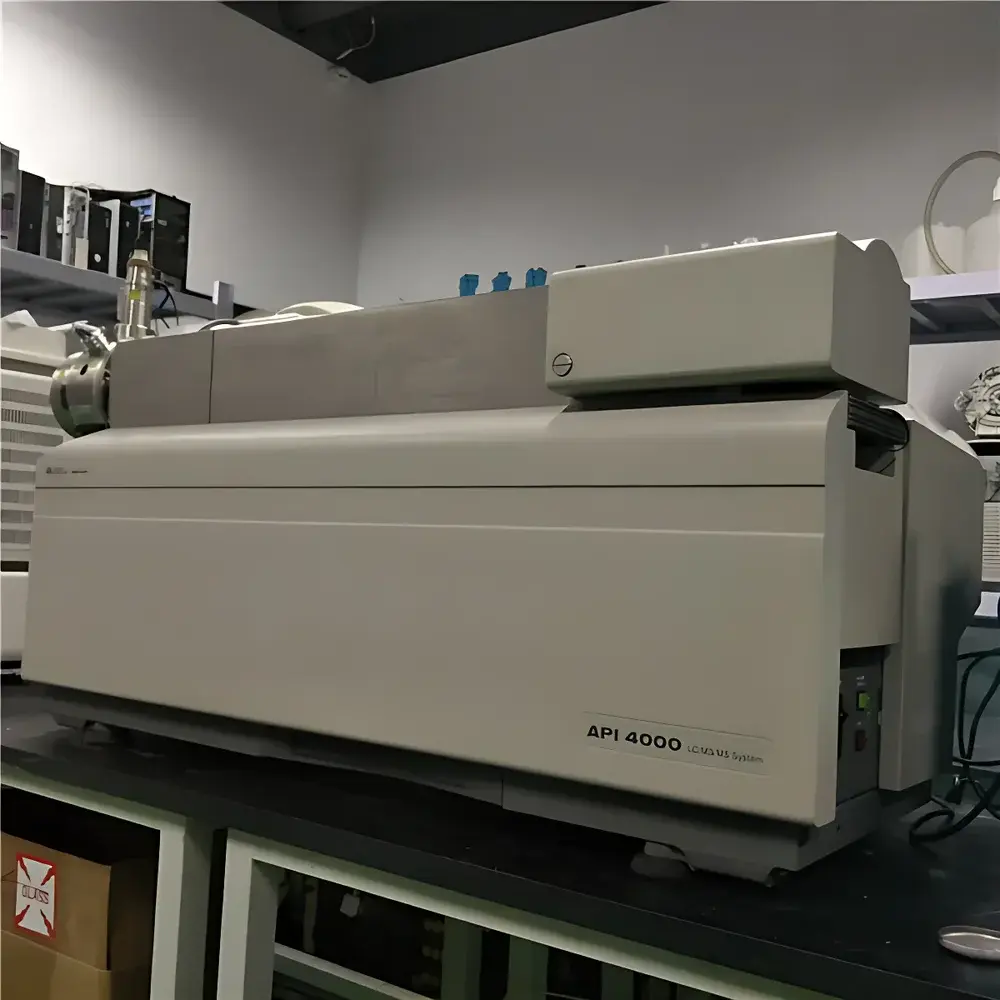
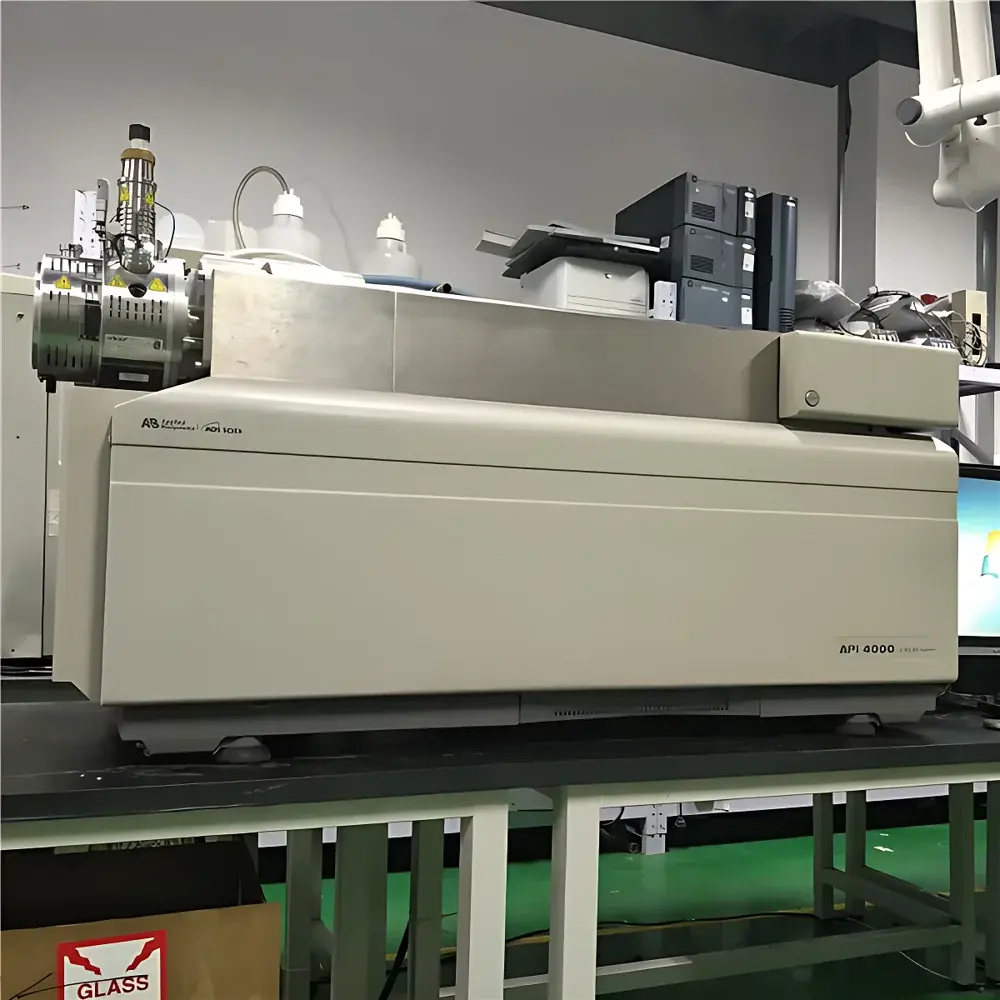
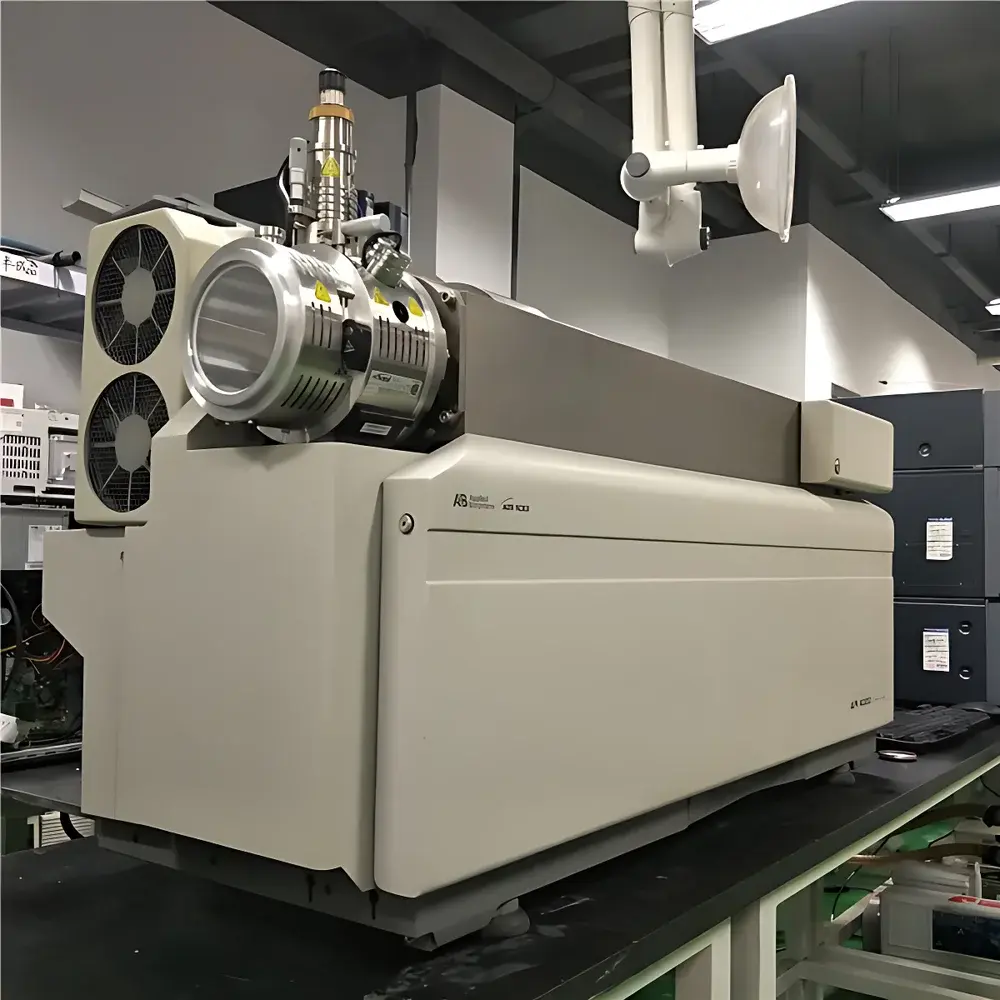
SCIEX API 4000 Triple Quadrupole Liquid Chromatography Mass Spectrometer (Refurbished)
| Brand | SCIEX |
|---|---|
| Origin | USA |
| Model | API 4000 |
| Instrument Type | Tandem Quadrupole (QqQ) |
| Ionization Modes | Electrospray Ionization (ESI) and Atmospheric Pressure Chemical Ionization (APCI) |
| Software Platform | Analyst® 1.6.3 or later |
| Regulatory Compliance | Designed for GLP/GMP environments |
| Mass Range | m/z 5–3,000 (typical operational range) |
| Sensitivity | Sub-femtogram on-column detection for selected pharmaceutical compounds (e.g., ≤5 fg on-column for midazolam in MRM mode) |
| Resolution | Unit mass resolution (0.7 Da full width at half maximum, FWHM) |
| Mass Accuracy | ±0.2 Da (calibrated) |
Overview
The SCIEX API 4000 Triple Quadrupole Liquid Chromatography Mass Spectrometer (refurbished) is a purpose-engineered tandem quadrupole (QqQ) system optimized for robust, high-sensitivity quantitative analysis and selective compound identification in regulated and research laboratories. Operating on the principle of precursor ion selection in Q1, collision-induced dissociation (CID) in the linear accelerator (LINAC) collision cell, and product ion detection in Q3, the API 4000 delivers exceptional specificity and reproducibility in multiple reaction monitoring (MRM) workflows. Its design reflects over two decades of industrial deployment in pharmaceutical development—supporting applications from early-stage drug discovery through clinical pharmacokinetic (PK) and toxicokinetic (TK) studies, bioanalytical method validation, and regulatory submission support. The system integrates seamlessly with ultra-high-performance liquid chromatography (UHPLC) and standard HPLC platforms, enabling precise coupling of chromatographic separation with highly selective mass filtering.
Key Features
- Triple quadrupole architecture with patented LINAC collision cell for high transmission efficiency, reduced cross-talk, and improved duty cycle in MRM acquisition
- Turbo V™ ion source supporting both electrospray ionization (ESI) and atmospheric pressure chemical ionization (APCI) with rapid polarity switching and stable performance across flow rates from 5 µL/min to 2 mL/min
- DuoSpray™ dual-ion-source option enabling concurrent ESI and APCI analysis without hardware reconfiguration—reducing method development time and increasing lab throughput
- PhotoSpray™ ion source (optional) extending analytical scope to thermally labile, non-polar, and low-proton-affinity compounds not amenable to conventional ESI or APCI
- Robust vacuum architecture with dual-stage turbomolecular pumping, ensuring long-term stability and resistance to matrix-induced contamination during high-volume biofluid or environmental sample analysis
- Integrated hardware-level calibration and automated tuning routines for consistent mass axis alignment and detector response across instrument lifetime
Sample Compatibility & Compliance
The API 4000 accommodates a broad range of sample matrices—including plasma, serum, urine, tissue homogenates, food extracts, wastewater, and forensic biological specimens—without requiring extensive pre-treatment. Its high tolerance for moderate levels of salts, phospholipids, and co-eluting interferences is attributable to the Turbo V source geometry and LINAC collision cell design. For regulated environments, the system supports installation qualification (IQ), operational qualification (OQ), and performance qualification (PQ) protocols aligned with ASTM D7869-14 (for LC-MS bioanalysis), USP , and ICH M10 guidelines. When operated with validated Analyst® software (v1.6.3 or later) and appropriate electronic record controls, it meets data integrity requirements under FDA 21 CFR Part 11 and EU Annex 11 for audit trail generation, user access management, and electronic signature implementation.
Software & Data Management
Data acquisition, processing, and reporting are managed via SCIEX Analyst® software—a platform widely adopted in contract research organizations (CROs) and pharmaceutical QA/QC labs. Analyst provides comprehensive tools for MRM method setup, peak integration using weighted regression models (e.g., 1/x, 1/x²), internal standard normalization, batch processing, and report generation compliant with GLP documentation standards. Raw data files (.wiff) are stored in a structured binary format compatible with third-party quantitation engines (e.g., MultiQuant™, PeakView®) and laboratory information management systems (LIMS). Audit trail functionality logs all critical user actions—including parameter changes, calibration events, and result modifications—with timestamps and operator IDs—enabling full traceability during regulatory inspections.
Applications
- Pharmaceutical bioanalysis: Quantification of small-molecule drugs and metabolites in biological matrices per FDA Bioanalytical Method Validation Guidance (2018)
- DMPK studies: Rapid turnover of PK/PD datasets for candidate selection and dose escalation decisions
- Food safety testing: Detection of veterinary drug residues (e.g., sulfonamides, β-agonists) at EU MRL-compliant levels
- Environmental monitoring: Trace analysis of pharmaceuticals in surface water and wastewater treatment effluents
- Forensic toxicology: Confirmation and quantification of controlled substances, novel psychoactive substances (NPS), and metabolites in postmortem samples
- Clinical research: Biomarker verification and assay transfer in translational medicine programs
FAQ
Is this a factory-refurbished unit or dealer-refurbished?
This instrument has undergone comprehensive refurbishment by an SCIEX-authorized service partner, including full mechanical inspection, vacuum system rebuild, ion optics cleaning and alignment, detector recalibration, and firmware/software update to the latest supported revision.
What documentation accompanies the system?
A complete refurbishment report, IQ/OQ test records, calibration certificates (mass axis, sensitivity, resolution), and a 12-month limited hardware warranty are provided with delivery.
Can the API 4000 be upgraded to support newer SCIEX software versions?
Analyst® software v1.7.1 is the final officially supported version for the API 4000 platform; no further major releases are planned. However, patch updates and security advisories remain available through SCIEX support channels for licensed users.
Does the system include a UHPLC interface?
The API 4000 is fully compatible with industry-standard LC interfaces (e.g., Waters, Agilent, Thermo Fisher). Optional nano-ESI or microflow kits can be added to support low-flow or nano-LC configurations.
What maintenance contracts are available post-purchase?
Extended service agreements—including preventive maintenance, priority technical support, and guaranteed response times—are offered through SCIEX-certified field service engineers globally.





