
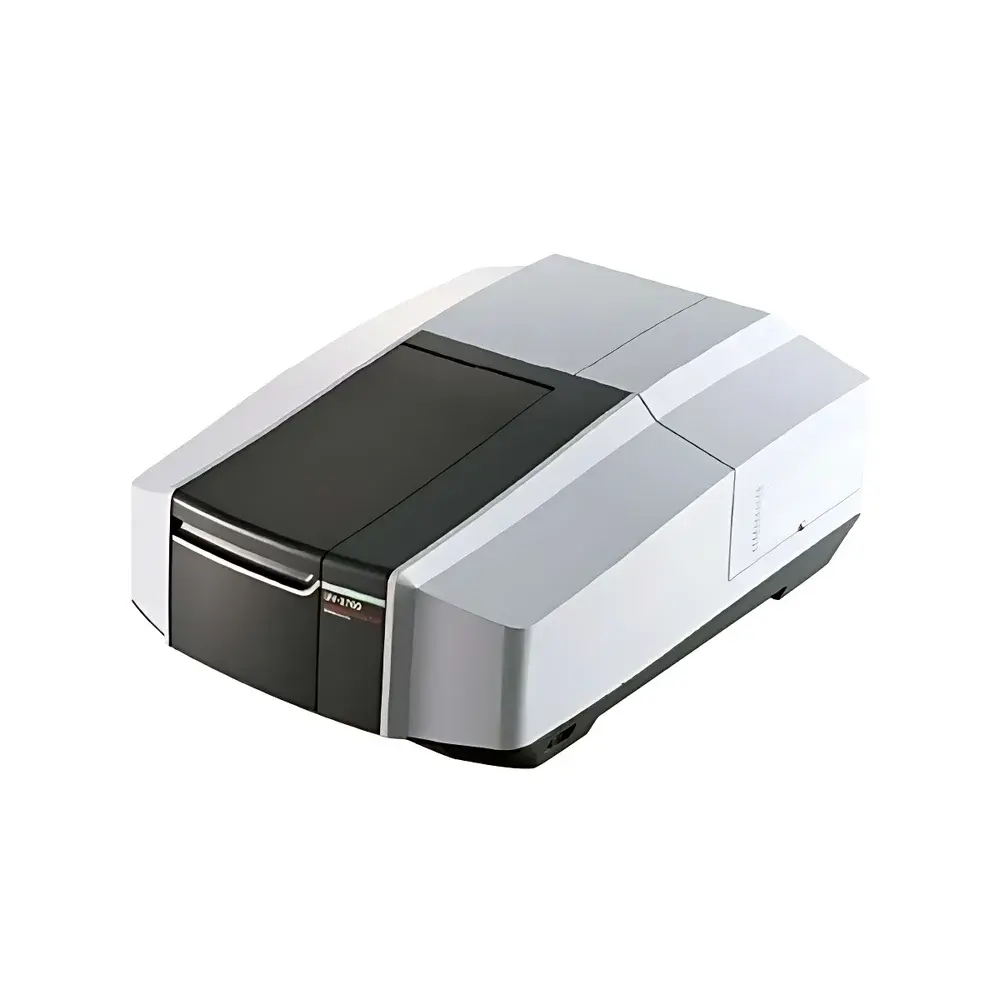
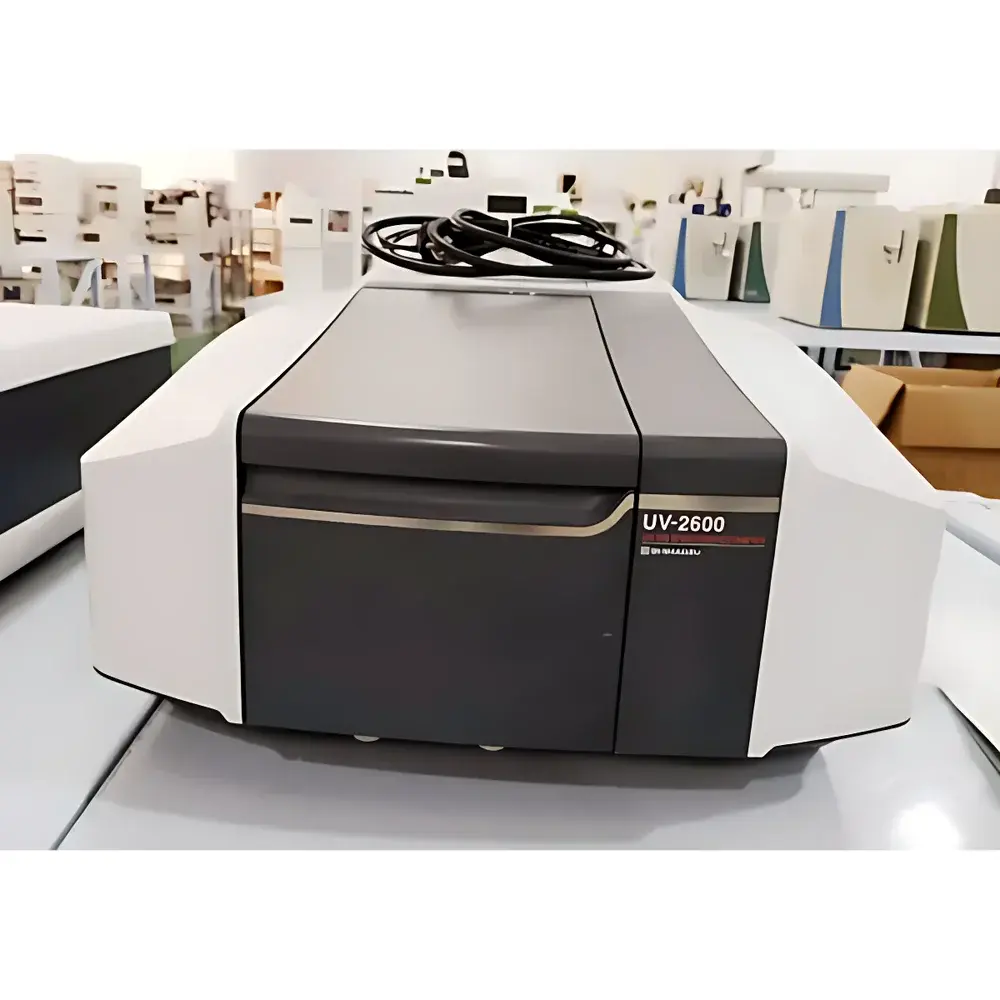
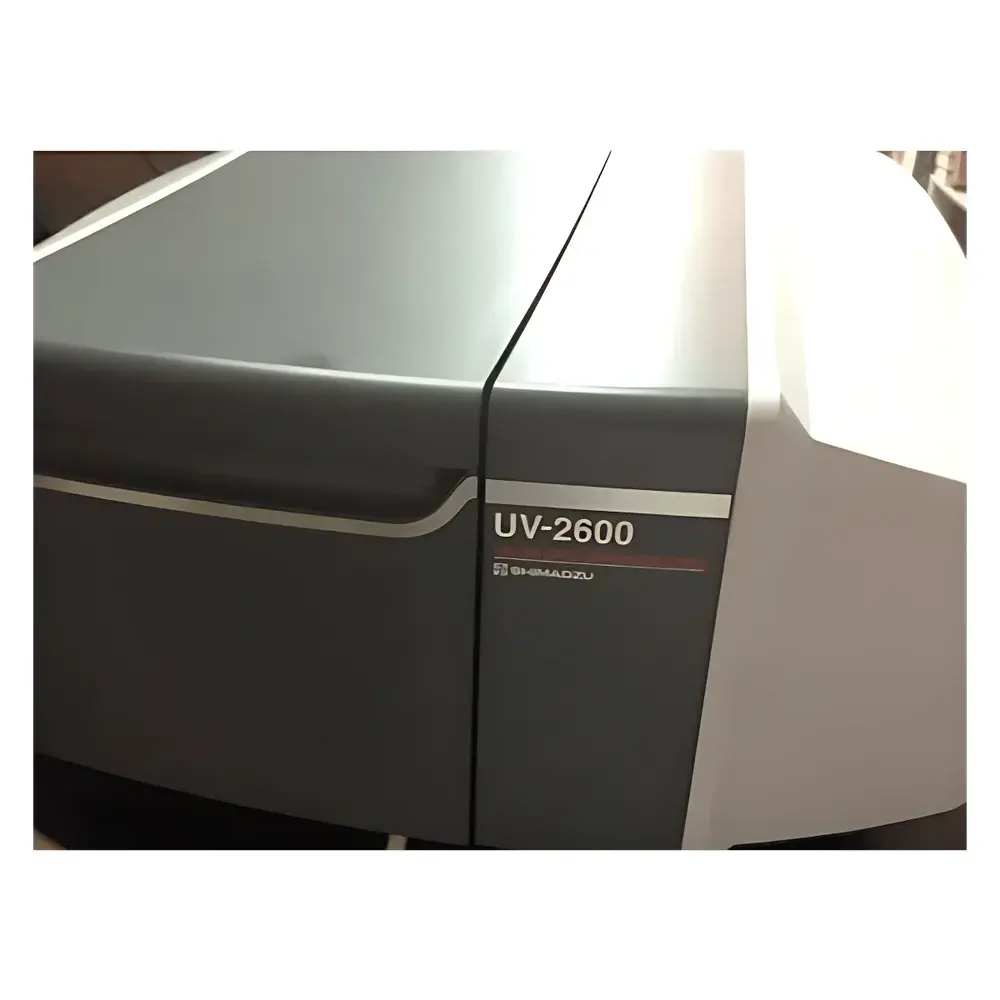
Shimadzu UV-2600 Used UV-Vis-NIR Spectrophotometer
| Brand | Shimadzu |
|---|---|
| Origin | Japan |
| Manufacturer Type | Authorized Distributor |
| Origin Category | Imported |
| Model | UV-2600 |
| Quotation | ¥30,000 (RMB) |
| Optical Design | Pseudo-Double-Beam |
| Detector Type | Photodiode Array (PDA) |
| Wavelength Range | 190–2600 nm |
| Automation Level | Automatic Wavelength Scanning |
Overview
The Shimadzu UV-2600 is a high-performance, used ultraviolet-visible-near-infrared (UV-Vis-NIR) spectrophotometer engineered for precision absorbance, transmittance, and reflectance measurements across an exceptionally broad spectral range—from deep ultraviolet (190 nm) through visible light to near-infrared (2600 nm). Its pseudo-double-beam optical architecture compensates for source intensity drift and detector sensitivity fluctuations in real time, enabling stable baseline performance during extended kinetic or temperature-controlled experiments. Unlike single-beam systems requiring manual reference correction, the UV-2600’s beam-splitting design—combined with synchronized PDA detection—ensures high photometric reproducibility (<±0.002 A at 1.0 A, typical) without interrupting sample measurement cycles. This configuration supports rigorous quantitative analysis in regulated environments where instrument stability directly impacts data integrity.
Key Features
- Pseudo-double-beam optical system with real-time reference compensation for enhanced photometric accuracy and long-term baseline stability
- Photodiode array (PDA) detector enabling full-spectrum acquisition in milliseconds—ideal for rapid kinetics, scanning spectroscopy, and multi-wavelength quantitation
- Extended wavelength coverage from 190 nm to 2600 nm, supporting applications in UV protein quantification, visible dye analysis, NIR polymer characterization, and semiconductor thin-film thickness evaluation
- Automatic wavelength scanning and auto-zero functionality, reducing operator dependency and minimizing procedural variability
- Robust mechanical design with thermally stabilized optics and precision grating drive mechanism—optimized for laboratory environments with moderate ambient fluctuations
- Compatible with standard 10 mm cuvettes, solid-sample holders, integrating spheres (optional), and fiber-optic probes for flexible measurement geometries
Sample Compatibility & Compliance
The UV-2600 accommodates liquid, solid, and semi-solid samples using interchangeable accessories including quartz and fused silica cuvettes (for UV-NIR transmission), diffuse reflectance attachments, and integrating spheres for absolute reflectance measurements. Its spectral fidelity meets the performance criteria outlined in ASTM E275 (Standard Practice for Describing and Measuring Performance of Ultraviolet–Visible Spectrophotometers) and ISO 9001-aligned calibration traceability protocols. While the instrument itself does not include built-in 21 CFR Part 11 compliance features, its data output format (ASCII, CSV, JCAMP-DX) supports integration into validated LIMS or ELN platforms where audit trails, electronic signatures, and user access controls are managed externally per GLP/GMP requirements.
Software & Data Management
The UV-2600 operates with Shimadzu’s proprietary UV Probe software (v2.x or later), providing intuitive control over scan parameters, baseline correction algorithms (including Savitzky-Golay smoothing), peak detection, derivative spectroscopy, and multi-component quantitation via simultaneous equation solving. Data export supports interoperability with third-party analytical tools such as MATLAB, OriginLab, and Python-based spectral processing libraries (e.g., SciPy, PySpectra). All spectra are timestamped and metadata-tagged (operator ID, date/time, instrument serial, lamp status), facilitating retrospective review and method validation documentation. Raw spectral files retain full 1 nm resolution across the entire 190–2600 nm range, preserving information content for reprocessing under updated analytical models.
Applications
- Pharmaceutical QC/QA: Assay of active pharmaceutical ingredients (APIs) per USP , excipient identification, dissolution profile monitoring
- Environmental testing: Quantification of nitrate, phosphate, and organic pollutants (e.g., PAHs, phenols) in water matrices per EPA Method 450.0 and ISO 10566
- Materials science: Bandgap estimation of semiconductors, optical density profiling of thin films, and degradation kinetics of UV-stabilized polymers
- Food & beverage: Color index determination (e.g., AOAC 993.01), antioxidant capacity assays (FRAP, DPPH), and adulterant screening in oils and juices
- Academic research: Enzyme kinetics (stopped-flow compatible with external triggering), ligand-binding studies, and nanoparticle surface plasmon resonance characterization
FAQ
Is the UV-2600 compliant with 21 CFR Part 11?
No—the base system lacks electronic signature capability, audit trail logging, or role-based access control. However, raw data exports can be ingested into validated enterprise systems that provide these functions.
What lamp configuration does the UV-2600 use?
It employs a deuterium lamp for the UV region (190–350 nm) and a tungsten-halogen lamp for visible-to-NIR (350–2600 nm), automatically switching at ~350 nm with spectral overlap correction.
Can the instrument be calibrated traceably to NIST standards?
Yes—certified reference materials (e.g., NIST SRM 930e filter set, Holmium oxide solution) are supported for wavelength and photometric calibration verification.
Is service support available for this used unit?
Third-party certified technicians provide preventive maintenance, lamp replacement, grating alignment, and optical path cleaning—documentation includes calibration certificates and performance verification reports.
Does the system support fiber-optic coupling?
Yes—via optional SMA-905 interface adapters, enabling remote sampling in hazardous or spatially constrained environments (e.g., reactor monitoring, in-line process analysis).




