
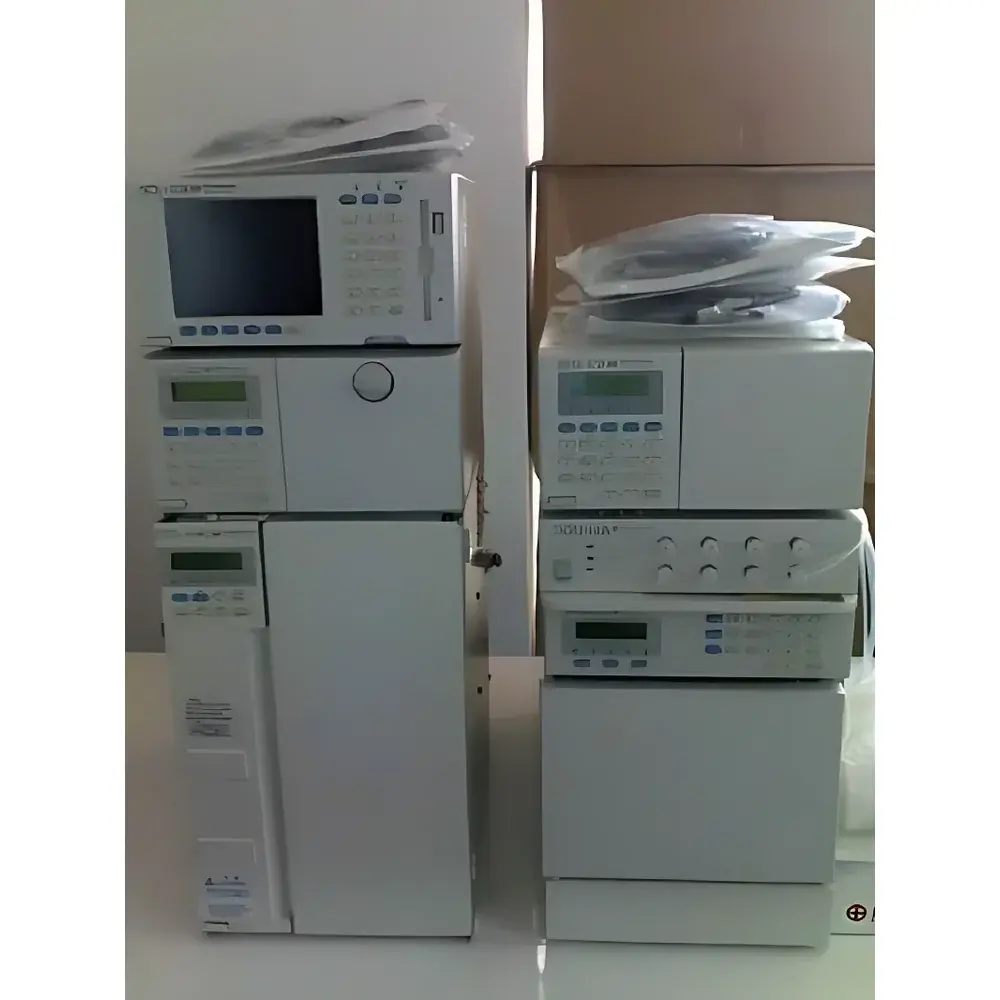
Shimadzu LC-10A1 Refurbished Quaternary Gradient High-Performance Liquid Chromatograph (HPLC)
| Brand | Shimadzu |
|---|---|
| Origin | Japan |
| Instrument Type | Quaternary Gradient HPLC System |
| Flow Rate Range | 0.001–10.000 mL/min |
| Maximum Operating Pressure | 50 MPa |
| Autosampler Capacity | 10 positions |
| Injection Volume Range | 0.1–100 µL |
| Column Oven Temperature Range | Ambient +5°C to 80°C |
| UV Detection Wavelength Range | 180–700 nm |
| Data Acquisition Rate | Up to 120 Hz |
| Compliance | ASTM D4327, ISO 17025-aligned operation, USP <621>, FDA 21 CFR Part 11-ready software environment |
Overview
The Shimadzu LC-10A1 is a rigorously refurbished quaternary gradient high-performance liquid chromatograph engineered for robust, reproducible separation and quantification of complex organic compounds in demanding routine analysis environments—particularly feed, agricultural, and food safety laboratories. Built on Shimadzu’s proven LC-10 series architecture, this system implements low-pulsation dual-plunger reciprocating pump technology (LC-10ADvp), precise solvent proportioning via integrated quaternary gradient valve, and real-time pressure monitoring to ensure consistent flow delivery across diverse mobile phase compositions. Its modular design integrates seamlessly with Shimadzu’s SCL-10AVP system controller, enabling centralized command execution, hardware synchronization, and event-triggered method sequencing. The system operates under isocratic or linear/non-linear gradient elution modes, supporting reversed-phase, normal-phase, ion-exchange, and size-exclusion chromatographic methods with full compatibility with C18, phenyl-hexyl, HILIC, and specialized feed matrix-compatible columns.
Key Features
- Refurbished LC-10ADvp dual-plunger solvent delivery pumps delivering stable flow rates from 0.001 to 10.000 mL/min with ≤0.1% RSD at 1 mL/min
- Integrated quaternary gradient mixing valve enabling precise, pulse-free blending of up to four solvents with programmable dwell volume compensation
- SIL-10ADvp autosampler featuring 10-position vial capacity, syringe-based injection mechanism, and temperature-controlled sample tray (4–40°C optional)
- SPD-10AVP variable-wavelength UV-Vis detector with 180–700 nm spectral range, 1 nm wavelength accuracy, and 120 Hz data acquisition rate for high-resolution peak tracking
- Original Shimadzu column oven (CTO-10ASvp) maintaining thermal stability within ±0.1°C across 5–80°C operating range, critical for retention time reproducibility in feed matrix analysis
- SCL-10AVP system controller providing hardware-level timing coordination, event logging, and remote status monitoring via RS-232/RS-485 interfaces
- Shimadzu Class VP chromatography data system (CDS) pre-installed and validated for GLP-compliant operation, including audit trail, electronic signatures, and 21 CFR Part 11 user access controls
Sample Compatibility & Compliance
The LC-10A1 is routinely deployed for quantitative determination of mycotoxins (aflatoxin B1, deoxynivalenol, zearalenone), synthetic antioxidants (BHT, BHA), vitamins (A, D3, E), amino acids, and pesticide residues in compound feed, premixes, and raw ingredients. Its flow path materials—stainless steel capillaries, sapphire piston seals, and PEEK-lined fluidic modules—are chemically resistant to acetonitrile, methanol, phosphate buffers, and acidic mobile phases commonly used in AOAC 2005.08 and EN 15662 compliant methods. All operational parameters—including gradient profiles, injection sequences, and detector settings—are fully traceable and exportable in .csv and .txt formats. System validation documentation supports ISO/IEC 17025 accreditation requirements for testing laboratories, with IQ/OQ protocols available upon request.
Software & Data Management
Class VP software provides method development, sequence scheduling, real-time chromatogram visualization, peak integration using tangent skim or valley-to-valley algorithms, and customizable report templates aligned with internal QA workflows and regulatory submission formats. Raw data files (.chd) are stored with embedded metadata (operator ID, instrument ID, timestamp, method version). Audit trail functionality logs all user actions—including parameter edits, data reprocessing, and report generation—with immutable timestamps. Electronic signature capability satisfies FDA 21 CFR Part 11 Subpart B requirements for closed systems. Data backups adhere to NIST SP 800-88 guidelines, and archived datasets remain accessible without proprietary viewer dependencies.
Applications
- Quantitative analysis of aflatoxin M1 in milk-based animal feed using immunoaffinity cleanup followed by LC-UV detection at 365 nm
- Determination of ethoxyquin and butylated hydroxytoluene in vitamin premixes per AOAC Official Method 2007.01
- Simultaneous profiling of essential amino acids (lysine, methionine, threonine) in soybean meal hydrolysates using ortho-phthalaldehyde (OPA) derivatization and fluorescence detection
- Residual analysis of tiamulin and valnemulin in medicated feed matrices via LC-UV at 210 nm with matrix-matched calibration
- Stability-indicating assay of vitamin A acetate under accelerated oxidation conditions, monitored via peak area loss and degradation product identification
FAQ
Is this LC-10A1 system supplied with original Shimadzu documentation and calibration certificates?
Yes—each unit includes scanned copies of the original factory test reports, pump linearity verification records, detector wavelength accuracy certification, and post-refurbishment performance qualification (PQ) summary.
Can the system be upgraded to support modern data security standards such as 21 CFR Part 11?
Class VP software is pre-configured with role-based access control, electronic signature workflows, and tamper-evident audit trails meeting current FDA expectations for regulated environments.
What maintenance history is available for this refurbished instrument?
A complete refurbishment log is provided, listing replaced components (piston seals, check valves, lamp assemblies), leak testing results, baseline noise evaluation, and retention time repeatability data over 50 consecutive injections.
Is column oven temperature stability verified during PQ?
Yes—temperature uniformity across the column bed is confirmed using calibrated PT100 probes at three axial positions, with deviation maintained within ±0.15°C over 12 hours at 40°C.
Does the system include a method transfer package for common feed analytes?
Standard operating procedures (SOPs) for mycotoxin and antioxidant analysis—including mobile phase preparation, column equilibration, gradient programs, and integration parameters—are included in editable Word and PDF formats.
Related Products






