
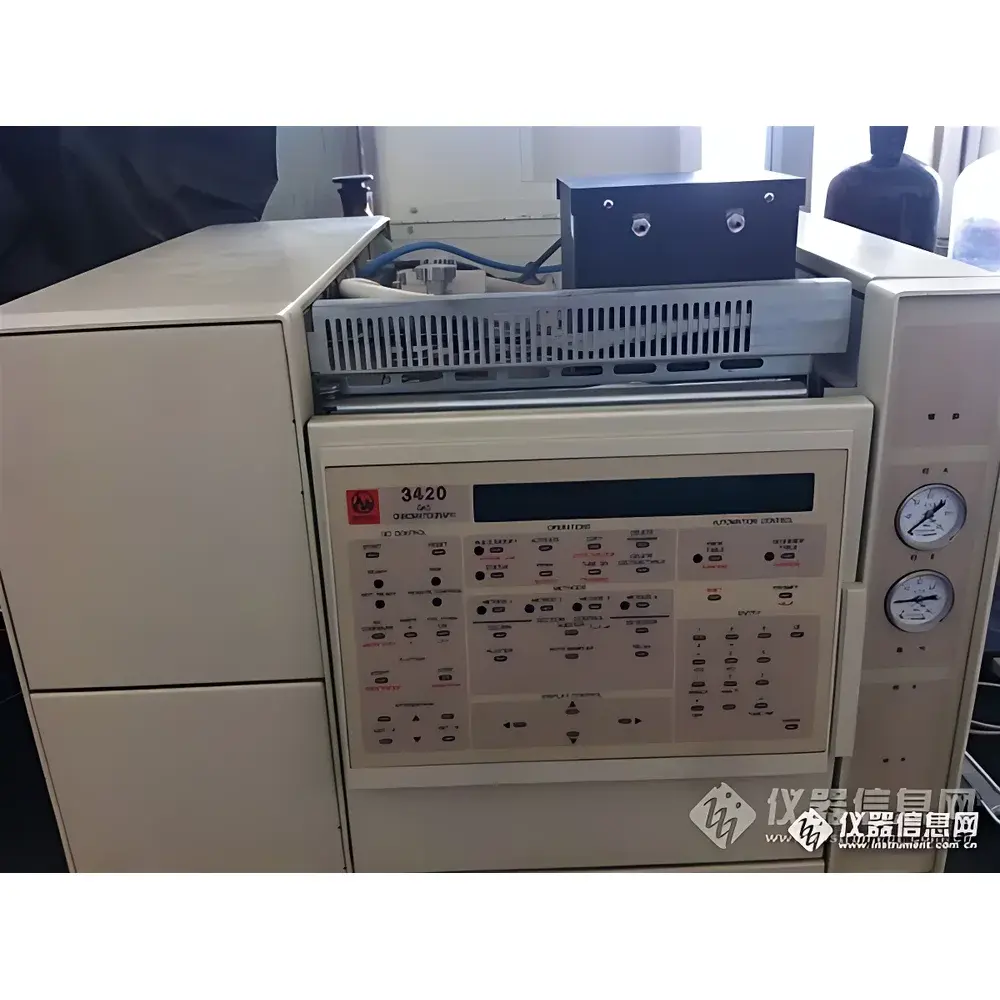
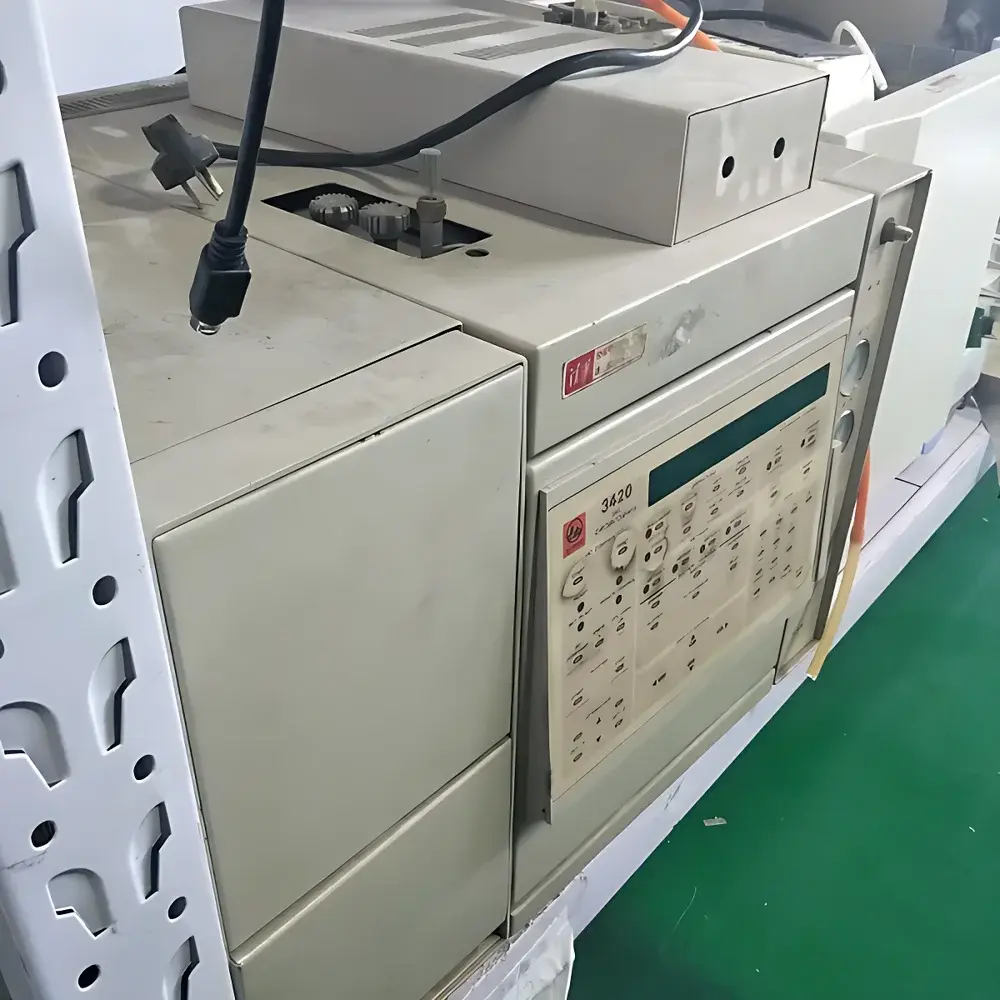
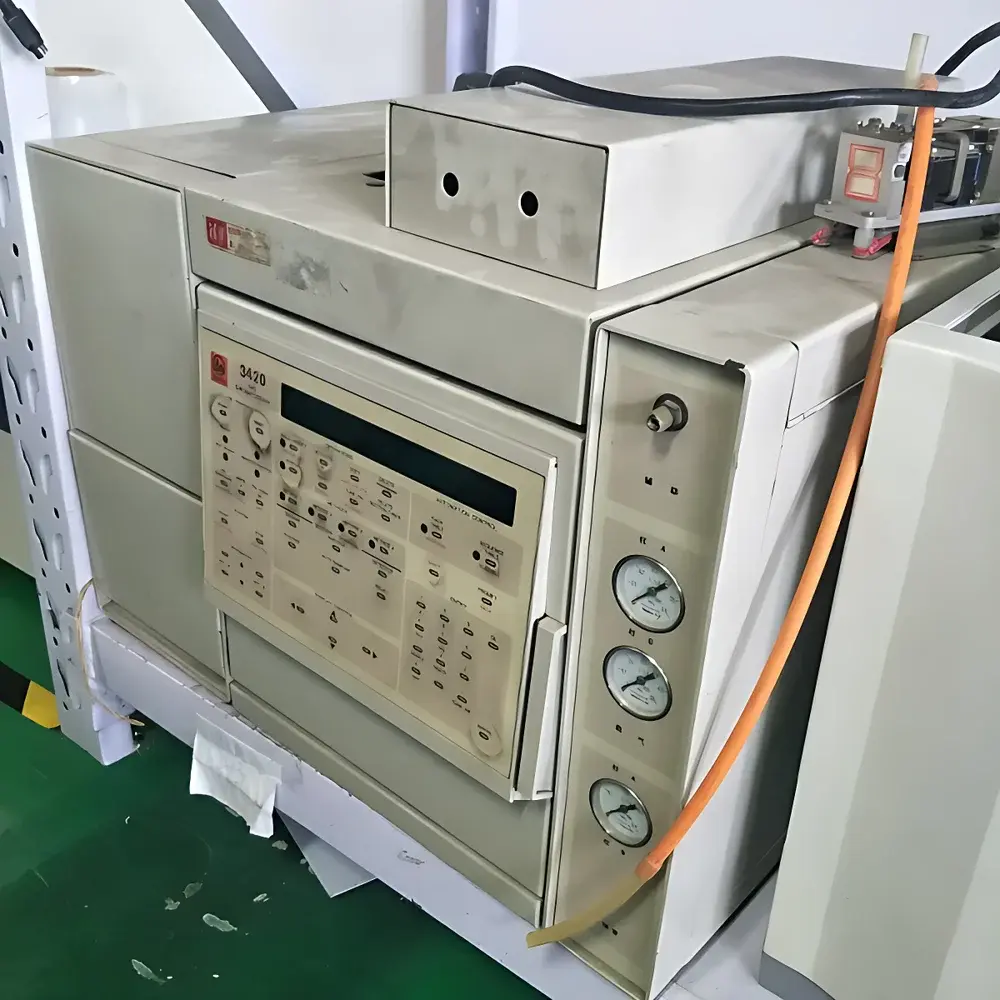
Beifen Ruili SP-3420 Used Gas Chromatograph
| Origin | Beijing, China |
|---|---|
| Manufacturer Type | Authorized Distributor |
| Origin Category | Domestic (PRC) |
| Model | SP-3420 |
| Instrument Type | Laboratory Gas Chromatograph |
| Application Focus | Pharmaceutical Analysis |
| Oven Temperature Range | Ambient +20°C to 400°C |
| Ramp Rate | 0.1–50°C/min |
| Cool-down Time | ~6 min (450°C → 50°C) |
| Carrier Gas Flow Control Range | 0–1200 mL/min |
| Carrier Gas Pressure Control Range | 0–970 kPa |
| Injector Max Operating Temperature | 450°C |
| Injector Pressure Setpoint Range | 0–970 kPa |
| Injector Total Flow Setpoint Range | 0–1200 mL/min |
| Column Oven Programmable Steps | 4×4 ramp/hold |
| Temperature Stability | ±0.1°C |
| Detector Options | TCD, FID, ECD, FPD, TSD |
| Injector Options | Packed Column, Split/Splitless Capillary |
| Power Supply | AC 220 V ±10%, 50 Hz |
| Power Consumption | 1650 W |
| Net Weight | 50 kg |
| Dimensions (H×W×D) | 500 × 588 × 550 mm³ |
Overview
The Beifen Ruili SP-3420 is a laboratory-grade gas chromatograph originally engineered under technology transfer from Varian (USA), designed for robust, reproducible separation and quantification of volatile and semi-volatile organic compounds. Built on a microprocessor-controlled architecture with integrated digital temperature regulation and real-time self-diagnostic capability, the SP-3420 implements classical gas chromatographic principles—sample vaporization, carrier-gas-driven partitioning across a stationary phase, and selective detection based on physicochemical response. Its column oven supports up to four independent temperature ramps per method (4×4 program steps), enabling precise thermal profiling for complex pharmaceutical matrices, residual solvent analysis, and impurity profiling in accordance with ICH Q2(R2) and USP . The system operates within ambient +20°C to 400°C for the column compartment, with injector and detector zones independently controllable up to 450°C and 400°C respectively—critical for thermally labile APIs and high-boiling excipients.
Key Features
- Microprocessor-based control system with full-keyboard interface and dual 32-digit LED display for real-time parameter monitoring and method editing
- Comprehensive self-diagnostic suite: continuous hardware status logging, fault localization (e.g., heater failure, pressure sensor drift), and on-screen remediation guidance
- Programmable detector settings: adjustable sensitivity range, attenuation time, and signal polarity for TCD, FID, ECD, FPD, and TSD detectors
- Automated valve sequencing and dual-detector signal switching—enabling unattended multi-detection workflows (e.g., simultaneous sulfur/phosphorus screening via FPD)
- Four user-storable method files with full thermal, flow, and detector parameter sets—facilitating rapid reconfiguration between QC release testing and stability-indicating assays
- Dual inlet configuration support: packed-column inlet for legacy USP methods and split/splitless capillary inlet compatible with modern 0.18–0.53 mm ID columns
- Multi-layer protection logic: TCD filament safeguard against carrier gas interruption, overtemperature cutoff for all heated zones, and photomultiplier tube (FPD) light-leak detection
Sample Compatibility & Compliance
The SP-3420 accommodates a broad spectrum of sample types relevant to pharmaceutical quality control—including raw material solvents (e.g., acetone, methanol, dichloromethane), active pharmaceutical ingredients (APIs), degradation products, and extractables/leachables from packaging components. Its validated temperature stability (±0.1°C) and precise carrier gas flow/pressure control (0–1200 mL/min, 0–970 kPa) ensure retention time repeatability ≤0.05 min RSD across ≥100 injections—a prerequisite for GLP-compliant stability studies and FDA-submitted analytical procedures. While the instrument predates formal 21 CFR Part 11 compliance certification, its audit-trail-capable firmware (via optional RS-232 or analog output logging) supports retrospective data integrity verification under ALCOA+ principles. It meets core performance criteria outlined in ASTM D3699 (hydrocarbon solvents), ISO 17025 clause 5.9 (method validation), and Chinese Pharmacopoeia Vol. IV (GC general chapter 0521).
Software & Data Management
As a standalone hardware platform, the SP-3420 outputs analog voltage signals (0–1 V or 0–5 V) and TTL-compatible event triggers compatible with third-party chromatography data systems (CDS) such as OpenLab CDS, Chromeleon, or Empower. Peak integration, calibration curve generation, and report export (PDF, CSV) are performed externally. For traceability, all method parameters—including oven ramp profiles, detector gain settings, and injection timing—are stored in non-volatile memory with timestamped access logs. Optional serial communication (RS-232) enables remote parameter upload/download and basic run initiation, supporting integration into centralized lab informatics infrastructure where full CDS deployment is not yet implemented.
Applications
- Residual solvent analysis per ICH Q3C guidelines using headspace-GC/FID
- Assay and related substances testing of small-molecule APIs per USP monographs
- Stability-indicating method development for oxidation, hydrolysis, and photolysis degradation products
- Quality control of excipients (e.g., polyethylene glycols, polysorbates) for volatile impurities
- Environmental monitoring of VOCs in pharmaceutical manufacturing cleanrooms (ISO 14644-8)
- Educational use in university analytical chemistry laboratories for GC fundamentals instruction
FAQ
Is the SP-3420 compliant with 21 CFR Part 11?
The SP-3420 does not include built-in electronic signature, audit trail, or user permission modules required for native 21 CFR Part 11 compliance. However, when interfaced with a validated third-party CDS that provides these capabilities, the system may be deployed in regulated environments under appropriate procedural controls.
What detector configurations are supported out-of-the-box?
The instrument chassis accommodates TCD, FID, ECD, FPD, and TSD detectors as factory-installed or field-upgradable options. Detector selection must be specified at time of refurbishment; no hot-swap capability exists between detector types.
Can the SP-3420 operate with hydrogen carrier gas?
Yes—the pressure and flow control system is compatible with H2, He, and N2. When using hydrogen, proper ventilation and leak-check protocols per NFPA 55 must be observed due to flammability risks.
What maintenance intervals are recommended for routine operation?
Column conditioning every 50 injections; inlet liner replacement every 100 injections; detector cleaning (FID jet, TCD cell) every 250 injections; annual calibration verification against NIST-traceable standards for temperature and flow accuracy.





