
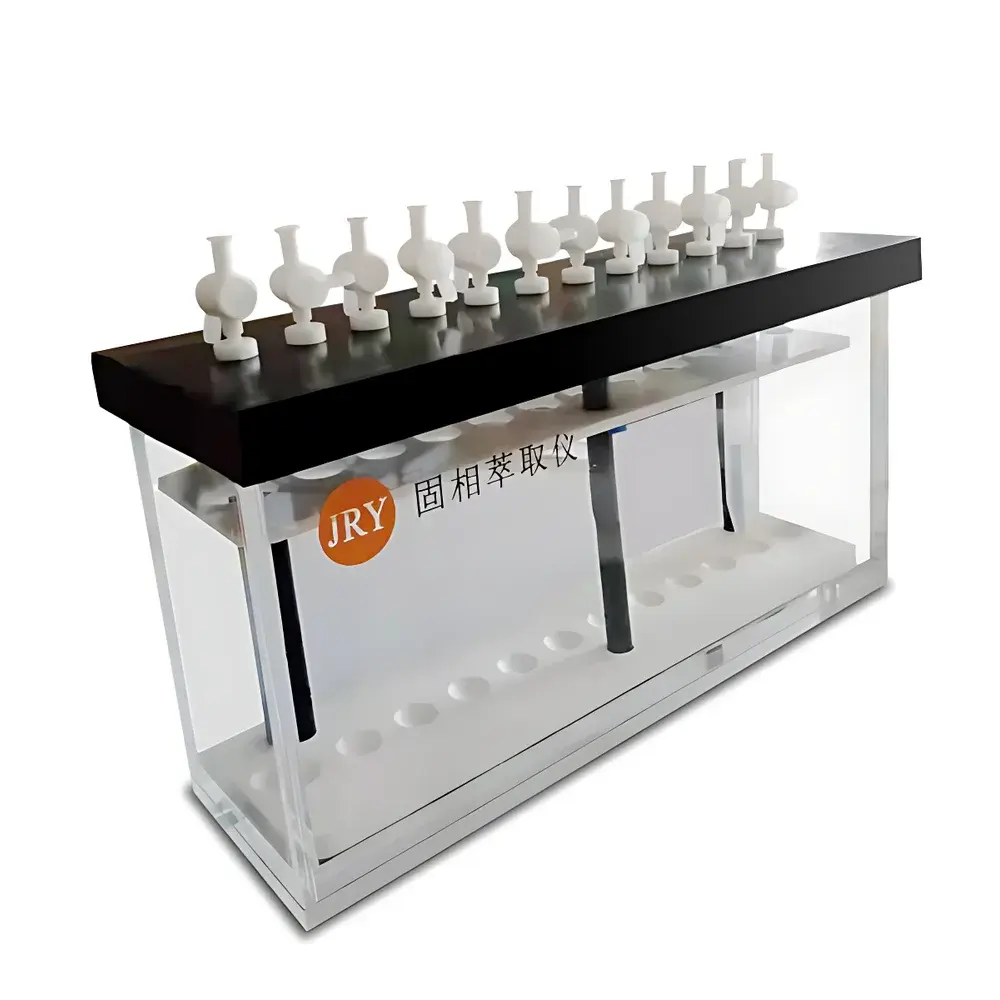
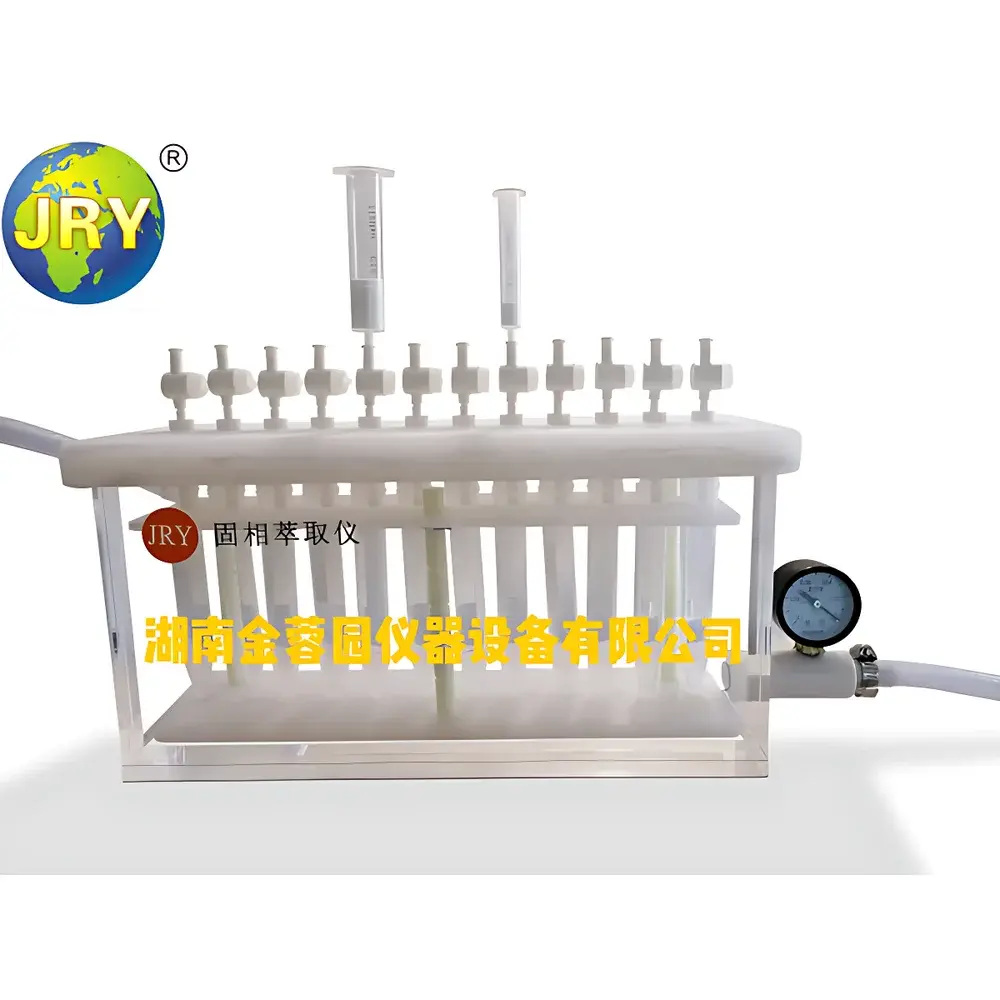
JRY JRY-SPE24 Semi-Automatic Multi-Channel Solid Phase Extraction System
| Brand | JRY |
|---|---|
| Origin | Hunan, China |
| Manufacturer Type | Direct Manufacturer |
| Product Origin | Domestic (China) |
| Model | JRY-SPE24 |
| Automation Level | Semi-Automatic |
| Channel Count | 24-Channel |
| Extraction Format | Cartridge-Based SPE |
| Flow Rate Control Range | 0.1–30 mL/min |
| Solvent Compatibility | Multiple Immiscible Solvents |
| Sample Capacity | 24 Samples per Run |
| Sample Loading Volume | Up to 50 mL per Cartridge |
| Wetted Materials | Borosilicate Glass (Cartridge Holders, Manifold, Reservoirs) |
Overview
The JRY JRY-SPE24 is a semi-automatic, 24-channel solid phase extraction (SPE) system engineered for reproducible, high-throughput sample preparation in analytical laboratories. It operates on the principle of selective adsorption and elution using disposable SPE cartridges packed with sorbent materials (e.g., C18, silica, ion-exchange resins), enabling efficient isolation, concentration, and cleanup of target analytes from complex liquid matrices—including environmental water, biological fluids, food extracts, and pharmaceutical formulations. Unlike fully automated robotic platforms, the JRY-SPE24 employs a manually initiated vacuum manifold architecture with precision-adjustable flow control valves, offering optimal balance between operator oversight, method flexibility, and throughput scalability. Its design prioritizes chemical inertness and mechanical stability—critical for maintaining method integrity across diverse solvent systems and regulatory workflows.
Key Features
- 24-Position Parallel Processing: Simultaneous conditioning, loading, washing, and elution across 24 SPE cartridges—reducing batch processing time by up to 75% compared to single-column manual protocols.
- Graduated Flow Rate Regulation: Independent fine-tuning of vacuum-driven flow (0.1–30 mL/min per channel) via calibrated needle valves, ensuring consistent residence time and minimizing breakthrough or channeling effects during sorbent activation and analyte retention.
- Chemically Resistant Wetted Path: All solvent-contact components—including manifold base, cartridge holders, solvent reservoirs, and vacuum tubing ports—are constructed from borosilicate glass (e.g., Pyrex®-grade), eliminating leaching, swelling, or degradation when exposed to aggressive solvents such as dichloromethane, acetonitrile, or concentrated acids/bases.
- Modular Vacuum Interface: Compatible with standard laboratory vacuum pumps (≤ –85 kPa) and optional pressure-assisted modules; includes integrated vacuum gauge and overpressure relief valve for safe operation under variable lab conditions.
- Ergonomic & Serviceable Design: Tool-free cartridge holder assembly/disassembly, removable glass reservoir trays for rapid cleaning, and labeled port indexing to prevent cross-contamination and support GLP-compliant documentation.
Sample Compatibility & Compliance
The JRY-SPE24 accommodates standard 1 mL, 3 mL, 6 mL, and 12 mL SPE cartridges (including stacked-bed and mixed-mode formats) from major global suppliers (e.g., Waters, Agilent, Thermo Fisher, Phenomenex). It supports aqueous samples up to 50 mL per cartridge and is validated for use in methods aligned with ASTM D7279 (water analysis), ISO 17993 (environmental testing), and USP (chromatographic separations). While not certified to FDA 21 CFR Part 11 out-of-the-box, its operational transparency—combined with user-defined SOP logging, manual audit trail maintenance, and physical record retention—enables full traceability required under GLP and GMP environments when integrated into documented laboratory quality systems.
Software & Data Management
As a semi-automatic platform, the JRY-SPE24 does not include embedded firmware or proprietary software. Instead, it is designed for seamless integration into existing laboratory informatics ecosystems: method parameters (flow rates, solvent sequences, hold times) are recorded manually or entered into LIMS/Electronic Lab Notebook (ELN) systems such as LabWare, Benchling, or Veeva Vault. The absence of digital control logic eliminates cybersecurity vulnerabilities associated with connected instrumentation and ensures uninterrupted operation during IT infrastructure updates—a key consideration for regulated QC labs maintaining continuous validation status.
Applications
- Pre-concentration and matrix removal prior to HPLC-UV, LC-MS/MS, or GC-MS analysis of pesticides in surface water (EPA Method 525.3).
- Cleanup of plasma, urine, and serum samples for therapeutic drug monitoring and toxicology screening.
- Isolation of polyphenols, mycotoxins, and veterinary drug residues from milk, honey, and cereal extracts.
- Method development support for multi-residue analysis where solvent gradient optimization and sorbent screening require iterative manual intervention.
- Teaching laboratories emphasizing hands-on understanding of retention mechanisms, breakthrough curves, and method robustness assessment.
FAQ
Is the JRY-SPE24 compatible with positive-pressure (nitrogen) elution?
Yes—vacuum ports can be repurposed for regulated nitrogen gas delivery using an external pressure regulator and inline filter; recommended maximum pressure: 30 psi.
Can I use 96-well plate SPE formats with this system?
No—the JRY-SPE24 is configured exclusively for individual cartridge-based SPE; plate-based workflows require dedicated manifold adapters not supplied with this model.
What maintenance is required for long-term reliability?
Monthly inspection of glass manifold integrity, valve seat lubrication with PTFE-compatible grease, and replacement of silicone gaskets every 6 months under continuous use.
Does the system meet ISO 9001 manufacturing standards?
JRY’s production facility is ISO 9001:2015 certified; device-specific conformity documentation (DoC) and material traceability reports are available upon request.
How is method transfer validated between operators?
Standardized checklists for cartridge packing, flow calibration, and vacuum decay testing are included in the user manual to ensure inter-operator consistency and minimize variability in recovery rates.



