
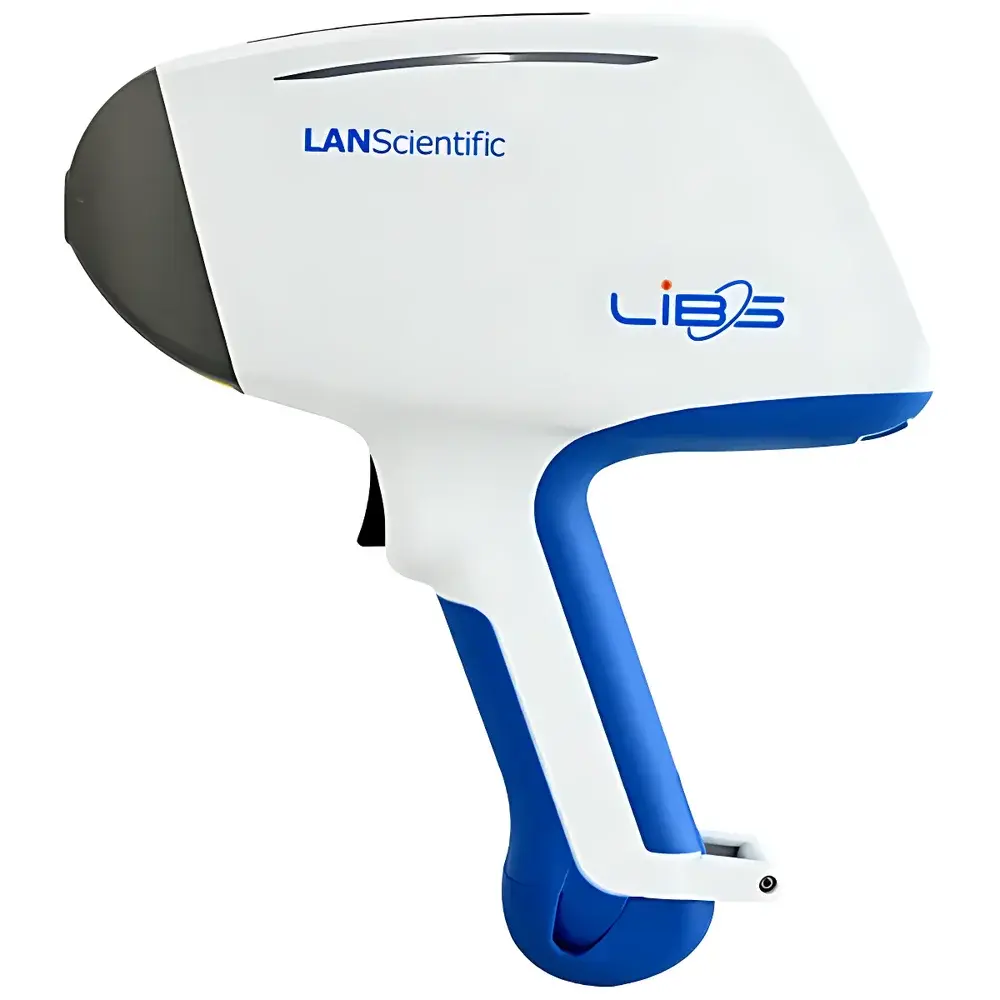
Brookfield LIBS 800 Handheld Laser-Induced Breakdown Spectroscopy Analyzer
| Brand | LANScientific |
|---|---|
| Origin | Jiangsu, China |
| Manufacturer Type | OEM Producer |
| Instrument Type | Handheld LIBS Analyzer |
| Model | LIBS 800 |
| Compliance | CE, RoHS, FDA 21 CFR Part 11 (Software Mode), ISO/IEC 17025–compatible workflow support |
| Laser Class | 3B (IEC 60825-1:2014) |
| Weight | 1.65 kg |
| Spectral Range | 190–950 nm |
| Optical Resolution | ≤0.1 nm (FWHM) |
| Detection Limits | Sub-ppm to % level (matrix-dependent) |
| Analysis Time | <2 s per measurement |
| Sample Interaction | Non-contact, micro-destructive (crater diameter <100 µm) |
| Power Supply | Rechargeable Li-ion battery (≥8 h continuous operation) |
Overview
The Brookfield LIBS 800 is a handheld Laser-Induced Breakdown Spectroscopy (LIBS) analyzer engineered for rapid, in-situ elemental analysis of solid metallic and alloyed materials. Based on the fundamental principle of laser ablation plasma emission spectroscopy, the instrument delivers high-reproducibility atomic emission spectra by focusing a nanosecond-pulsed 3B-class laser onto the sample surface. When local energy density exceeds the material’s optical breakdown threshold, a transient microplasma (T ≈ 5,000–15,000 K) forms; its cooling phase emits characteristic line spectra corresponding to constituent elements. These emissions are collected via fiber-coupled optics and resolved using a high-throughput Czerny-Turner spectrometer with back-illuminated CCD detection. Unlike XRF or OES, LIBS requires no vacuum, inert gas purge, or conductive coating—making it uniquely suited for field-deployable, real-time metallurgical verification under variable ambient conditions.
Key Features
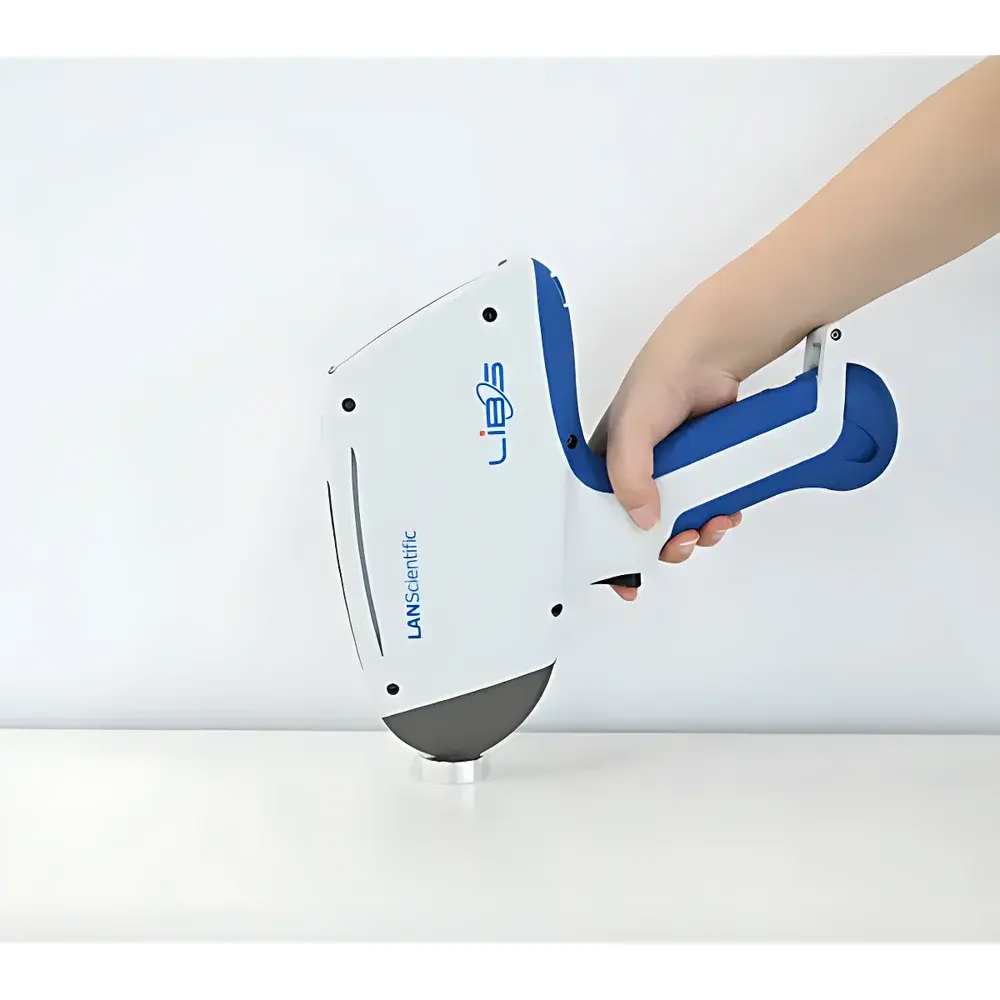
- True handheld ergonomics: 1.65 kg mass, balanced center-of-gravity design, and intuitive trigger-activated measurement interface optimized for one-handed operation in confined or elevated workspaces.
- Micro-ablation capability: Single-shot crater diameter <100 µm, depth <1 µm—preserving sample integrity for critical components such as aerospace fasteners or heritage metal artifacts.
- Multi-element simultaneous detection: Capable of quantifying Mg, Al, Si, Fe, Cu, Zn, Mn, Cr, Ni, Ti, and other major/minor alloying elements across 190–950 nm spectral window without spectral scanning.
- Integrated safety architecture: Dual-layer laser interlock system (hardware-based shutter + proximity sensor feedback) compliant with IEC 60825-1:2014 Class 3B requirements; automatic beam termination upon grip release or tilt angle deviation >15°.
- Battery-powered field autonomy: Industrial-grade Li-ion pack supports ≥8 h of continuous analysis (typical duty cycle: 120 measurements/hour) with hot-swappable option for extended campaigns.
Sample Compatibility & Compliance
The LIBS 800 accommodates heterogeneous solid samples—including castings, forgings, extrusions, welds, and coated substrates—without polishing, flattening, or electrical grounding. Its non-vacuum, ambient-air operation enables direct analysis of oxidized, painted, or lightly contaminated surfaces. While primarily validated for metallic matrices (Al-, Mg-, Ti-, and Fe-based alloys), empirical calibration libraries extend applicability to geological slags, refractory ceramics, and recycled scrap streams. The system supports GLP/GMP-aligned data governance: all spectra, metadata (GPS timestamp, operator ID, environmental T/RH), and quantitative reports are cryptographically signed and stored in audit-trail-enabled SQLite databases. Software workflows comply with ISO/IEC 17025 documentation standards and FDA 21 CFR Part 11 electronic record requirements when configured with user authentication and electronic signature modules.
Software & Data Management
Embedded firmware runs on a Linux-based real-time OS with deterministic acquisition timing (<5 ms jitter). The proprietary SpectraLink™ software suite provides: (i) automated spectral preprocessing (dark current subtraction, cosmic ray removal, continuum background correction); (ii) multi-peak fitting using constrained Voigt profiles; (iii) matrix-matched calibration models with internal standard normalization (e.g., Al I 396.15 nm for aluminum alloys); and (iv) ASTM E2925-compliant grade identification against UNS, EN, and GB/T alloy databases. Raw spectra (.spe) and processed reports (.pdf/.xlsx) export via USB-C or Wi-Fi 5 (802.11ac), with optional cloud synchronization to secure enterprise servers supporting role-based access control (RBAC) and automated backup retention policies.
Applications
- Aerospace: Rapid verification of Ti-6Al-4V, Al 7075-T6, and Mg-AZ31B billets during incoming inspection and in-process QA.
- Automotive: On-line sorting of mixed Al scrap streams (e.g., 5xxx vs. 6xxx series) at shredder facilities; validation of wheel alloy composition pre-anodizing.
- Metal recycling: Real-time discrimination of stainless steel grades (304/316/430) and detection of hazardous Pb/Cd contamination in post-consumer electronics housings.
- Construction: Field assessment of reinforcing bar (rebar) chemistry to confirm ASTM A615 compliance prior to concrete pouring.
- Manufacturing: In-situ monitoring of weld metal dilution ratios and filler wire composition drift during robotic MIG welding of structural frames.
FAQ
What is the typical detection limit for magnesium in aluminum-magnesium alloys?
Detection limits for Mg in Al matrices range from 10–50 ppm under optimized measurement conditions (3–5 averaged shots, clean surface, ambient humidity <60%). Actual performance depends on surface oxide thickness and local plasma shielding effects.
Can the LIBS 800 analyze liquids or powders?
While designed for solids, liquid samples may be analyzed in static droplet mode using optional sample cup fixtures; powders require pelletization or binder-free pressing to ensure consistent ablation yield. Quantitative accuracy for non-solid phases requires matrix-specific calibration.
Does the instrument require annual recalibration?
No scheduled recalibration is mandated. Wavelength calibration is stabilized via onboard neon-argon reference lamp; intensity drift compensation is performed automatically before each measurement sequence using internal photodiode monitoring.
How does LIBS compare to handheld XRF for light element analysis?
LIBS provides superior sensitivity for elements below sodium (Z30) due to higher counting statistics.
Is spectral data export compatible with third-party chemometric tools?
Yes. ASCII-formatted spectra (.csv) contain wavelength (nm), intensity (counts), and shot number metadata—fully importable into MATLAB, Python (SciPy/NumPy), or commercial PLS regression platforms like Unscrambler® or Pirouette®.
Related Products





