
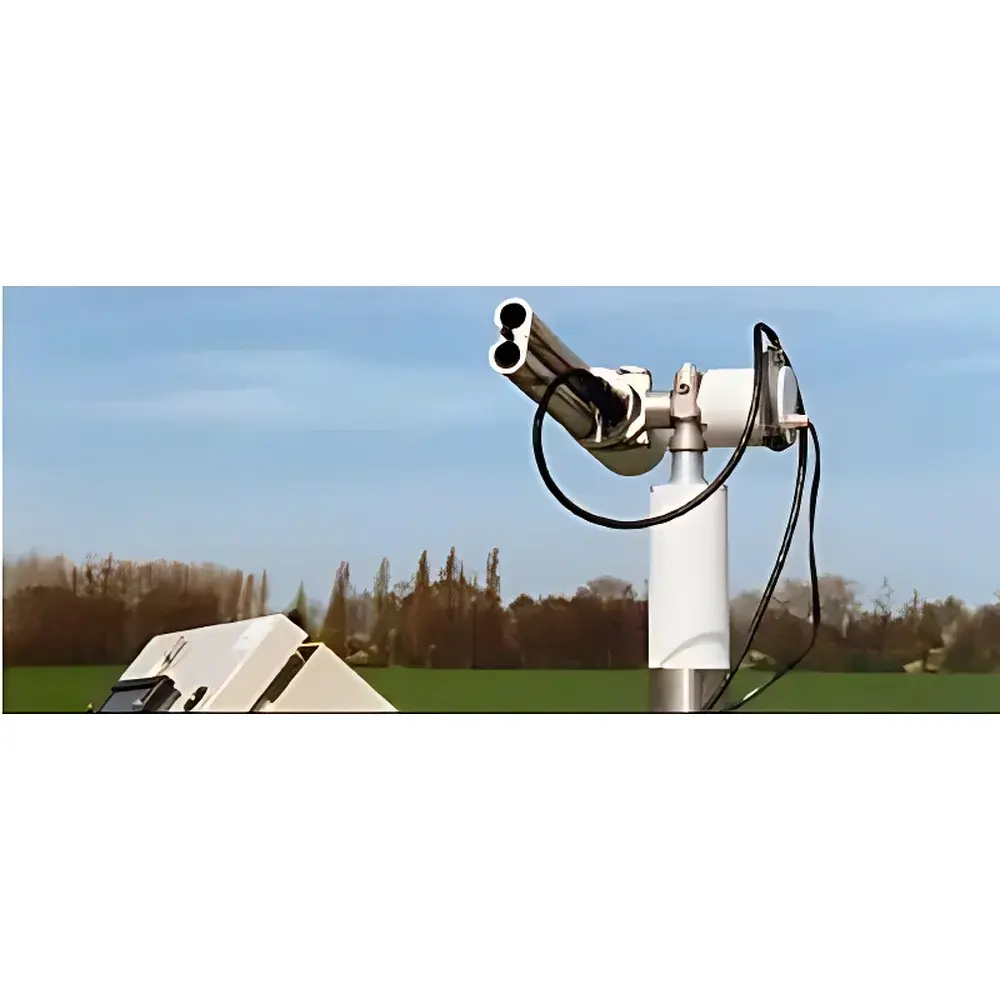
Cimel CE318 Automated Sun Photometer
| Brand | Cimel |
|---|---|
| Origin | France |
| Model | CE318 |
| Instrument Type | Aerosol Optical Depth (AOD) & Sky Radiance Spectroradiometer |
| Standard Spectral Channels | 340, 380, 440, 500, 675, 870, 936, 1020, 1640 nm (FWHM ≤ 10 nm) |
| Field of View | 1.3° (full width at half maximum) |
| Detector Configuration | Enhanced silicon photodiode (direct sun), silicon photodiode (sky radiance) |
| Solar Tracking Accuracy | < 0.1° (dual-axis stepper motor + quadrant detector fine adjustment) |
| Operating Temperature Range | −30 °C to +60 °C |
| Power Supply | Internal battery (optical head), external battery (motor drive) |
| Data Interfaces | RS-232 serial, USB, optional Wi-Fi/3G/Geostationary Satellite (Meteosat/GOES/GMS) telemetry |
| Environmental Protection | Automatic rain shutdown via integrated hygrometer |
Overview
The Cimel CE318 Automated Sun Photometer is a field-deployable, high-precision spectroradiometric instrument engineered for continuous, autonomous measurement of direct solar irradiance and sky radiance across nine discrete spectral bands in the ultraviolet–near-infrared range (340–1640 nm). Based on the principle of multi-spectral extinction and angular sky radiance sampling, the CE318 enables quantitative retrieval of aerosol optical depth (AOD), Ångström exponent, single-scattering albedo, aerosol size distribution, and column-integrated water vapor. Its operational architecture integrates physical optics, real-time celestial mechanics computation, and robust environmental hardening—making it a foundational tool for ground-based validation of satellite remote sensing missions (e.g., MODIS, VIIRS, Sentinel-3/5P), long-term atmospheric monitoring networks (e.g., AERONET, SKYNET), and climate model evaluation. The system complies with AERONET Level 1.5/2.0 processing protocols and supports traceable calibration against NIST-traceable reference standards.
Key Features
- Dual-mode autonomous operation: Direct-sun tracking mode for AOD derivation and sky-scanning modes—including almucantar, principal plane, and polarized radiance scans—for full Mueller matrix characterization.
- High-fidelity optical design: Two coaxial telescopic tubes—one optimized for collimated direct-sun irradiance (no condensing lens), the other for diffuse sky radiance (with f/10 condenser lens)—ensuring minimal stray light and spectral crosstalk.
- Precision dual-axis solar tracking: Primary positioning via time-based ephemeris calculation; sub-arcminute refinement using a four-quadrant silicon photodetector feedback loop (tracking accuracy < 0.1° RMS).
- Environmental resilience: Integrated hygrometer triggers automatic optical shutter closure and system hibernation during precipitation events; operating envelope certified from −30 °C to +60 °C.
- Flexible power architecture: Modular battery management with solar panel charging capability and AC backup—enabling unattended deployment in remote or off-grid locations for >6 months.
- Multi-layer data acquisition and telemetry: Local storage (SD card), direct PC interface (RS-232/USB), and optional satellite uplink (Meteosat, GOES, GMS) or cellular/Wi-Fi transmission compliant with FTP/HTTP(S) protocols.
Sample Compatibility & Compliance
The CE318 is designed exclusively for outdoor atmospheric column measurements and does not interface with liquid, solid, or gaseous samples in conventional laboratory formats. It measures extraterrestrial and atmospheric-path radiance under clear-sky, partly cloudy, and turbid conditions—subject to standard AERONET quality assurance criteria (e.g., cloud-screening algorithms, pointing error correction, Langley regression validity thresholds). The instrument meets IEC 60529 IP54 enclosure rating for dust and splash resistance. All firmware and data processing routines adhere to AERONET v3.0 metadata conventions and support ISO/IEC 17025-aligned calibration traceability documentation. Optional configurations include polarization-sensitive channels (CE318-P) and extended NIR bands (up to 2200 nm), each validated per ASTM E261–22 (Standard Practice for Determining Precision Limits of Spectral Irradiance Measurements).
Software & Data Management
Data acquisition and real-time control are managed via the proprietary Cimel Control Software (CCS), compatible with Windows 7–11 and Linux (via Wine). Raw measurements are stored in ASCII-based .LEV1 files containing timestamped spectral voltages, motor angles, temperature/humidity logs, and status flags. Post-processing leverages the AERONET Cloud–Free Algorithm Suite (v4.0+) for automated cloud screening, Langley extrapolation, inversion of sky radiances using the GRASP (Generalized Retrieval of Atmosphere and Surface Properties) algorithm, and generation of Level 2.0 products—including aerosol volume size distribution, complex refractive index, and vertical profile constraints via synergy with lidar. All data exports comply with CF-NetCDF 1.8 and NASA’s HDF-EOS5 standards. Audit trails, user authentication, and electronic signatures satisfy FDA 21 CFR Part 11 requirements when deployed in regulated environmental monitoring programs under GLP frameworks.
Applications
- Long-term trend analysis of aerosol loading and transport (e.g., dust storms, biomass burning plumes, volcanic ash dispersion)
- Pre-launch and on-orbit calibration/validation of Earth observation sensors (e.g., Terra/Aqua MODIS, Suomi-NPP VIIRS, Sentinel-3 OLCI)
- Input parameterization for radiative transfer models (e.g., libRadtran, MODTRAN) used in climate forcing assessments
- Urban air quality monitoring networks integrating AOD with PM₂.₅/PM₁₀ ground station data via empirical or machine-learning downscaling
- Support of atmospheric correction workflows in hyperspectral and multispectral image processing pipelines
- Education and training in atmospheric physics, remote sensing, and environmental instrumentation laboratories
FAQ
What spectral resolution does the CE318 achieve?
The CE318 employs interference filters with nominal full-width-at-half-maximum (FWHM) bandwidths ≤10 nm across all standard channels. Absolute center wavelength tolerance is ±0.5 nm, verified during factory calibration and traceable to NIST SRM 2036.
Can the CE318 operate without internet connectivity?
Yes. All core functions—including solar tracking, spectral acquisition, internal data logging (up to 12 months at 15-min intervals), and local display—are fully autonomous. Remote telemetry is optional and configurable post-deployment.
Is the CE318 compatible with AERONET data submission protocols?
Yes. The instrument natively generates Level 1.0 data files formatted to AERONET specifications. With proper site registration and calibration history upload, Level 2.0 inversion products are automatically ingested into the global AERONET database.
How often does the CE318 require recalibration?
Cimel recommends laboratory recalibration every 24 months, or after any event involving optical component replacement, severe mechanical shock, or prolonged exposure beyond specified thermal limits. Field calibration checks using Langley plots are performed daily during stable atmospheric conditions.
Does the CE318 support real-time data streaming to cloud platforms?
Yes—via optional embedded cellular modem (LTE-M/NB-IoT) or satellite transceiver modules. Data payloads conform to MQTT or RESTful API schemas, enabling integration with AWS IoT Core, Azure IoT Hub, or custom environmental dashboards.
Related Products







