
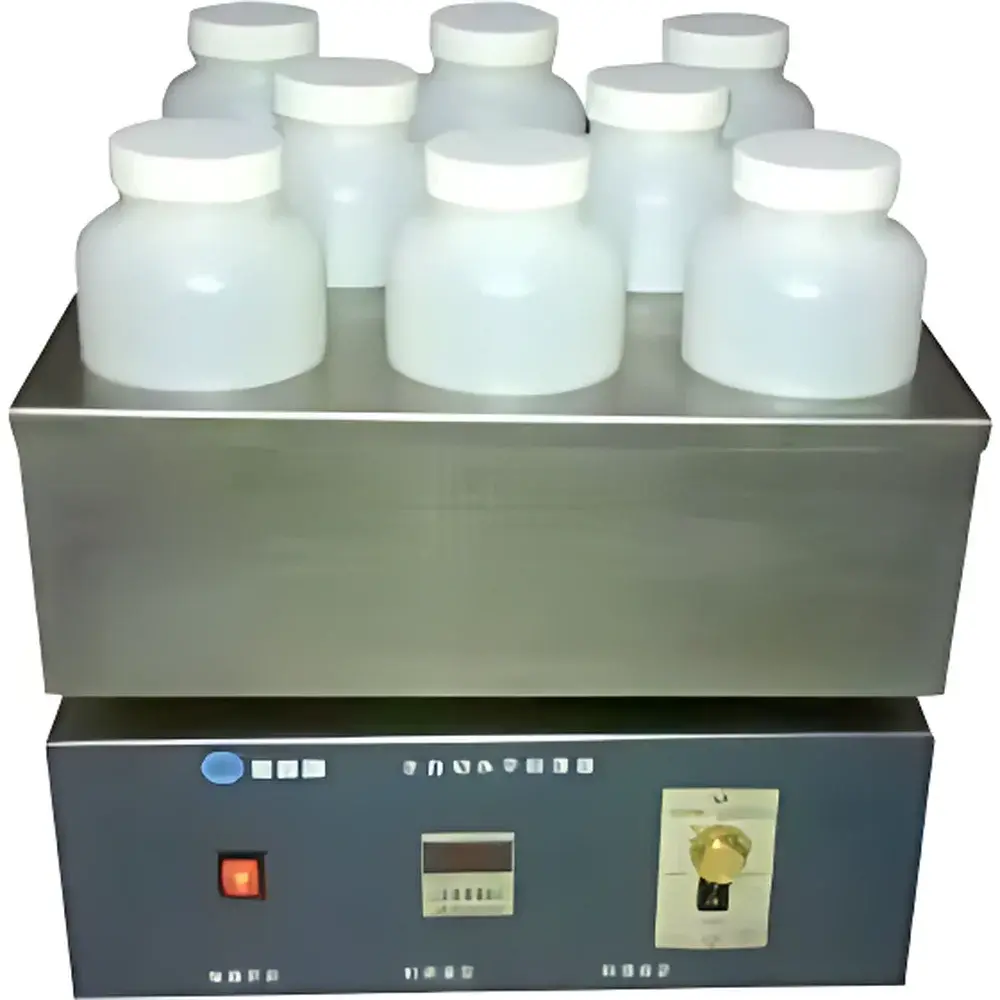
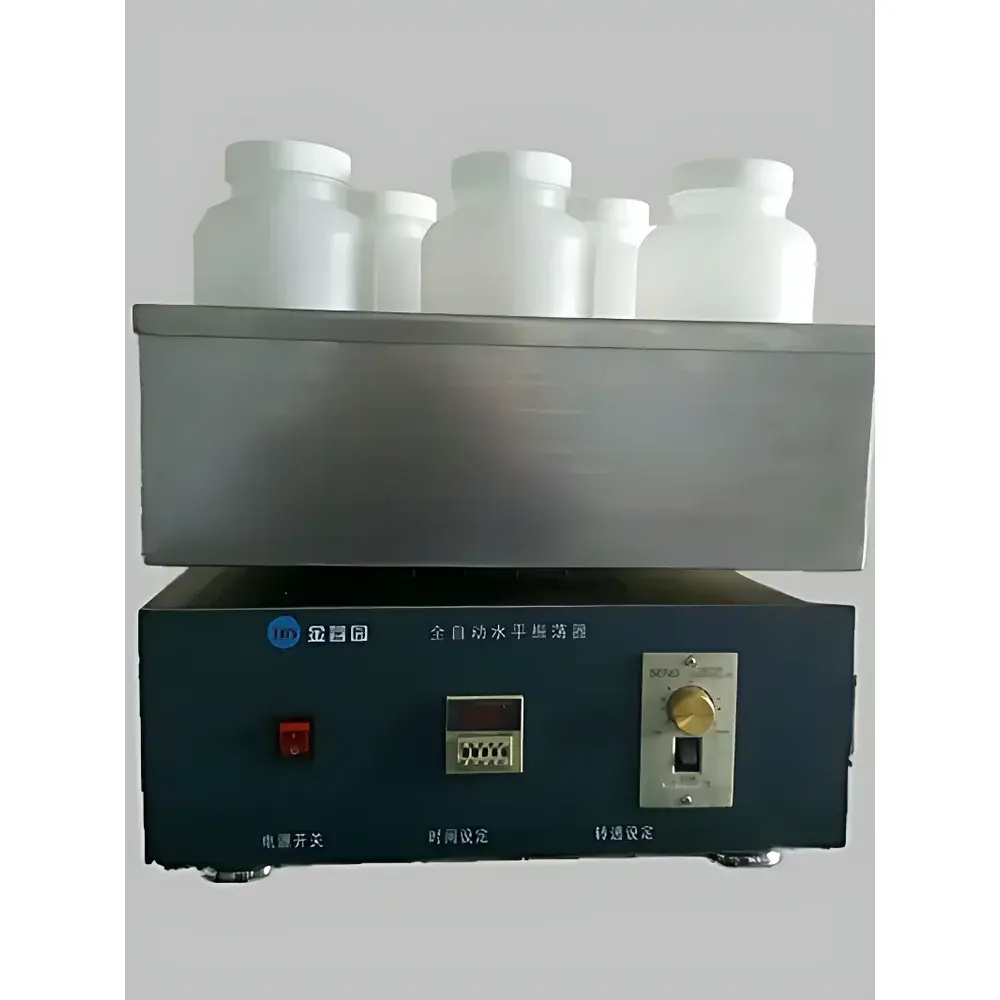
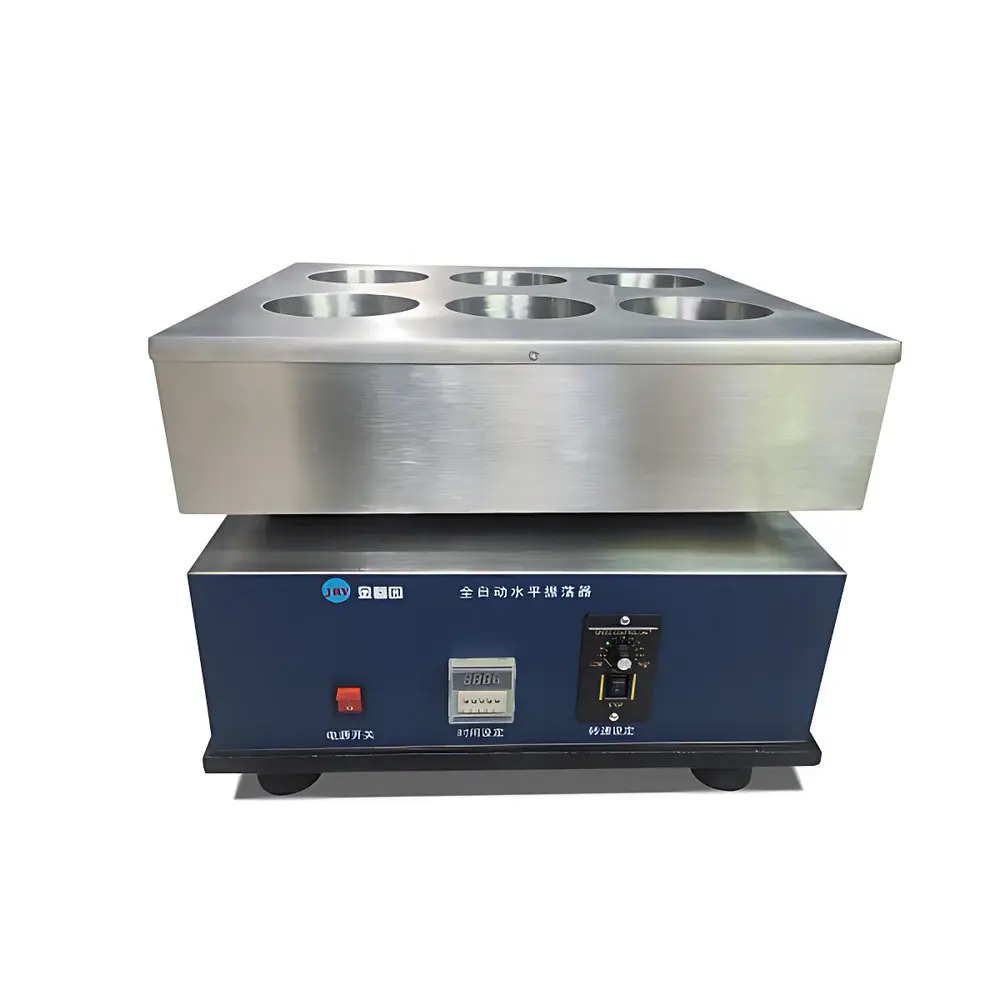
JRY JRY-S06/S08/S10/S12 Automated Horizontal Shaker for Solid Waste Toxicity Leaching
| Brand | JRY |
|---|---|
| Origin | Hunan, China |
| Manufacturer Type | Direct Manufacturer |
| Country of Origin | China |
| Model | JRY-S06 / S08 / S10 / S12 |
| Price Range | USD 2,800–7,000 (FOB) |
| Oscillation Frequency | 0–150 rpm (adjustable) |
| Timer Range | 0–99.99 h |
| Sample Bottle Capacity | 2 L per bottle |
| Number of Sample Positions | 6 / 8 / 10 / 12 |
| Operating Temperature Range | Ambient to 23 °C |
| Temperature Control Accuracy | ±1 °C |
| Drive Mechanism | Linear reciprocating motion |
| Stroke Amplitude | 40 mm |
| Rated Voltage | 220 V, 50 Hz |
| Motor Power | 120 W (S06) / 140 W (S08) / 160 W (S10) / 180 W (S12) |
| External Dimensions (W×D×H, mm) | 450×290×360 (S06–S10) / 600×450×360 (S12) |
| Net Weight | 14 kg (S06) / 16 kg (S08) / 18 kg (S10) / 20 kg (S12) |
| Housing Material | Full stainless steel (AISI 304) |
Overview
The JRY-S Series Automated Horizontal Shaker is an engineered platform designed specifically for standardized leaching procedures in solid waste characterization and environmental regulatory compliance testing. It operates on a linear reciprocating motion principle—generating controlled horizontal oscillation across a fixed stroke amplitude of 40 mm—to simulate the physical contact and mass transfer dynamics observed during natural leaching of hazardous constituents from solid matrices. This mechanical agitation ensures uniform suspension and consistent liquid–solid interaction, critical for reproducible extraction of metals, organic compounds, and other regulated analytes under defined pH, time, and temperature conditions. The system complies with core U.S. EPA and Chinese environmental standard methods—including EPA Method 1311 (TCLP), EPA Method 1312 (SPLP), and most critically, HJ 557–2010 “Leaching Toxicity Test Method for Solid Waste” — which mandates horizontal shaking at 30 ± 2 rpm for 18 h at ambient temperature (20–25 °C) using 2-L extraction vessels. Its design prioritizes mechanical stability, long-term duty-cycle reliability, and minimal thermal drift—enabling unattended operation over extended durations without compromising method fidelity.
Key Features
- Stainless steel (AISI 304) housing ensures corrosion resistance, chemical compatibility, and ease of decontamination—essential for multi-analyte laboratories handling acidic, alkaline, or organic leachates.
- Precise digital control interface enables independent adjustment of oscillation frequency (0–150 rpm) and timer duration (0–99.99 h) with ±0.5 rpm repeatability and ±0.01 h resolution.
- Modular sample tray configuration supports interchangeable platforms for 6, 8, 10, or 12 positions—each accommodating standard 2-L glass, HDPE, or PTFE bottles per HJ 557–2010 specifications.
- Low-noise, high-torque brushless motor architecture delivers stable performance under full load (up to 24 kg total vessel weight), with vibration isolation mounts minimizing cross-platform interference.
- Passive ambient-temperature operation (20–23 °C range, ±1 °C stability) eliminates active heating/cooling components—reducing energy consumption, calibration complexity, and risk of thermal artifact generation during leaching.
- Front-accessible clamping mechanism allows rapid, tool-free bottle installation and removal while maintaining secure retention across all operational frequencies.
Sample Compatibility & Compliance
The JRY-S Series is validated for use with 2-L extraction vessels fabricated from borosilicate glass, food-grade HDPE, or inert PTFE—materials explicitly referenced in HJ 557–2010, HJ 637–2018 (petroleum hydrocarbons), and HJ 889–2017 (cation exchange capacity). Its mechanical parameters meet the strict kinematic requirements of multiple international leaching protocols: oscillation frequency tolerance ≤ ±2 rpm, stroke linearity ≥ 99.2%, and angular deviation < 0.5° over full load. All models are CE-marked and manufactured under ISO 9001-certified quality management systems. While not intrinsically compliant with FDA 21 CFR Part 11, the shaker’s deterministic operation (no data storage or user authentication) renders it suitable for GLP/GMP environments when integrated into documented SOPs with external audit-trail logging.
Software & Data Management
This instrument operates as a standalone electromechanical device with no embedded firmware, network interface, or onboard data storage—eliminating cybersecurity risks and software validation burdens. All operational parameters (start time, set frequency, elapsed duration) are displayed via LED digits and retained only during active runtime. For laboratory information management system (LIMS) integration or electronic recordkeeping, users may pair the shaker with external time-stamped video monitoring, programmable logic controllers (PLCs), or IoT-enabled power meters. Calibration verification is performed annually using traceable tachometers and digital timers accredited to ISO/IEC 17025 standards; certificates of conformance accompany each unit shipment.
Applications
- Regulatory leaching tests for hazardous waste classification per HJ 557–2010, EPA TCLP (Method 1311), and EN 12457 series.
- Extraction of priority pollutants—including As, Cd, Cr(VI), Pb, Hg, Ni, and PAHs—from contaminated soils, sediments, slags, and municipal solid waste residues.
- Preparatory agitation for subsequent analysis by ICP-MS, AAS, GC-MS, or UV-Vis spectrophotometry following standardized digestion or filtration steps.
- Method development and validation studies requiring precise control over agitation intensity, contact time, and vessel geometry in solid–liquid partitioning experiments.
- Quality assurance testing of landfill liner materials, stabilization/solidification products, and encapsulated waste forms under simulated field leaching conditions.
FAQ
Does this shaker support active temperature control beyond ambient?
No. The JRY-S Series maintains passive thermal equilibrium within ambient laboratory conditions (20–23 °C). For temperature-controlled leaching (e.g., SPLP at 25 °C), external environmental chambers must be used.
Can I use non-standard bottle sizes such as 1-L or 5-L containers?
The platform is mechanically optimized for 2-L vessels. Use of alternative volumes requires custom fixture validation to ensure center-of-mass alignment and oscillation uniformity.
Is maintenance required between runs?
Routine cleaning of the stainless steel deck and clamping surfaces is recommended after each batch; no lubrication or recalibration is needed under normal operating conditions.
What electrical safety certifications does the unit carry?
All models comply with GB 4793.1–2018 (equivalent to IEC 61010-1) for laboratory electrical equipment and include dual redundant thermal cutoffs and ground-fault protection.
How is traceability ensured for regulatory audits?
Each unit ships with a factory calibration report referencing NIST-traceable instruments; users are responsible for maintaining logbooks documenting usage, preventive maintenance, and periodic verification checks per internal QA protocols.







