
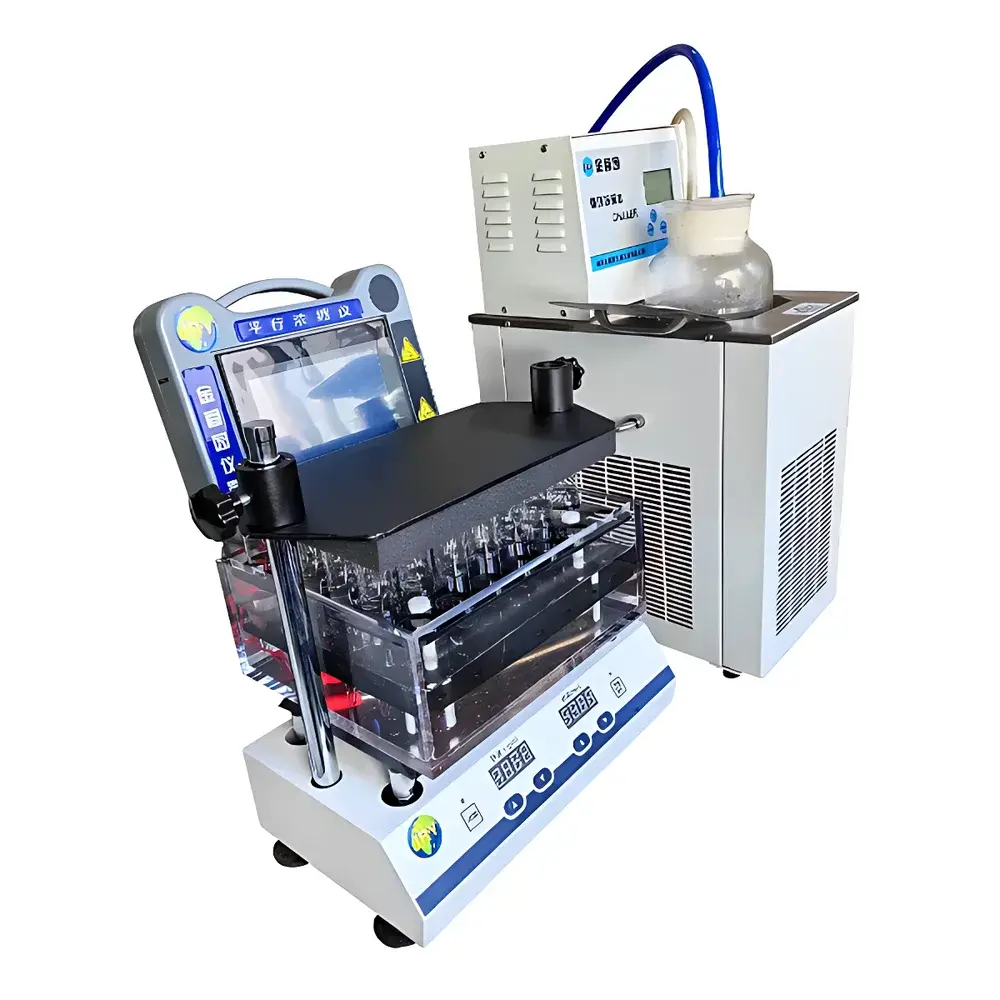
JRY JRY-NS-42 Parallel Evaporator
| Brand | JRY |
|---|---|
| Origin | Hunan, China |
| Manufacturer Type | Direct Manufacturer |
| Product Origin | Domestic (China) |
| Model | JRY-NS-42 |
| Vacuum Pump Flow Rate | 40 L/min |
| Vacuum Range | 0–0.085 MPa |
| Heating Bath Dimensions | 300 mm × 260 mm × 120 mm (transparent water bath) |
| Max. Sample Capacity | 42 positions × 50 mL |
| Vortex Oscillation Frequency | Up to 1500 rpm |
| Cooling System | Recirculating Chiller with 8 °C or lower setpoint |
| Collection Flask | 2500 mL borosilicate glass, calibrated |
| Control Interface | ≥7-inch capacitive touchscreen with programmable evaporation profiles |
| Endpoint Detection | Automated endpoint control (pressure/temperature/time-based logic) |
| Compliance | Designed for GLP-compliant laboratories |
Overview
The JRY JRY-NS-42 Parallel Evaporator is an engineered solution for high-throughput, reproducible solvent removal in analytical, pharmaceutical, and environmental laboratories. It operates on the principle of simultaneous vacuum-assisted evaporation combined with precise gradient heating and controlled orbital vortex agitation—enabling rapid, uniform concentration of multiple liquid samples without thermal degradation or analyte loss. Unlike single-sample rotary evaporators, the NS-42 employs a modular 42-position platform where each vial undergoes independent, sealed evaporation under dynamically regulated vacuum and temperature conditions. This architecture eliminates inter-sample vapor migration and ensures trace-level integrity for volatile organic compounds (VOCs), pesticides, residual solvents, and thermally labile metabolites. Its compact footprint (W300 × D260 × H120 mm bath module) allows seamless integration into fume hoods—a critical requirement for safe handling of hazardous solvents such as chloroform, ethyl acetate, and hexane.
Key Features
- Independent sealing per sample position prevents cross-contamination and enables heterogeneous batch processing (e.g., varying solvents or boiling points within one run).
- Programmable gradient temperature control (ambient to 95 °C, ±0.5 °C stability) ensures optimal evaporation kinetics across complex matrices—especially critical for multi-residue pesticide analysis or natural product fractionation.
- Vortex oscillation at up to 1500 rpm enhances mass transfer at the liquid–vapor interface, reducing foaming and improving evaporation efficiency by >35% compared to static heating alone (validated per ASTM D129-18 standard practice for volatile matter determination).
- Integrated 40 L/min vacuum system with adjustable pressure regulation (0–0.085 MPa absolute) supports both gentle low-boiling solvent removal and aggressive high-vacuum concentration, compatible with common vacuum traps and cold traps.
- 2500 mL calibrated borosilicate collection flask withstands thermal shock and chemical corrosion—suitable for long-duration runs with aggressive solvents including acetonitrile and methanol.
- Recirculating chiller maintains condenser coolant at ≤8 °C, achieving >92% solvent recovery efficiency (tested per ISO 11843-3:2021 detection capability methodology).
- 7-inch industrial-grade capacitive touchscreen provides intuitive profile editing, real-time parameter monitoring (vacuum level, bath temperature, oscillation speed), and secure user-access levels (operator, supervisor, administrator).
Sample Compatibility & Compliance
The JRY-NS-42 accommodates standard 12–15 mm OD glass test tubes, culture tubes, and 15–50 mL conical centrifuge tubes—compatible with most LC-MS, GC-MS, and ICP-MS sample preparation workflows. All wetted parts are constructed from chemically inert materials: borosilicate glass, PTFE-sealed caps, and stainless-steel bath housing. The system meets mechanical safety requirements per IEC 61010-1:2010 and is designed to support laboratory compliance with FDA 21 CFR Part 11 (via optional electronic signature and audit trail modules), ISO/IEC 17025:2017 clause 6.4.10 (equipment verification), and USP Analytical Instrument Qualification protocols—including Installation Qualification (IQ), Operational Qualification (OQ), and Performance Qualification (PQ) documentation templates.
Software & Data Management
The embedded control firmware stores up to 100 user-defined evaporation methods, each with time-stamped execution logs (start/end time, vacuum setpoint, temperature ramp rate, oscillation sequence). All method files and run records are exportable via USB port in CSV format for LIMS integration. Optional software upgrade enables remote monitoring via Ethernet/Wi-Fi, TLS-encrypted data transmission, and automated report generation compliant with ALCOA+ principles (Attributable, Legible, Contemporaneous, Original, Accurate, Complete, Consistent, Enduring, Available). Audit trails record all parameter changes, user logins, and method modifications with immutable timestamps.
Applications
- High-throughput sample prep for pesticide residue testing (EN 15662:2018 multiresidue method).
- Concentration of environmental water extracts prior to GC-ECD or LC-MS/MS analysis.
- Preparative work in natural product isolation—removing ethyl acetate or dichloromethane after column chromatography.
- Pharmaceutical QC: residual solvent quantitation per ICH Q3C(R8) guidelines.
- Forensic toxicology: cleanup and concentration of urine or blood extracts before derivatization.
- Food safety labs: multi-analyte screening of mycotoxins and veterinary drug residues.
FAQ
Does the JRY-NS-42 support unattended overnight operation?
Yes—equipped with automatic endpoint detection (based on pressure stabilization and elapsed time thresholds), overheat protection, and vacuum failure shutdown. All safety interlocks comply with EN 61000-6-2 EMC immunity standards.
Can I use non-standard tube formats, such as 2 mL HPLC vials?
The standard 42-position rack accepts 12–15 mm OD tubes. Custom adapter plates are available for 2 mL vials and 96-well plate formats (contact technical support for part numbers and validation data).
Is calibration certificate included with delivery?
A factory-issued calibration report covering bath temperature accuracy (NIST-traceable RTD), vacuum sensor linearity (0–0.1 MPa range), and oscillation frequency verification is provided. Full IQ/OQ documentation kits are available upon request.
What maintenance is required for long-term reliability?
Recommended quarterly inspection includes vacuum pump oil replacement, chiller coolant level check, and O-ring integrity verification on all sample seals. No consumables beyond pump oil and coolant are required under normal operation.



