
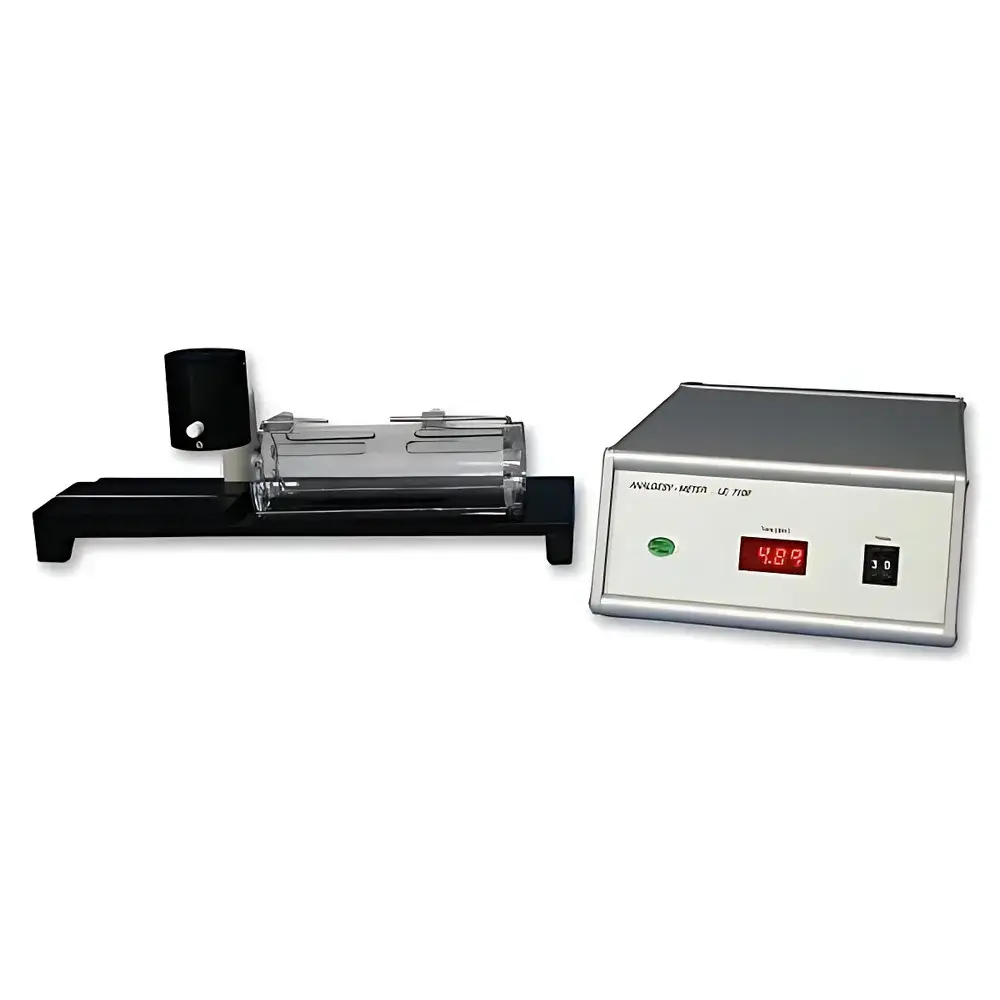
Harvard Apparatus LE7106 Tail Flick Analgesiometer
| Brand | Harvard Apparatus |
|---|---|
| Origin | USA |
| Model | LE7106 |
| Stimulus Source | Halogen lamp |
| Max Stimulus Temperature | 250 °C |
| Ramp Time (40 °C → 250 °C) | ≤10 s |
| Default Cut-off Time | 20 s |
| Adjustable Cut-off Time | Yes |
| Temporal Resolution | 0.1 s |
| Display | 4-digit LED |
| Dimensions (Controller) | 350 × 350 × 130 mm |
| Dimensions (Stimulator) | 400 × 140 × 155 mm |
| Housing Material | Methyl methacrylate |
| Animal Weight Range | 20–400 g |
| Compliance | CE certified |
| Interface | RS232 |
| Optional Software | SeDaCom |
| Footswitch | Included |
| Tail Restraint | Adjustable groove-based fixture for mice and rats |
Overview
The Harvard Apparatus LE7106 Tail Flick Analgesiometer is a precision-engineered thermal nociception testing system designed for objective, reproducible quantification of thermal pain sensitivity in rodents. It operates on the established tail-flick reflex principle: a focused, calibrated halogen light beam delivers controlled radiant heat to the dorsal surface of the animal’s tail; upon detection of the reflexive tail-withdrawal response, the stimulus terminates automatically, and the latency—defined as the time interval between stimulus onset and behavioral response—is recorded with 0.1-second resolution. This method is grounded in validated neurophysiological pathways involving Aδ and C nociceptors and has been widely adopted in preclinical pharmacology for evaluating centrally and peripherally acting analgesic compounds. The LE7106 is not a generic thermal stimulator but a purpose-built instrument engineered for consistency across repeated trials and inter-operator use—critical for longitudinal studies, dose-response characterization, and comparative genotypic phenotyping.
Key Features
- Halogen-based thermal stimulus source with rapid thermal ramping (≤10 s from 40 °C to 250 °C), enabling precise control over stimulus intensity without thermal inertia artifacts.
- Adjustable cut-off time (default 20 s) prevents tissue damage and ensures ethical compliance with IACUC and OECD Guideline 420 requirements for acute toxicity and analgesia testing.
- Dedicated, size-graded tail restraints featuring machined methyl methacrylate grooves—optimized for mice (20–30 g) and rats (200–400 g)—minimize lateral tail movement and standardize irradiated surface area.
- Footswitch-activated remote operation eliminates manual handling during stimulation, reducing experimenter-induced stress and motion artifacts.
- Integrated 4-digit LED display provides real-time latency readout at the bench; no software dependency required for basic assay execution.
- CE-marked construction confirms adherence to EU electromagnetic compatibility (EMC) and low-voltage directives, supporting laboratory integration in GLP-compliant environments.
Sample Compatibility & Compliance
The LE7106 is validated for use with intact, conscious, non-sedated Sprague-Dawley rats, Wistar rats, C57BL/6 mice, and BALB/c mice within the 20–400 g weight range. Animals must be acclimated to handling and restraint prior to testing; naive or highly stressed subjects may exhibit elevated baseline latencies or false negatives due to immobility or hypervigilance—not analgesia. The system excludes animals exhibiting motor deficits, peripheral neuropathy, or dermatological lesions on the tail. Experimental protocols align with NIH Guide for the Care and Use of Laboratory Animals and are compatible with endpoints defined in ASTM E1937–22 (Standard Practice for Conducting Acute Thermal Nociception Assays in Rodents). The fixed irradiation geometry and thermal profile stability support data traceability required under FDA 21 CFR Part 11 when used with SeDaCom and audit-trail-enabled configurations.
Software & Data Management
The optional SeDaCom software suite enables full digital acquisition, timestamped event logging, and batch-wise statistical analysis via RS232 serial interface. SeDaCom supports automated latency export to CSV and Excel formats, group-wise ANOVA-ready dataset structuring, and customizable report generation—including latency distribution histograms and dose–response curve fitting (log-dose vs. %MPE). When deployed in regulated environments, SeDaCom can be configured with user-level access controls, electronic signatures, and audit trails compliant with 21 CFR Part 11 Annex 11 and ISO/IEC 17025 documentation standards. Raw latency values are stored locally in non-volatile memory within the controller unit, ensuring data integrity during power interruption.
Applications
- Preclinical evaluation of opioid, NSAID, and novel small-molecule analgesics across multiple dose levels.
- Characterization of thermal hyperalgesia or hypoalgesia in transgenic rodent models (e.g., TRPV1-KO, Nav1.7 mutant lines).
- Screening for off-target CNS effects during early safety pharmacology assessment (ICH S7A).
- Validation of drug delivery systems targeting peripheral nerve endings (e.g., topical capsaicin analogs, nanoparticle-mediated thermal sensitizers).
- Longitudinal monitoring of pain modulation in chronic inflammatory or neuropathic models—when combined with habituation protocols and intra-subject baseline normalization.
FAQ
What is the maximum recommended exposure time before automatic cut-off?
The default cut-off time is 20 seconds; this value is user-adjustable via front-panel controls to accommodate protocol-specific ethical constraints.
Can the LE7106 be used for both mice and rats without hardware modification?
Yes—the system includes interchangeable tail fixtures with dimensionally optimized grooves for mice (narrow) and rats (wide), ensuring consistent beam alignment and thermal flux density across species.
Is calibration traceable to national standards?
While the LE7106 does not include an onboard NIST-traceable temperature sensor, its halogen lamp output profile and temporal resolution have been validated against reference thermopile measurements per ISO/IEC 17025-accredited methods by Harvard Apparatus’ quality engineering team.
Does the system meet GLP requirements for regulatory submission studies?
When operated with SeDaCom in audit-trail mode, documented SOPs, and routine performance verification (e.g., latency accuracy check using timed pulse generator), the LE7106 supports GLP-compliant data generation per OECD Principles of Good Laboratory Practice.
What maintenance is required to ensure long-term measurement stability?
Annual visual inspection of halogen lamp filament integrity, periodic cleaning of optical path surfaces with lint-free isopropanol wipes, and verification of footswitch continuity constitute the manufacturer-recommended preventive maintenance schedule.





