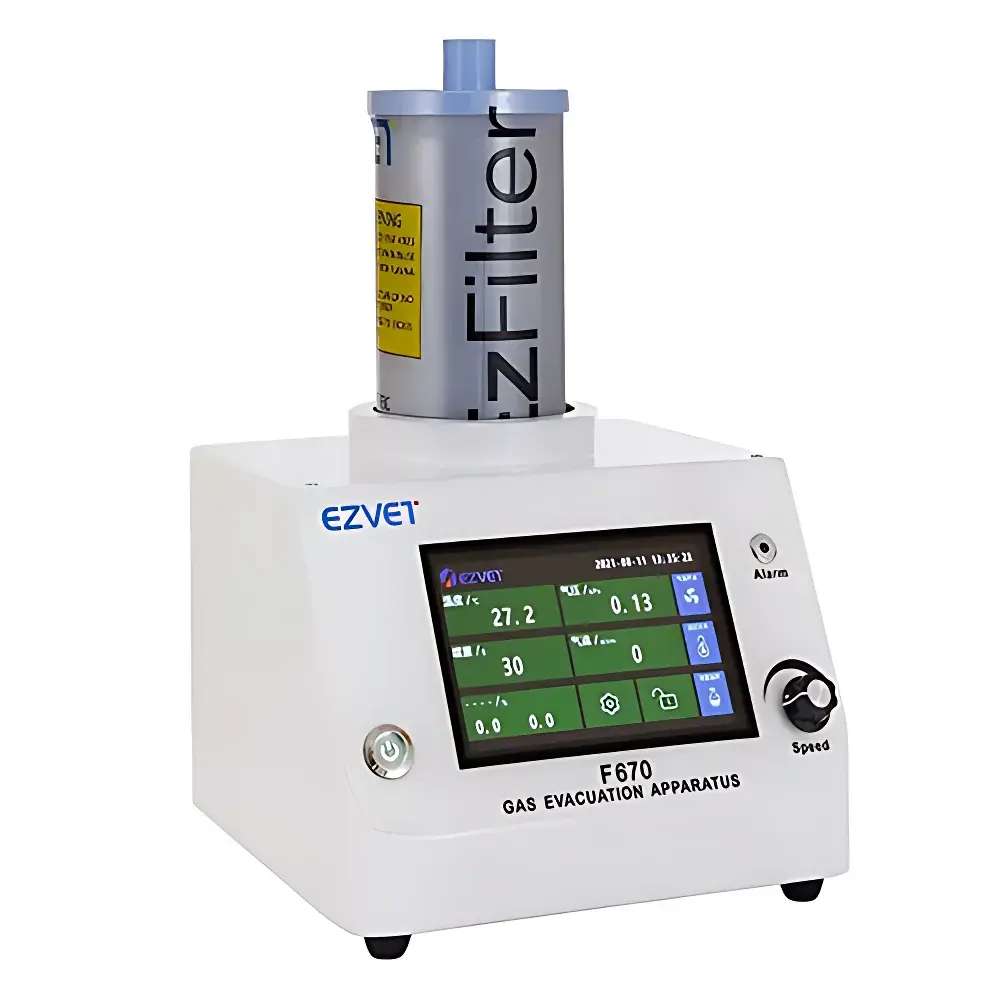
EZ Vet F670 Weight-Based Anesthetic Waste Gas Scavenging System
| Brand | EZ Vet |
|---|---|
| Origin | Beijing, China |
| Manufacturer Type | Authorized Distributor |
| Region of Origin | Domestic (China) |
| Model | F670 |
| Price Range | USD 140 – 700 |
| Flow Rate | 8–60 L/min |
| Filter Initial Mass | 1200 g |
| Replacement Threshold | ≥1400 g |
| Noise Level | <20 dB(A) |
| Compatible Anesthetics | Isoflurane, Sevoflurane, Halothane |
| Not Compatible | Nitrous Oxide (N₂O) |
| Display | Color Touchscreen with Real-Time Flow, Pressure & Mass Readout |
| Safety Alerts | Low-Pressure Alarm, Overweight Filter Alarm, One-Touch Mute Function |
| Regulatory Compliance | Designed for GLP-aligned laboratory environments |
Overview
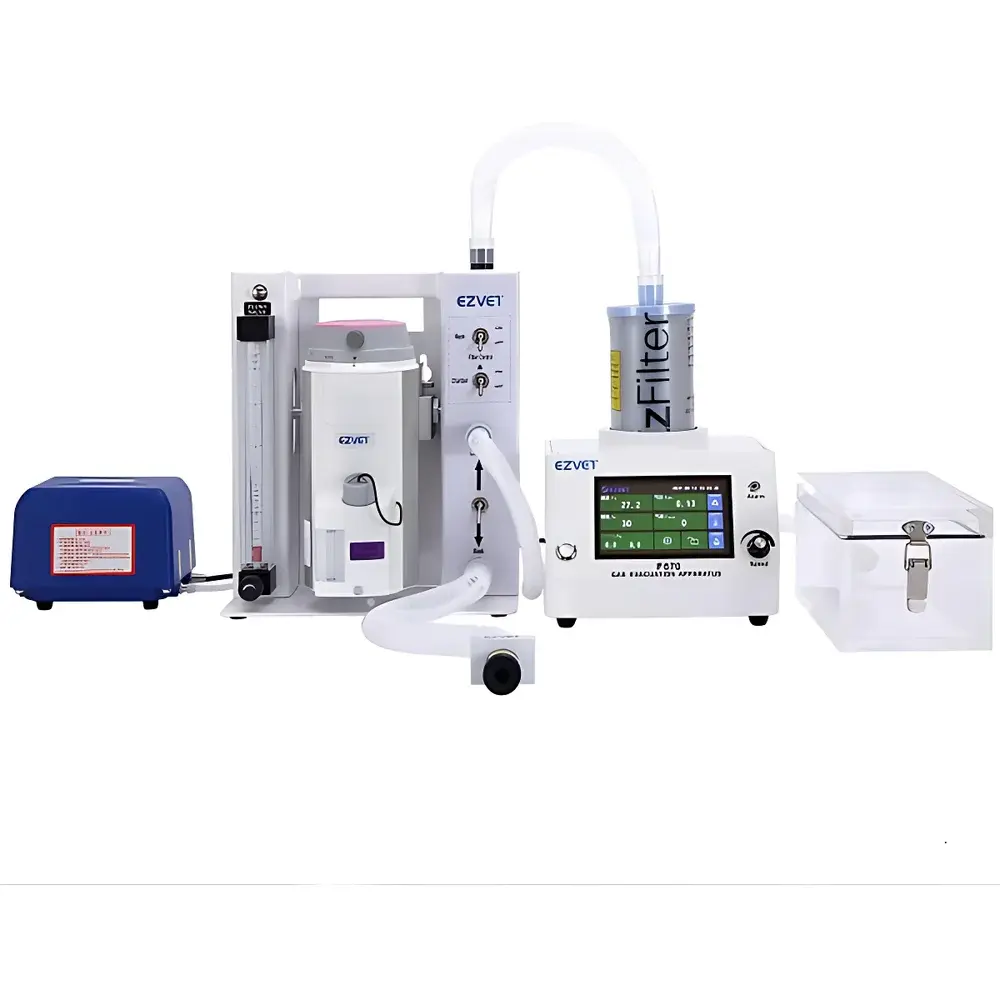
The EZ Vet F670 Weight-Based Anesthetic Waste Gas Scavenging System is an engineered solution for the safe and compliant removal of volatile inhalational anesthetics—specifically isoflurane, sevoflurane, and halothane—from animal anesthesia workspaces. Operating on a negative-pressure scavenging principle, the F670 actively draws exhaled and leaked anesthetic-laden air from induction chambers, nose cones, or non-rebreathing circuits through a dedicated Fluosorber™ activated carbon filter cartridge. Unlike passive charcoal canisters, the F670 integrates real-time mass monitoring to objectively determine filter saturation: the system continuously tracks filter weight via high-resolution load-cell sensing, triggering an audible and visual alert when mass exceeds 1400 g (starting from a nominal 1200 g tare). This eliminates reliance on subjective indicators such as odor detection—a known failure mode, as NIOSH confirms that olfactory perception of isoflurane occurs only above 2 ppm, well beyond its recommended 8-hour time-weighted average exposure limit (REL). The F670 thus serves as a critical engineering control in rodent and small-mammal research labs seeking alignment with OSHA, NIH, and institutional Environmental Health & Safety (EH&S) requirements.
Key Features
- Real-time weight-based filter monitoring with automatic saturation alert at ≥1400 g—ensuring quantifiable, auditable filter lifecycle management
- Adjustable vacuum flow (8–60 L/min) via precision Speed dial, with LED-displayed flow rate and dynamic pressure feedback
- Color touchscreen interface providing simultaneous visualization of flow, differential pressure, filter mass, and alarm status
- Ultra-low-noise architecture (<20 dB[A]) achieved via four-sided acoustic damping and optimized brushless DC motor design—minimizing behavioral disturbance during sensitive behavioral or electrophysiological assays
- One-touch mute function for temporary suppression of saturation alerts without disabling monitoring or data logging
- Modular filter housing compatible with standard 3″ × 6″ cylindrical activated carbon cartridges—including third-party and OEM variants—enabling seamless integration across diverse anesthesia platforms
- Expandable architecture supporting optional add-on modules: analog/anesthetic vapor concentration sensor (0–5% v/v range), ambient temperature regulation (±0.5 °C stability), and digital I/O for lab-wide BMS integration
Sample Compatibility & Compliance
The F670 is validated for continuous use with small-animal inhalational anesthesia systems employing non-rebreathing (open or semi-open) circuits—commonly used in murine, rat, and rabbit models. It effectively captures and retains isoflurane (boiling point 48.5 °C), sevoflurane (58.6 °C), and halothane (50.2 °C) via chemisorption and physisorption within iodinated activated carbon media. It does not retain nitrous oxide (N₂O), consistent with ANSI/ASHRAE Standard 110 and ISO 8573-1 purity class requirements for scavenging system selectivity. While not FDA-cleared as a medical device, the F670 meets functional criteria outlined in NIH Office of Research Facilities (ORF) Guidelines for Inhalational Anesthesia Waste Management and aligns with GLP documentation expectations for maintenance logs, calibration records, and filter replacement traceability. Its mechanical design conforms to IEC 61000-6-3 (EMC emissions) and IEC 61000-6-2 (immunity).
Software & Data Management
The F670 operates embedded firmware (v2.4+) with local data persistence: all flow setpoints, pressure events, filter mass readings, and alarm timestamps are stored onboard for ≥30 days. Export is supported via USB-C dump to CSV format for integration into institutional EH&S audit trails or LIMS. Optional Ethernet/Wi-Fi module enables remote monitoring and centralized fleet management across multi-room vivaria. All alarm conditions—including low suction pressure (<–2 kPa), filter overload, and sensor fault—are timestamped with millisecond resolution and support configurable email/SNMP notifications. Audit log entries comply with ALCOA+ principles (Attributable, Legible, Contemporaneous, Original, Accurate, Complete, Consistent, Enduring, Available) for GLP/GCP environments.
Applications
- Preclinical neuroscience studies requiring stable, undisturbed animal states during fMRI, EEG, or optogenetic stimulation
- Long-duration surgical procedures in transgenic mouse models where consistent anesthetic depth and operator safety must be concurrently maintained
- Vivarium-wide deployment in AAALAC-accredited facilities seeking documented compliance with PHS Policy and Guide for the Care and Use of Laboratory Animals
- Core imaging facilities integrating anesthesia delivery with MRI/PET/CT—where electromagnetic compatibility and acoustic quietness are mandatory
- Teaching laboratories performing hands-on inhalational anesthesia training under faculty supervision
FAQ
How does the F670 determine when the filter requires replacement?
It uses a calibrated internal load cell to monitor total filter mass in real time. When mass increases by ≥200 g from the factory tare value (1200 g → ≥1400 g), the system triggers a dual-mode alert (visual icon + tone) indicating adsorption capacity exhaustion.
Can the F670 be used with nitrous oxide (N₂O)-based anesthesia?
No. The Fluosorber™ carbon formulation is optimized for halogenated ethers and does not retain N₂O. For N₂O scavenging, a separate catalytic or cryogenic capture system is required.
Is calibration of the weight sensor required by the user?
No. The load cell is factory-calibrated with NIST-traceable standards and includes auto-zero compensation during idle periods. Annual verification against certified test weights is recommended for GLP audits.
Does the F670 meet regulatory requirements for use in FDA-regulated preclinical studies?
While the unit itself is not FDA-listed, its performance parameters, documentation capabilities, and alarm traceability support adherence to 21 CFR Part 11 expectations for electronic records when paired with appropriate SOPs and validation protocols.
What maintenance intervals are recommended?
Filter replacement is event-driven (mass-based), not time-based. Mechanical inspection of pump seals and inlet tubing is advised every 6 months; fan filter cleaning every 90 days in high-dust environments.