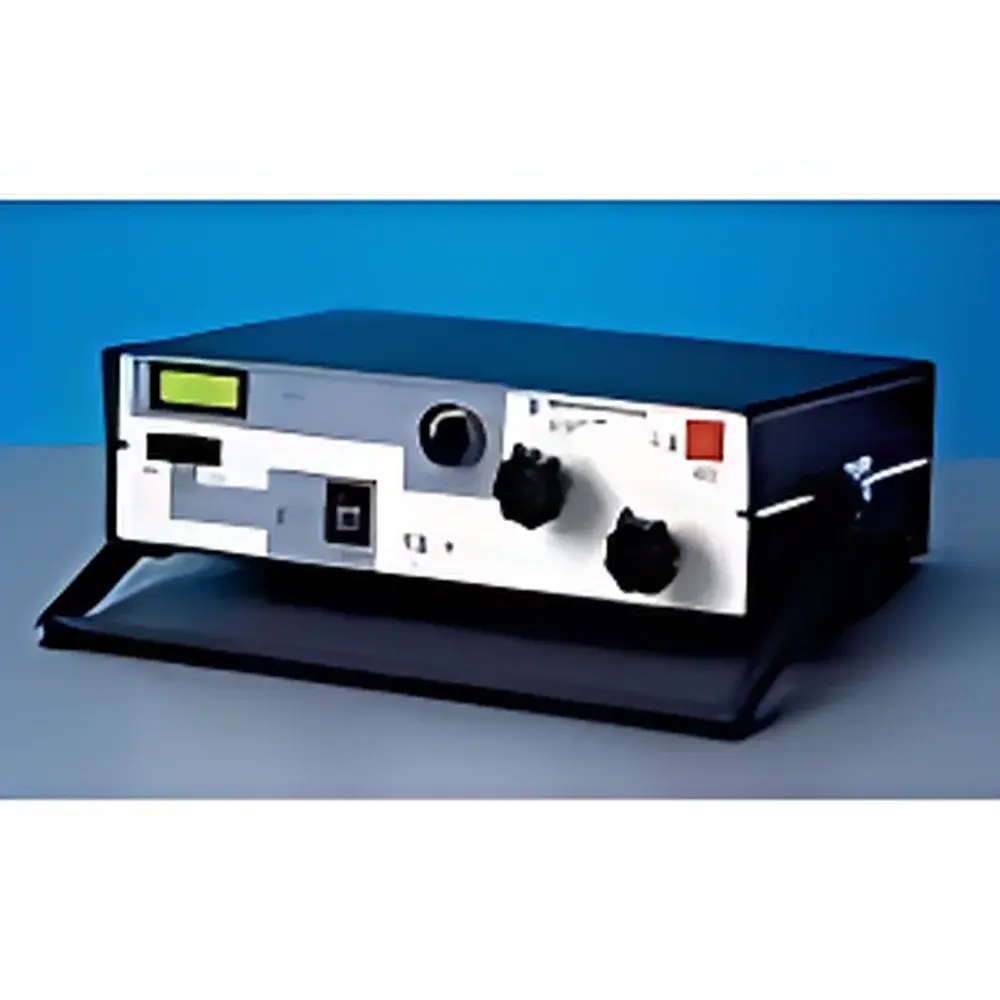
Harvard Apparatus PLI-90A Microinjector
| Brand | Harvard Apparatus |
|---|---|
| Origin | USA |
| Model | PLI-90A |
| Input Pressure | 480–720 kPa (70–105 psi) |
| Injection Pressure Range | 2.8–413 kPa (0.2–60 psi), adjustable via multi-turn control |
| Balance Pressure Range | 6.9–68.9 kPa (0.1–3.5 psi), adjustable via multi-turn control |
| Purge Pressure | Full input pressure, non-adjustable |
| Injection Time | 0.01–0.99 s (10 ms increments) or 1–99 s (1 s increments) |
| Pressure Display | 3.5-digit digital readout |
| Trigger Modes | Footswitch or front-panel switch |
| Timing Modes | Internal timer or external gate control |
| Power Supply | 100/110/220/240 V AC, 50/60 Hz |
| Power Consumption | 220 W |
| Dimensions (H×W×D) | 11 × 38 × 25.5 cm |
| Weight | 6.8 kg |
Overview
The Harvard Apparatus PLI-90A Microinjector is a precision pneumatic microinjection system engineered for reproducible, low-volume fluid delivery in live-cell manipulation, embryology, transgenic model generation, and single-cell electrophysiology applications. Operating on a regulated compressed-air principle, the PLI-90A delivers controlled positive and negative pressure pulses to glass micropipettes—enabling precise aspiration, loading, injection, post-injection balance, and tip clearance without mechanical contact. Its architecture is grounded in Coulter-style pneumatic actuation with analog pressure regulation translated into digital time-domain control, ensuring high reproducibility across repeated injections under variable physiological conditions. Designed for integration with upright and inverted microscopes, the PLI-90A supports rigorous experimental protocols requiring traceable, auditable parameter settings—making it suitable for GLP-compliant developmental biology studies and preclinical cell-line engineering workflows.
Key Features
- Triple-pressure architecture: Independent, digitally displayed control of injection pressure (2.8–413 kPa), balance pressure (6.9–68.9 kPa), and purge pressure (full input line pressure)
- High-resolution timing: Dual-range digital timer—0.01–0.99 s in 10-ms steps for subcellular precision; 1–99 s in 1-s increments for extended perfusion or wash cycles
- Multi-turn analog pressure regulators with digital feedback: Enables repeatable, traceable pressure calibration across users and sessions
- Zero-backflow balance mode: Applies sustained low-pressure counterforce immediately after injection to prevent cytoplasmic reflux and pipette clogging
- Dual trigger options: Front-panel push-button and optional footswitch—supporting hands-free operation during delicate micromanipulation
- External gate compatibility: Synchronizes injection events with electrophysiological recording systems (e.g., patch-clamp amplifiers) or imaging triggers (e.g., TTL pulse from camera or laser stimulator)
- Integrated digital pressure display: 3.5-digit LED readout for real-time monitoring of active pressure mode (injection/balance/purge)
Sample Compatibility & Compliance
The PLI-90A interfaces seamlessly with standard borosilicate or quartz capillaries (1–2 mm OD) pulled to tip diameters ranging from 5 µm. It accommodates both beveled and fire-polished tips and supports injection volumes spanning femtoliters (fL) to microliters (µL), validated through gravimetric calibration per ISO 8655-5 and ASTM E2758. The system complies with IEC 61010-1 for electrical safety in laboratory equipment and meets EMC requirements per IEC 61326-1. While not FDA-cleared as a medical device, its operational parameters and documentation support use in research governed by NIH Guidelines for Recombinant DNA Molecules, AAALAC-accredited animal protocols, and institutional biosafety committee (IBC) approvals. Audit trails are maintained manually via operator logbooks; electronic data capture requires integration with third-party acquisition software supporting timestamped TTL event logging.
Software & Data Management
The PLI-90A operates as a standalone hardware controller with no embedded firmware or proprietary software stack. All parameter configuration—including pressure setpoints, timing intervals, and trigger source selection—is performed via front-panel rotary encoders and tactile switches. Pressure and timing values are retained in non-volatile memory upon power-down. For traceability in regulated environments, users may record settings in laboratory notebooks aligned with 21 CFR Part 11 principles (e.g., user ID, date/time stamp, parameter values, purpose of injection). When integrated with acquisition platforms such as Axon pCLAMP, NIS-Elements, or μManager, the PLI-90A’s TTL-compatible gate input enables synchronized event annotation—facilitating correlation between injection onset and downstream physiological or fluorescent responses.
Applications
- Microinjection of mRNA, CRISPR-Cas9 ribonucleoproteins, or fluorescent dyes into zebrafish, Xenopus, or mouse oocytes and embryos
- Single-cell loading of calcium indicators (e.g., Fura-2, Fluo-4) or optogenetic actuators (e.g., ChR2) in primary neuronal cultures
- Pressure-assisted patch-clamp pipette filling and seal formation in slice electrophysiology
- Controlled cytoplasmic or nuclear delivery in stem cell reprogramming assays
- Calibrated nanoliter dispensing for microfluidic device priming or organoid microinjection
- Cell fixation and permeabilization via controlled osmotic shock using balanced pressure gradients
FAQ
What types of micropipettes are compatible with the PLI-90A?
Standard soda-lime or borosilicate glass capillaries (1.0–2.0 mm outer diameter), pulled using laser or gravity-based pullers, with tip inner diameters from 0.2 µm to 5 µm.
Can the PLI-90A be used for intracytoplasmic sperm injection (ICSI)?
Yes—its balance pressure mode and sub-100-ms timing resolution meet the mechanical requirements for clinical-grade ICSI training systems, though regulatory approval for human ART use must be obtained separately.
Is external pressure regulation required?
Yes—the unit requires a clean, oil-free compressed air supply regulated to 480–720 kPa (70–105 psi); an inline filter and moisture trap are strongly recommended.
How is calibration verified?
Users perform volumetric calibration using calibrated pipettes or gravimetric methods (e.g., injecting into pre-weighed vials on an analytical balance), referencing Harvard Apparatus Application Note AN-PLI-01.
Does the PLI-90A support automated sequential injections?
No—sequential control requires external TTL sequencing via a programmable stimulus generator or DAQ device; the PLI-90A responds to individual gate pulses only.