
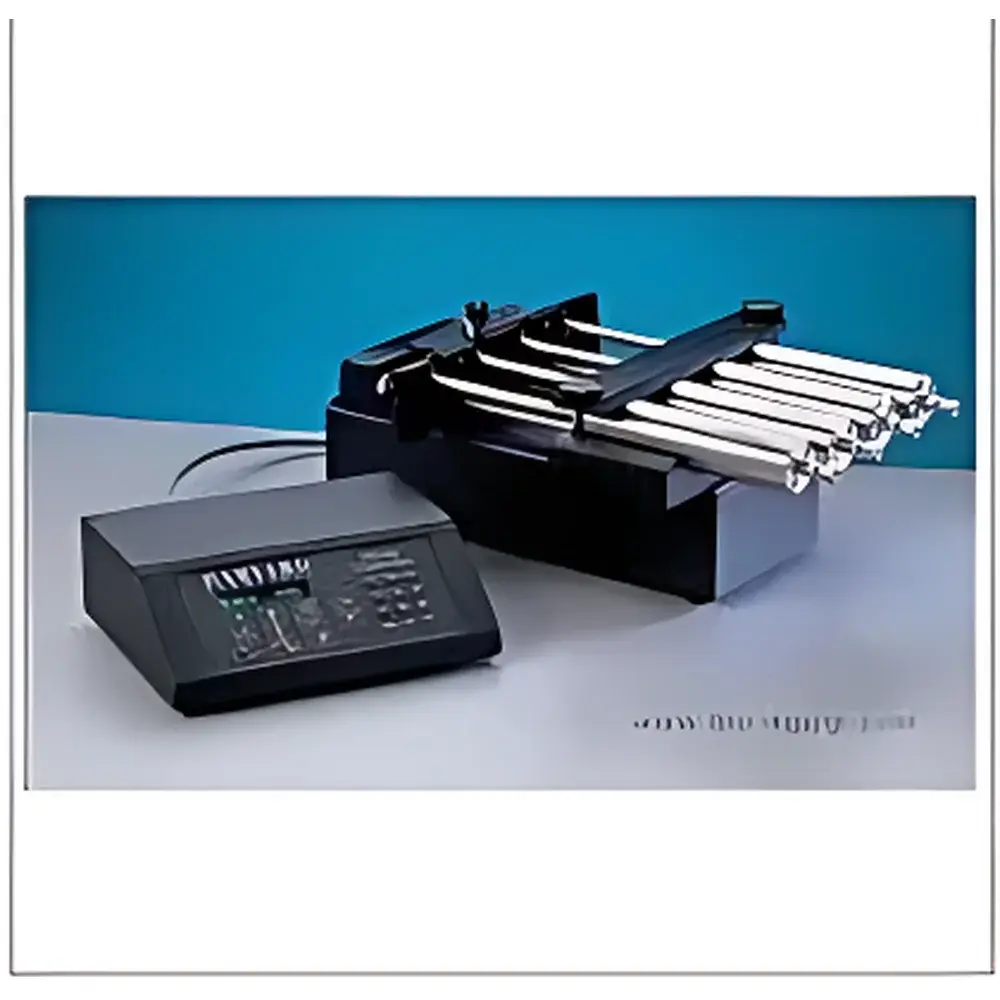
Harvard Apparatus PHD 22/2000 Hpsi High-Pressure Programmable Syringe Pump
| Brand | Harvard Apparatus |
|---|---|
| Origin | USA |
| Model | PHD 22/2000 Hpsi |
| Injection Capacity | up to 800 mL (4 × 200 mL syringes) |
| Max Force Output | 197 kg (433 lbf) |
| Accuracy | ±0.5% (stability), ±0.05% (repeatability) |
| Syringe Range | 20–200 mL stainless steel only |
| Flow Rate | 1.5 µL/hr – 112 mL/min |
| Drive Resolution | 0.0397 µm/step |
| Input Voltage | 100–240 VAC, 50/60 Hz |
| Communication | RS-232 (9-pin D-Sub), TTL, RJ11-4 |
| Control Box Dimensions | 9.5 × 27.9 × 22.9 cm |
| Syringe Mount Dimensions | 22.9 × 43.2 × 30.5 cm |
| Cable Length | 1.5 m (standard), optional 9.1 m extension |
Overview
The Harvard Apparatus PHD 22/2000 Hpsi is a microprocessor-driven, high-force programmable syringe pump engineered for demanding laboratory applications requiring precise, sustained fluid delivery under elevated backpressure. Unlike peristaltic or diaphragm-based systems, this device operates on a precision lead-screw actuation principle—translating motor rotation into linear plunger displacement with sub-micron resolution. Its architecture is optimized for high-viscosity media, corrosive solvents, and closed-system infusions where pressure integrity and volumetric fidelity are non-negotiable. Designed and manufactured in the United States, the PHD 22/2000 Hpsi represents the culmination of Harvard Apparatus’ decades-long expertise in positive-displacement fluid handling—building upon their legacy as pioneers of mechanical-thread-based ultra-micro injection technology.
Key Features
- High-capacity multi-syringe configuration: Supports up to four independently controlled 20–200 mL stainless steel syringes, enabling cumulative infusion volumes up to 800 mL without manual intervention.
- Ultra-high force output: Delivers up to 197 kg (433 lbf) of linear thrust—exceeding all other syringe pumps in the Harvard Apparatus portfolio—making it suitable for applications involving viscous polymer solutions, particle-laden suspensions, or pressurized vascular or microfluidic circuits.
- Programmable keypad interface: Enables full operational control—including flow rate, volume, direction (infuse/withdraw), ramp profiles, and pause/resume sequences—without external computing hardware. Stores up to four user-defined programs, each containing ten discrete steps, retained in non-volatile memory.
- Exceptional metrological performance: Achieves ±0.5% stability accuracy and ±0.05% repeatability across its full operating range, validated under ISO 8536-4 and ASTM D3418 conditions for syringe pump calibration traceability.
- Rugged industrial construction: Utilizes hardened steel drive components, sealed stepper motors, and reinforced aluminum chassis to ensure long-term mechanical integrity and resistance to thermal drift in continuous-duty environments.
- Flexible integration: Equipped with dual communication interfaces—RS-232 (9-pin D-Sub) and TTL-level digital I/O via RJ11-4 connector—for synchronization with data acquisition systems, PLCs, or custom LabVIEW/Automation Studio environments.
Sample Compatibility & Compliance
The PHD 22/2000 Hpsi is exclusively compatible with Harvard Apparatus-certified stainless steel syringes (models 20–200 mL), which are rated for pressures exceeding 10,000 psi and chemically resistant to halogenated solvents, strong acids, and organic bases. These syringes comply with ISO 7886-1 for dimensional consistency and USP for material biocompatibility when used in preclinical dosing studies. The pump itself meets IEC 61010-1 safety requirements for laboratory equipment and supports audit-ready operation under GLP and GMP frameworks through deterministic program execution and timestamped event logging (when paired with compliant software). While not FDA 21 CFR Part 11–certified out-of-the-box, its deterministic firmware behavior and external logging capability enable validation pathways for regulated pharmaceutical or toxicology workflows.
Software & Data Management
Although fully functional via front-panel programming, the PHD 22/2000 Hpsi integrates seamlessly with Harvard Apparatus’ PumpControl™ software suite (Windows-compatible) for advanced protocol design, real-time monitoring, and export of time-stamped volumetric and pressure-event logs in CSV or XML format. All internal program executions are logged with millisecond-resolution timestamps, supporting retrospective analysis and compliance documentation. When connected to networked lab infrastructure, the pump can be incorporated into centralized instrument management platforms using standard SCPI command syntax over RS-232. Firmware updates are performed via serial interface and include version-controlled release notes aligned with ISO 13485 change control practices.
Applications
- High-pressure chromatography sample loading and gradient elution priming in preparative HPLC and SFC systems.
- Controlled intravascular or intracerebroventricular infusion in rodent and large-animal pharmacokinetic studies.
- Delivery of abrasive slurries or nanoparticle dispersions into MEMS-based microreactors and lab-on-chip devices.
- Long-duration solvent exchange protocols in cryo-EM grid preparation and automated tissue processing.
- Calibration and challenge testing of pressure transducers, flow sensors, and leak-detection instrumentation.
FAQ
Can I use glass or plastic syringes with the PHD 22/2000 Hpsi?
No. Only Harvard Apparatus stainless steel syringes (20–200 mL) are mechanically and thermally rated for the pump’s maximum force output and thermal stability requirements.
Is the pump suitable for sterile or ISO Class 5 cleanroom use?
The pump itself is not classified for cleanroom operation; however, its stainless steel syringe interface and absence of internal fluid paths allow full external sterilization of consumables and integration behind laminar flow hoods with appropriate cable routing.
Does the PHD 22/2000 Hpsi support bidirectional flow control?
Yes—it supports both infusion and withdrawal modes with independent parameter definition per step, including dwell periods and directional transitions.
What is the minimum resolvable volume increment?
Based on 0.0397 µm/step resolution and standard 20 mL stainless steel syringe geometry, the theoretical minimum displacement is approximately 1.2 nL per motor step—though practical resolution depends on fluid compressibility and system compliance.
How is calibration verified and maintained?
Calibration is performed at factory using NIST-traceable gravimetric methods. Users may perform routine verification using certified volumetric flasks and analytical balances per ASTM E2758, with results documented in internal log files or external LIMS.
Related Products



