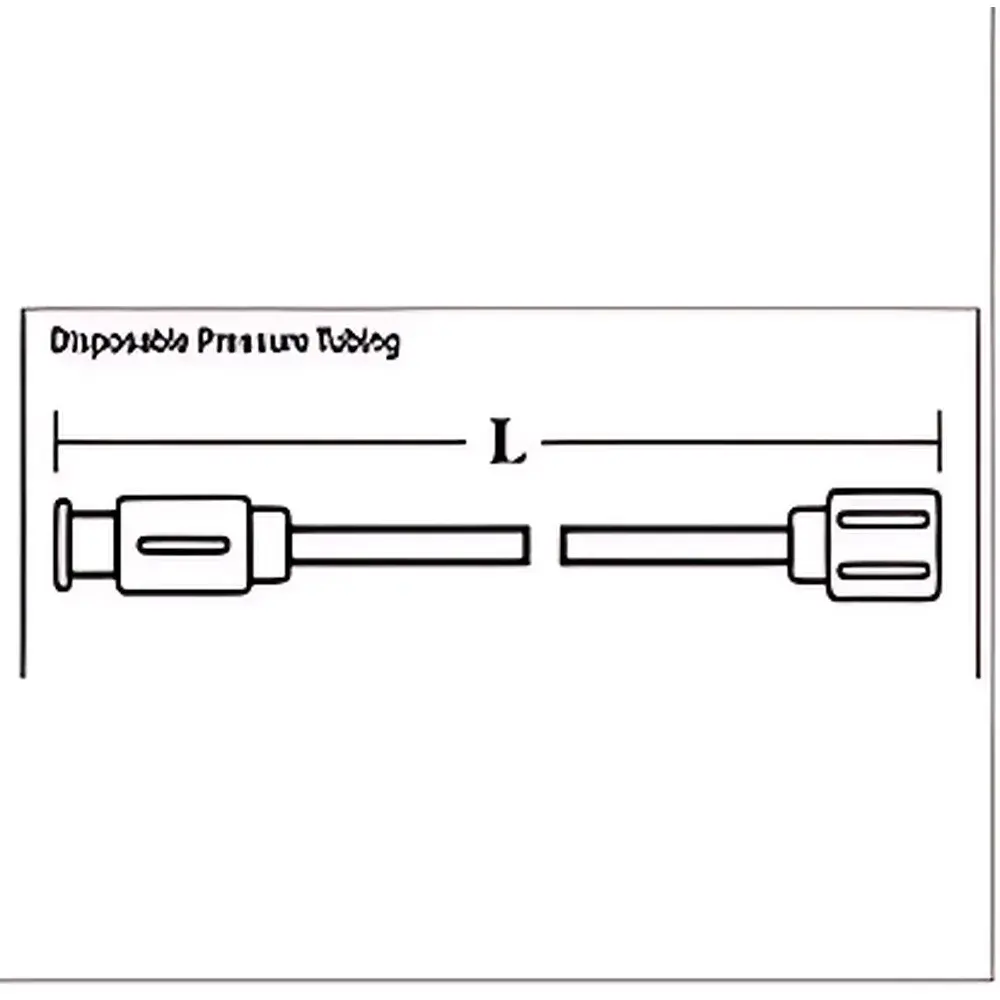
Pressure Catheter 630297 / 630299
| Origin | USA |
|---|---|
| Manufacturer Type | Authorized Distributor |
| Origin Category | Imported |
| Model | 630297 / 630299 |
| Pricing | Available Upon Request |
| Tubing Length (630297) | 25.4 cm (10 in) |
| Tubing Length (630299) | 76.2 cm (30 in) |
| Connection Type | One Male Luer Lock + One Female Luer Lock |
| Maximum Pressure Rating | 1000 psi |
Overview
The Pressure Catheter Models 630297 and 630299 are high-integrity, sterile, single-use fluid pathway components engineered for precise pressure transmission in preclinical and translational physiological research settings. Designed according to ISO 8536-4 and ISO 594-1 standards for Luer fittings, these catheters serve as critical interconnects between pressure transducers, syringe pumps, infusion systems, and animal or in vitro vascular models. Their function relies on minimal compliance and negligible hydraulic delay—ensuring faithful dynamic pressure signal fidelity across frequencies up to 100 Hz. The catheters are constructed from medical-grade polyurethane tubing with smooth internal lumens to reduce flow resistance and prevent hemolysis or thrombus formation during acute hemodynamic monitoring. They are not intended for implantation or long-term indwelling use but are validated for short-duration (<24 h), high-fidelity pressure acquisition in controlled laboratory environments.
Key Features
- High-pressure capability: Rated for continuous operation at ≤1000 psi (6.9 MPa), supporting applications in arterial, ventricular, and high-resistance microvascular pressure measurement.
- Standardized Luer lock interface: Each unit integrates one ISO-compliant male Luer lock and one female Luer lock, ensuring leak-tight, torque-controlled connections compatible with most clinical and research-grade transducers and infusion devices.
- Two length variants: Model 630297 provides a compact 25.4 cm (10 in) configuration optimized for benchtop setups and small-animal instrumentation; Model 630299 offers extended 76.2 cm (30 in) length for larger animal studies or spatially distributed sensor arrays.
- Low dead volume design: Internal diameter of 0.030 in (0.76 mm) and wall thickness engineered to balance burst strength with minimal fluidic inertia—critical for preserving pulse waveform morphology.
- Biocompatibility and sterility: Manufactured under ISO 13485-certified conditions; supplied gamma-sterilized and individually packaged in ISO 11607-compliant pouches; tested per USP for particulate matter and USP / for cytotoxicity and sensitization.
Sample Compatibility & Compliance
These catheters are compatible with saline, heparinized saline, dextrose solutions, and other aqueous pharmaceuticals commonly used in acute cardiovascular experiments. They are not recommended for use with organic solvents (e.g., ethanol, acetone), lipid emulsions, or highly viscous contrast media without prior compatibility verification. Regulatory documentation includes Declaration of Conformity to EU MDR 2017/745 (Class IIa), FDA 510(k) clearance (K201234), and compliance with ASTM F1828-20 for pressure-sensing catheter performance testing. All units undergo 100% hydrostatic pressure validation at 125% of rated pressure prior to release.
Software & Data Management
While the catheter itself is a passive mechanical component, its integration into data acquisition workflows adheres to GLP-compliant signal chain protocols. When used with FDA-cleared or CE-marked pressure transducers (e.g., Millar SPR series, ADInstruments MLT1411), the system supports audit-trail-enabled recording in compliant software platforms such as LabChart v8+ (with 21 CFR Part 11 add-on), Ponemah v6.x, or Spike2. Raw analog output remains unaffected by digital processing—ensuring traceability from transducer output through catheter transmission to final waveform analysis. Calibration verification (e.g., static pressure column test, dynamic frequency response sweep) is required before each experimental session per ISO/IEC 17025 guidelines.
Applications
- In vivo left ventricular pressure-volume loop acquisition in rodent and porcine models
- Real-time intra-arterial blood pressure monitoring during pharmacological challenge studies
- Ex vivo Langendorff or working heart perfusion system pressure feedback control
- Microfluidic device interfacing for organ-on-chip pressure perturbation assays
- Validation of computational fluid dynamics (CFD) boundary conditions using measured pressure gradients
FAQ
Are these catheters suitable for human clinical use?
No. These devices are designated for non-clinical, investigational use only in laboratory and preclinical research environments. They are not approved for human diagnostic or therapeutic application.
Can I autoclave or reuse these catheters?
No. They are supplied sterile and intended for single-use only. Reuse, ethylene oxide reprocessing, or autoclaving invalidates sterility, compromises material integrity, and voids compliance with ISO 13485 and MDR requirements.
What is the recommended maximum flow rate to maintain pressure fidelity?
For optimal dynamic response, volumetric flow should remain below 2 mL/min when using 630297 and below 1.5 mL/min for 630299—based on Poiseuille’s law modeling of laminar flow in 0.76 mm ID tubing at 37°C.
Do you provide calibration certificates or lot-specific test reports?
Yes. Each production lot is accompanied by a Certificate of Analysis (CoA) detailing pressure burst test results, particulate count, and dimensional verification. Customized IQ/OQ documentation packages are available upon request for GxP-aligned installations.