
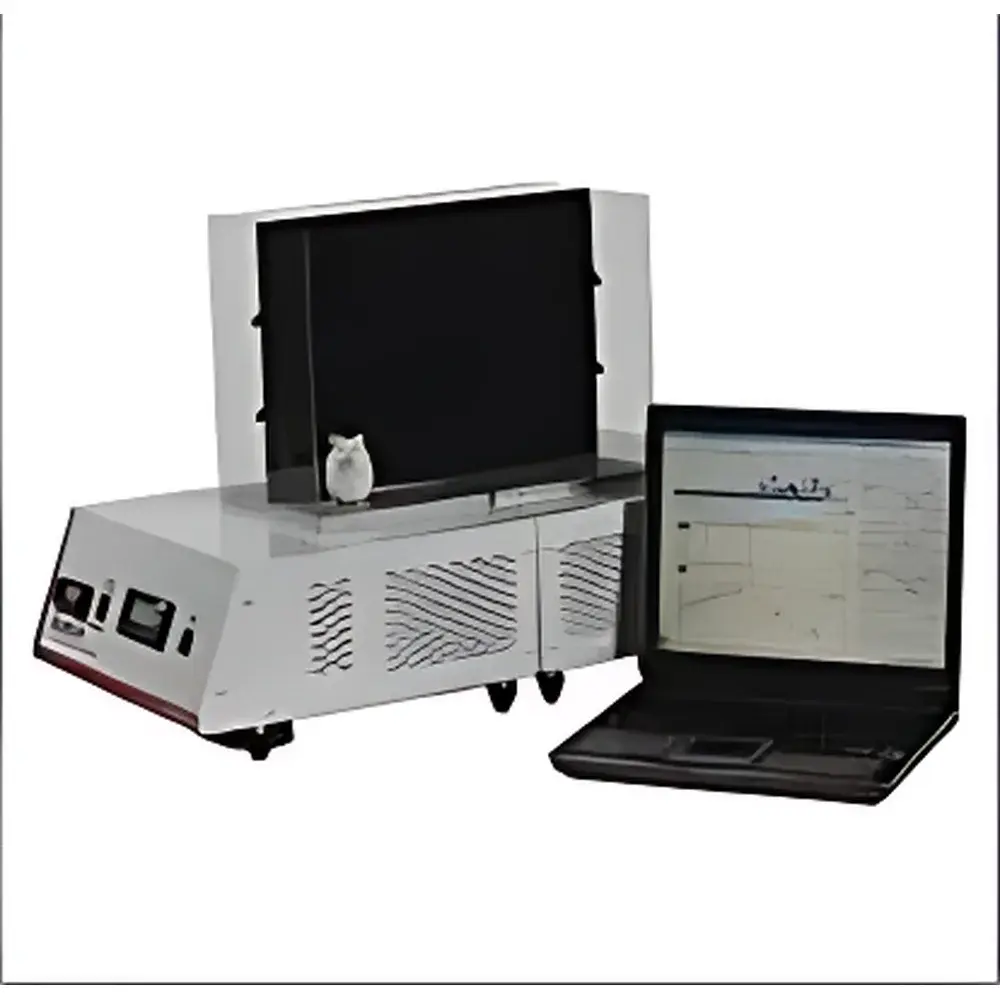
Ugo Basile BIO-T2CT Thermal Place Preference Test System
| Brand | Ugo Basile |
|---|---|
| Origin | Italy |
| Model | BIO-T2CT |
| Temperature Range | –3 °C to 65 °C |
| Temperature Accuracy | ±0.5 °C |
| Chamber Dimensions (L×W×H) | 33 cm × 16.5 cm × 30 cm |
| Overall Unit Dimensions (L×W×H) | 32 cm × 57 cm × 45.5 cm |
| Species Compatibility | 1 rat or 2 mice |
Overview
The Ugo Basile BIO-T2CT Thermal Place Preference Test System is a precision-engineered behavioral assay platform designed for objective, quantitative assessment of thermal nociception and thermosensory preference in rodent models. Based on the principle of operant thermal gradient avoidance/preference, the system enables subjects to freely explore a linear thermal gradient chamber segmented into discrete temperature zones. By measuring time spent, entry frequency, latency to enter, and dwell duration per zone — all under fully automated, non-invasive conditions — the BIO-T2CT delivers high-reproducibility data reflective of central and peripheral thermosensory processing. Unlike reflex-based assays (e.g., tail-flick or hot-plate), this paradigm captures affective-motivational dimensions of pain perception, making it particularly valuable in translational studies of analgesic efficacy, neuropathic pain mechanisms, and thermoregulatory dysfunction. The system operates within a calibrated temperature range of –3 °C to 65 °C with ±0.5 °C accuracy across the entire gradient, ensuring strict experimental control aligned with ISO/IEC 17025 traceability requirements for preclinical instrumentation.
Key Features
- Programmable multi-zone thermal gradient: Up to five independently controlled temperature segments (configurable via intuitive touchscreen interface) enable precise mapping of thermal preference thresholds and aversion boundaries.
- High-resolution synchronized video acquisition: Integrated HD camera with adjustable frame rate and timestamped metadata supports ethogram-based behavioral annotation and retrospective event validation.
- Automated behavioral quantification: Real-time tracking algorithms compute zone occupancy, transition events, velocity profiles, and immobility bouts — all exported in CSV and HDF5 formats for downstream statistical analysis.
- GLP-compliant audit trail: Full electronic record retention including user logins, parameter changes, calibration logs, and raw video archives; supports 21 CFR Part 11–ready configurations with electronic signatures and role-based access control.
- Dual-species flexibility: Optimized chamber geometry accommodates either one adult rat (up to 500 g) or two adult mice (up to 35 g each) without hardware modification; removable floor inserts ensure consistent thermal coupling across species.
- Thermal stability architecture: Peltier-based heating/cooling modules with PID feedback loops maintain setpoint stability within ±0.2 °C over 60-minute continuous operation, minimizing thermal drift during extended trials.
Sample Compatibility & Compliance
The BIO-T2CT is validated for use with Sprague-Dawley and Wistar rats, C57BL/6, BALB/c, and CD-1 mice. Its enclosed, low-stress environment minimizes confounding variables such as air currents, ambient light gradients, or acoustic interference. All thermal sensors are NIST-traceable and recalibrated annually per manufacturer specifications. The system meets essential design criteria outlined in OECD Test Guideline 428 (Skin Absorption) for environmental control integrity and adheres to Annex II of Directive 2010/63/EU regarding refinement of thermal nociception assays. Data output structures comply with MIAME and MINSEQE metadata standards for integration into institutional ELN systems.
Software & Data Management
Control and analysis are executed via Bioseb’s proprietary T2CT Suite v3.2 (Windows 10/11 64-bit), featuring modular workflows for protocol definition, real-time monitoring, batch processing, and statistical visualization. Raw thermal and positional datasets are stored in encrypted SQLite databases with SHA-256 checksums. Export options include ANSI-compliant ASCII files compatible with GraphPad Prism, R, Python (pandas), and MATLAB. Audit logs capture every user action with ISO 8601 timestamps, IP addresses (for network deployments), and hash-verified parameter snapshots — satisfying FDA GLP inspection readiness and internal QA audits.
Applications
- Evaluation of opioid and non-opioid analgesics across dose-response curves, including detection of paradoxical hyperalgesia.
- Characterization of thermal allodynia and hyperalgesia in chronic constriction injury (CCI), spared nerve injury (SNI), and streptozotocin-induced diabetic neuropathy models.
- Pharmacological profiling of TRP channel modulators (e.g., TRPV1 antagonists, TRPM8 agonists) through shift analysis of cold/heat preference thresholds.
- Genetic screening of thermosensory mutants (e.g., TRPA1-KO, Nav1.7-deficient lines) using unsupervised clustering of spatial-temporal occupancy patterns.
- Longitudinal assessment of thermoregulatory deficits in neurodegenerative models (e.g., APP/PS1, MPTP-treated mice).
FAQ
What is the minimum acclimation time required before testing?
Animals must undergo a minimum 30-minute habituation period in the apparatus at uniform 25 °C prior to gradient initiation to establish baseline exploratory behavior.
Can the system be integrated with third-party electrophysiology or optogenetics rigs?
Yes — TTL-compatible trigger I/O ports support synchronized stimulation onset with thermal zone entry events; API documentation is provided for LabVIEW, MATLAB, and Python integration.
Is calibration certification included with shipment?
Each unit ships with a factory-issued calibration certificate traceable to INRIM (Istituto Nazionale di Ricerca Metrologica), valid for 12 months from date of installation.
How is thermal uniformity verified across the chamber width?
A 9-point grid validation (per ASTM E2203) is performed during commissioning using a calibrated micro-thermocouple array; deviation remains ≤±0.3 °C across the 16.5 cm width.
Does the software support blinded experimental designs?
Yes — randomization modules assign group IDs post-acquisition, and analysis pipelines operate on anonymized dataset identifiers to eliminate operator bias during quantification.





