
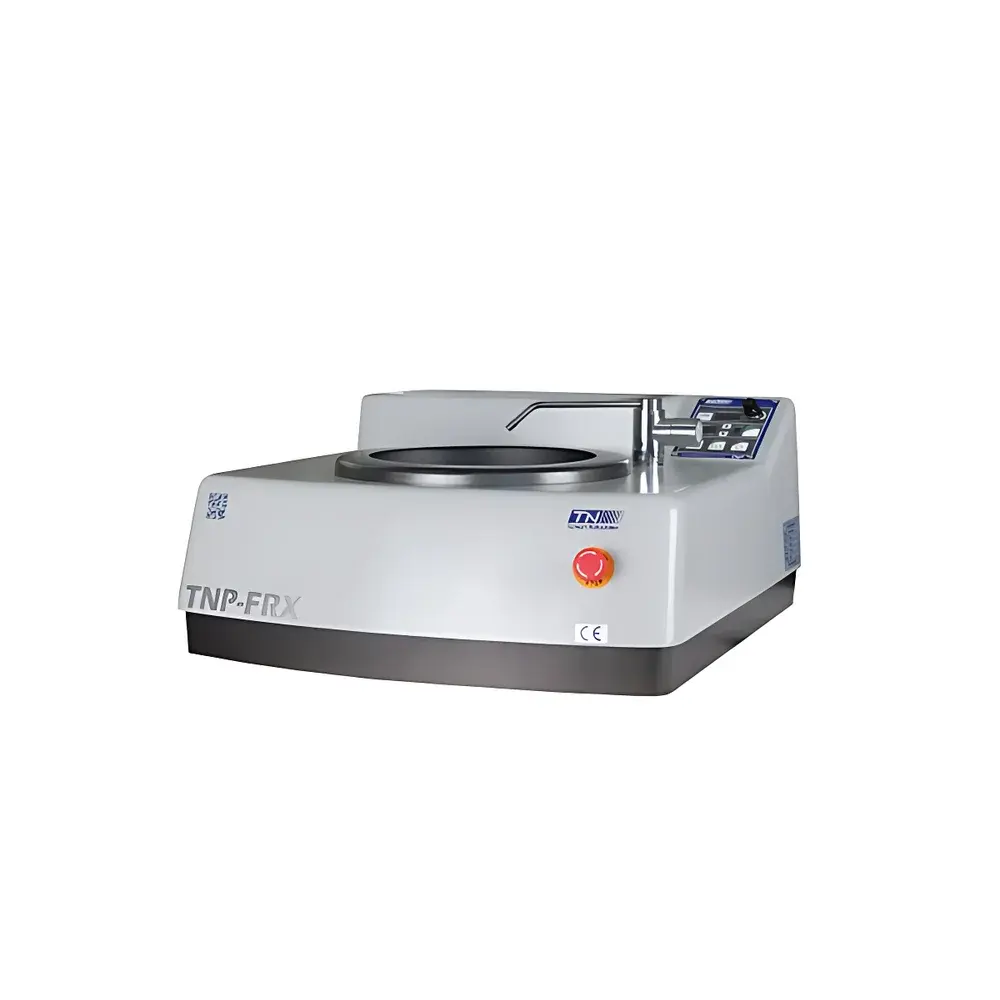
TN Testing TNP-1020FRX Manual Single-Disc Metallographic Grinder-Polisher
| Brand | TN Testing |
|---|---|
| Origin | Taiwan |
| Model | TNP-1020FRX |
| Dimensions (L×W×D) | 556 × 652 × 568 mm |
| Grinding/Polishing Plate Count | 1 |
| Plate Diameter | 200 mm |
| Plate Speed | 800 rpm |
| Construction | Cast Aluminum Base with FRP Enclosure |
| Cooling System | Stainless Steel–Ceramic Adjustable Spray Nozzle |
| Control Interface | Waterproof Membrane Keypad with 9-Step Parameter Memory |
| Water Pathway | Anti-Clogging Triangular Flow Design |
| Optional Accessory | Removable Stain-Resistant Liner |
Overview
The TN Testing TNP-1020FRX is a manually operated, single-disc metallographic grinder-polisher engineered for precision sample preparation in metallurgical, materials science, and quality control laboratories. It employs conventional abrasive grinding and cloth-based polishing mechanisms—relying on controlled mechanical removal via rotating 200 mm-diameter plates under consistent pressure and coolant delivery. Designed for reproducible planar surface generation prior to optical or electron microscopy analysis, the system adheres to core ASTM E3, ISO 14487, and GB/T 13298 material preparation principles. Its cast aluminum structural base—distinct from conventional cast iron alternatives—provides superior vibration damping and thermal stability during extended operation, directly contributing to improved flatness uniformity across specimen surfaces and reduced acoustic emission in shared lab environments.
Key Features
- Robust cast aluminum base with integrated high-efficiency transmission assembly, minimizing operational vibration and enhancing long-term dimensional stability.
- Quick-change plate system compatible with standard diamond-impregnated grinding discs and woven polishing cloths; magnetic adapter interface enables tool-free disc mounting and rapid consumable swaps.
- Stainless steel–ceramic spray nozzle—co-engineered with industrial sanitary fixture manufacturers—delivers precisely angled, adjustable coolant flow optimized for metallographic abrasion control and heat dissipation.
- Waterproof membrane keypad with nine programmable parameter sets, storing independent configurations for rotation speed (up to 800 rpm), cycle duration, and coolant activation timing per step.
- Triangular-section water channel architecture reduces sediment accumulation risk by shortening flow path length, optimizing internal angles, and utilizing corrosion-resistant polymer tubing.
- FRP (fiberglass-reinforced polymer) outer enclosure resists chemical splashes and particulate adhesion, facilitating wipe-down maintenance without solvent exposure.
Sample Compatibility & Compliance
The TNP-1020FRX accommodates standard metallographic specimens up to 40 mm in diameter mounted in thermosetting resin (e.g., phenolic or epoxy), as well as softer non-ferrous alloys, ceramics, and composites requiring low-pressure finishing. Its mechanical design conforms to IEC 61000-6-2 (immunity) and IEC 61000-6-4 (emission) electromagnetic compatibility standards. The unit supports GLP-aligned documentation practices through manual logbook integration and is routinely deployed in facilities maintaining ISO/IEC 17025-accredited testing workflows. While not inherently automated for regulatory audit trails, its repeatable parameter memory function enables traceable process replication when paired with external procedural SOPs.
Software & Data Management
The TNP-1020FRX operates without embedded firmware or network connectivity—its control logic resides entirely in hardware-based microcontroller logic. All operational parameters are stored locally in non-volatile memory and recalled via tactile keypad input. No software installation, license management, or cybersecurity configuration is required. This architecture eliminates validation overhead associated with computerized systems under FDA 21 CFR Part 11 or EU Annex 11, making it suitable for regulated environments where simplicity, reliability, and deterministic behavior are prioritized over digital data capture. Process records must be maintained externally using laboratory notebooks or LIMS-integrated manual entry.
Applications
- Preparation of ferrous and non-ferrous alloy cross-sections for grain structure evaluation per ASTM E112.
- Surface leveling of sintered powder metallurgy parts prior to porosity quantification (ASTM B276).
- Routine QC grinding/polishing of weld joints in aerospace or power generation components.
- Specimen thinning for subsequent ion milling or focused ion beam (FIB) sectioning.
- Teaching laboratories requiring durable, intuitive equipment for undergraduate metallurgy instruction.
FAQ
Is the TNP-1020FRX compliant with ISO 14487 for metallographic specimen preparation?
Yes—the mechanical consistency, plate flatness tolerance, and coolant delivery repeatability align with the procedural requirements outlined in ISO 14487 for manual grinding and polishing stages.
Can the unit be used with electrochemical polishing accessories?
No—this is a purely mechanical grinder-polisher; it lacks electrical output ports, current regulation, or electrolyte containment features required for electropolishing.
What maintenance intervals are recommended for the transmission unit?
Under typical academic or industrial QC usage (≤4 hrs/day), gear oil inspection is advised every 12 months; replacement only if viscosity degradation or metallic particulate contamination is observed.
Does the optional removable liner meet USP Class VI biocompatibility standards?
No—the liner is constructed from food-grade polypropylene for cleanability, not pharmaceutical-grade polymer; it is not certified for direct contact with drug substances.
Is the 800 rpm plate speed adjustable in real time during operation?
Yes—speed is continuously variable within the 0–800 rpm range using the front-panel rotary encoder; no shutdown or mode switching is required.



