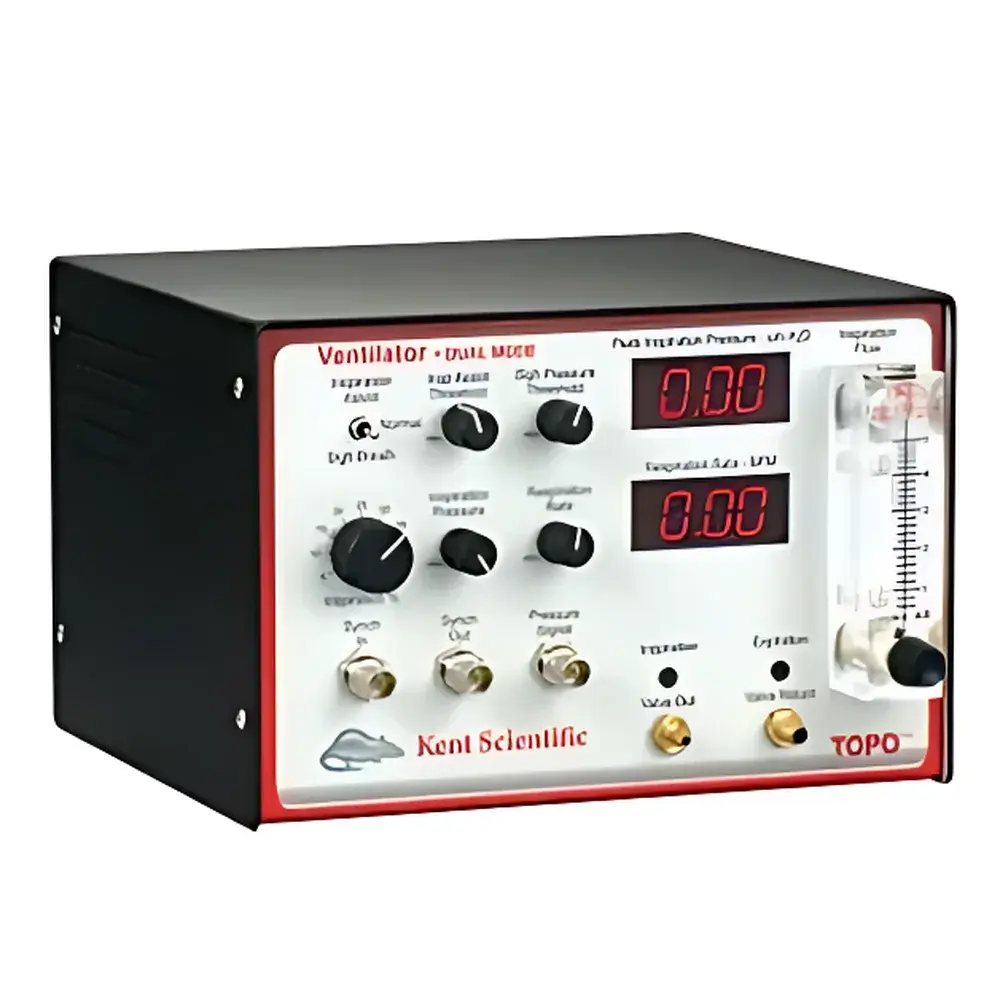
Harvard Apparatus TOPO Animal Ventilator
| Brand | Harvard Apparatus |
|---|---|
| Origin | USA |
| Manufacturer Type | Authorized Distributor |
| Origin Category | Imported |
| Model | TOPO |
| Pricing | Upon Request |
Overview
The Harvard Apparatus TOPO Animal Ventilator is a microprocessor-controlled, electrically powered ventilatory support system engineered for precision and flexibility in preclinical research. Unlike pneumatically driven ventilators requiring high-pressure gas sources, the TOPO operates independently using an integrated brushless DC motor and precision flow control valves—enabling safe, quiet, and MRI-compatible operation in shielded imaging environments. It employs dual-mode ventilation architecture based on established clinical respiratory physiology principles: pressure-controlled (PCV) and volume-controlled (VCV) ventilation, both compliant with fundamental gas exchange theory and lung protective ventilation strategies. The device supports spontaneous breathing synchronization via pressure-triggered assist modes and incorporates physiological adjuncts—including sigh ventilation and PEEP—to mitigate atelectasis, improve V/Q matching, and maintain alveolar recruitment during prolonged anesthesia or critical care modeling. Designed for translational fidelity, the TOPO bridges bench-to-bedside methodology by replicating human ventilator logic in rodent, rabbit, porcine, and non-human primate models.
Key Features
- Electrically actuated, oil-free, and MRI-safe design—no external compressed air or oxygen supply required
- Dual ventilation modes: Pressure-Controlled Ventilation (PCV) with dynamic tidal volume compensation and Volume-Controlled Ventilation (VCV) with pressure capping
- Three operational modes: Controlled Mandatory Ventilation (CMV), Assisted Spontaneous Breathing (ASB), and Sigh Ventilation (SIGH) with adjustable interval and amplitude (1.5–2× baseline tidal volume or pressure)
- Integrated PEEP (Positive End-Expiratory Pressure) control to counteract intrinsic PEEP and enhance functional residual capacity
- Real-time analog pressure waveform display and digital readout of airway pressure, trigger threshold, inspiratory/expiratory ratio, and breath-by-breath event logging
- Fail-safe pressure-limiting sensor and automatic circuit disconnect upon overpressure detection (>30 cmH₂O)
- Full rotary-knob interface—no touchscreen or software dependency—ensuring intuitive, glove-compatible operation in sterile or high-humidity lab settings
Sample Compatibility & Compliance
The TOPO platform accommodates a broad species-weight range: 10 g–10 kg (TOPO standard) and 10–50 kg (TOPO LG variant), supporting murine, guinea pig, rat, rabbit, ferret, canine, ovine, and porcine models. Its modular gas pathway permits seamless integration with vaporizer-based anesthetic delivery systems (e.g., isoflurane, sevoflurane) without flow interference. All internal wetted materials comply with USP Class VI biocompatibility standards; the device meets IEC 61000-4 electromagnetic immunity requirements for laboratory use and conforms to ISO 13485–aligned quality management practices. While not FDA-cleared for human use, its operational logic aligns with ASTM F2797 (Standard Guide for Preclinical Ventilator Performance Testing) and supports GLP-compliant study documentation when paired with validated data capture workflows.
Software & Data Management
The TOPO operates as a standalone hardware controller with no embedded OS or network stack—eliminating cybersecurity vulnerabilities and ensuring deterministic real-time response. Analog pressure output (0–5 V) and TTL-compatible breath-trigger signals are provided for integration with third-party acquisition systems (e.g., LabChart, Spike2, MATLAB). Optional analog-to-digital converter modules enable timestamped CSV export of pressure, flow, and trigger events for post-hoc analysis. Audit trails are maintained via external electronic lab notebooks (ELN); while the device itself does not implement 21 CFR Part 11 electronic signature controls, its deterministic behavior and hardware-based parameter locking support GxP-aligned validation protocols when deployed within documented SOP frameworks.
Applications
- Acute and chronic respiratory physiology studies—including ARDS, COPD, and pulmonary fibrosis modeling
- Neuroimaging-supported functional studies (fMRI, PET-MRI) requiring silent, non-magnetic ventilation
- Anesthesia maintenance during surgical procedures with concurrent gas anesthetic delivery
- Pharmacodynamic evaluation of bronchodilators, neuromuscular blockers, and respiratory stimulants
- Cardiopulmonary bypass and extracorporeal membrane oxygenation (ECMO) support validation in large-animal models
- Development and verification of closed-loop ventilation algorithms under controlled hypoxia/hypercapnia challenges
FAQ
Does the TOPO require a high-pressure gas source?
No. It is fully electrically powered and generates airflow via an internal brushless motor and precision valve assembly.
Can the TOPO be used inside a 3T MRI scanner room?
Yes. Its non-magnetic construction, absence of ferromagnetic components, and lack of RF-emitting electronics make it suitable for MRI-conditional use per ASTM F2503 labeling guidelines.
How does the sigh mode function physiologically?
SIGH delivers periodic augmented breaths (1.5–2× baseline tidal volume or pressure) to recruit collapsed alveoli, counteract time-dependent atelectasis, and sustain gas exchange efficiency during extended ventilation periods.
What safety mechanisms prevent barotrauma?
A redundant pressure transducer array continuously monitors proximal airway pressure; if the preset limit (max 30 cmH₂O) is exceeded, the system halts inspiration and opens the expiratory valve within <15 ms.
Is PEEP adjustable, and what is its physiological role in animal models?
PEEP is continuously adjustable from 0–15 cmH₂O. It prevents end-expiratory alveolar collapse, improves oxygenation, and offsets auto-PEEP generated during expiratory flow limitation—particularly relevant in obstructive disease models.