
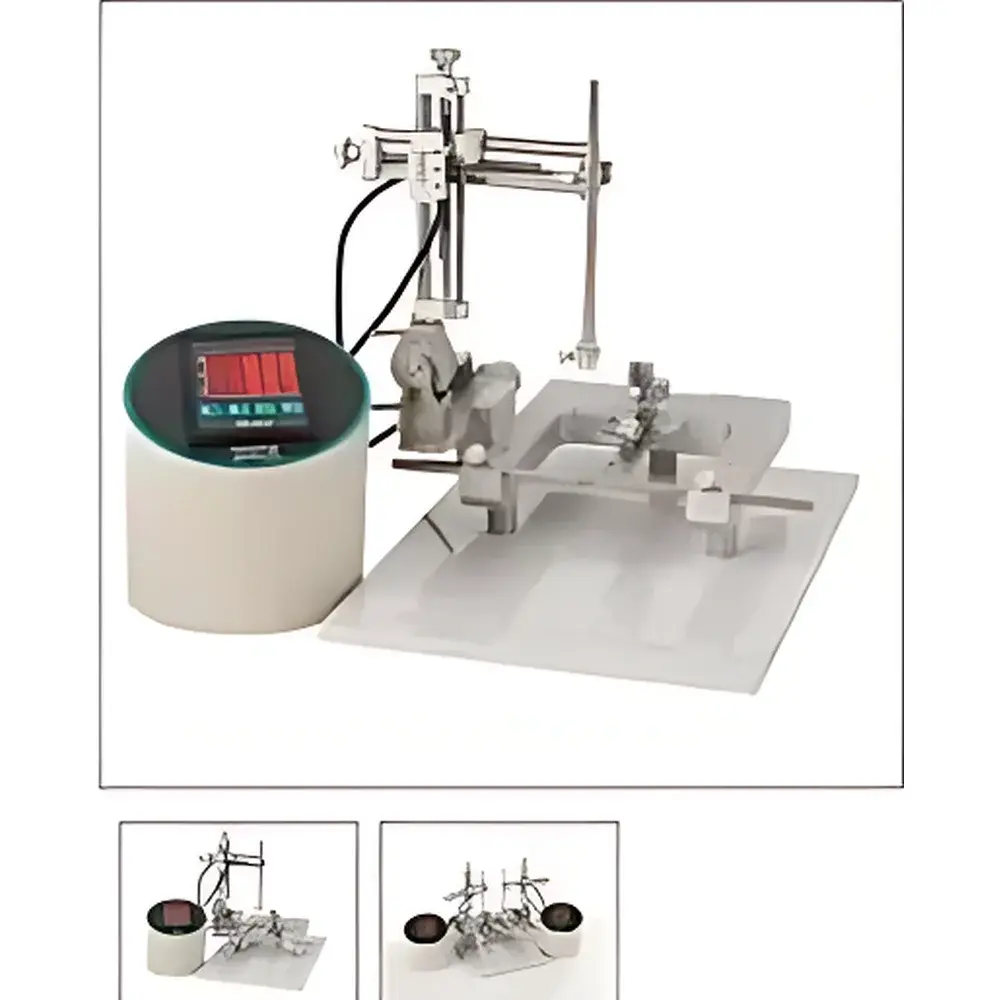
Stoelting Digital Display Stereotaxic Instrument
| Origin | USA |
|---|---|
| Manufacturer Type | Authorized Distributor |
| Origin Category | Imported |
| Model | Stoelting |
| Pricing | Upon Request |
Overview
The Stoelting Digital Display Stereotaxic Instrument is a precision-engineered neurosurgical alignment system designed for reproducible, high-accuracy intracranial targeting in rodent and small-animal neuroscience research. Built upon the foundational principles of stereotaxic coordinate geometry—where anatomical landmarks are mapped to a standardized 3D brain atlas—the instrument enables sub-millimeter spatial registration relative to bregma or lambda reference points. Unlike analog counterparts relying on vernier scales and manual interpolation, this system integrates sealed, non-contact electronic position sensors directly into each manipulator axis (anterior–posterior, medial–lateral, dorsal–ventral), delivering real-time digital readouts with ±10 µm resolution. Its rigid aluminum alloy frame and low-backlash micrometer drives ensure mechanical stability during chronic electrode implantation, viral vector injection, or optogenetic fiber placement—critical for longitudinal studies requiring consistent target reproducibility across cohorts.
Key Features
- Integrated 3-axis digital display with direct coordinate readout—no external monitor or cabling required
- Hermetically sealed linear position sensors mounted on each manipulator arm, eliminating dust ingress and mechanical wear
- ±10 µm positional resolution per axis, validated against NIST-traceable calibration standards
- Zero-point memory function: user-selectable origin reset at any physical location on the stereotaxic grid, enabling rapid repositioning without recalculating offsets
- Compact, space-efficient design with integrated battery compartment—powered by standard CR2032 coin cells (typical service life: 12–18 months under normal lab use)
- Modular arm configuration compatible with Stoelting’s full ecosystem of accessories, including hydraulic microdrives, electrode holders, and laser ablation adapters
Sample Compatibility & Compliance
The instrument supports stereotaxic surgery across common preclinical models, including mice (C57BL/6, BALB/c), rats (Sprague-Dawley, Wistar), and ferrets. Head fixation is achieved via calibrated ear bars and incisor plate with adjustable torque control to minimize cranial deformation. All materials comply with ISO 10993-5 (biological evaluation of medical devices) for cytotoxicity and are autoclavable (up to 121°C, 20 min) for GLP-compliant facility reuse. The digital readout firmware adheres to IEC 62304 Class B software safety requirements, and audit trail functionality—including timestamped coordinate logs and user ID tagging—is available via optional USB data export for 21 CFR Part 11–aligned workflows.
Software & Data Management
While the core unit operates as a standalone hardware system, optional companion software (Stoelting NeuroLink v3.2) enables synchronized coordinate logging, experimental session annotation, and batch export to CSV or MATLAB-compatible .mat formats. Data files include embedded metadata: operator ID, date/time stamp, animal ID, atlas version (e.g., Paxinos & Watson 7th Ed.), and calibration status flag. All exported datasets maintain traceability for regulatory submissions under FDA GLP guidelines or EMA Annex 11 requirements. Firmware updates are delivered via encrypted USB key with SHA-256 signature verification.
Applications
- Precise intracerebral injection of AAV vectors, lentiviruses, or pharmacological agents
- Chronic implantation of tetrodes, silicon probes, or EEG depth electrodes
- Targeted optogenetic fiber optic cannula placement in defined nuclei (e.g., VTA, BLA, mPFC)
- Lesion studies using electrolytic or thermocoagulative methods with coordinate-based repeatability
- Validation of functional MRI or PET targeting protocols through post-hoc histological correlation
- Training platform for stereotaxic technique standardization across multi-investigator labs
FAQ
Is the digital display powered solely by the internal coin cell battery?
Yes—the display draws power exclusively from two CR2032 batteries; no AC adapter or external power supply is required.
Can the instrument be calibrated in-house without sending it to service?
Yes—built-in calibration mode allows users to perform axis-specific zero-offset verification using a certified gauge block set (NIST-traceable, 10 mm ±0.5 µm).
Does the system support third-party manipulators or only Stoelting-branded arms?
It is mechanically and electronically optimized for Stoelting’s 51600-series manipulators; integration with non-Stoelting arms is not supported due to proprietary sensor interface protocols.
What is the maximum weight load capacity of the manipulator arms?
Each axis supports up to 1.2 kg static load without drift or hysteresis—sufficient for dual-electrode carriers, microinjection pumps, or lightweight imaging modules.
How often does the system require recalibration for GLP-regulated studies?
Per ISO/IEC 17025 recommendations, full calibration verification is advised every 6 months or after 200 surgical procedures—whichever occurs first.





