
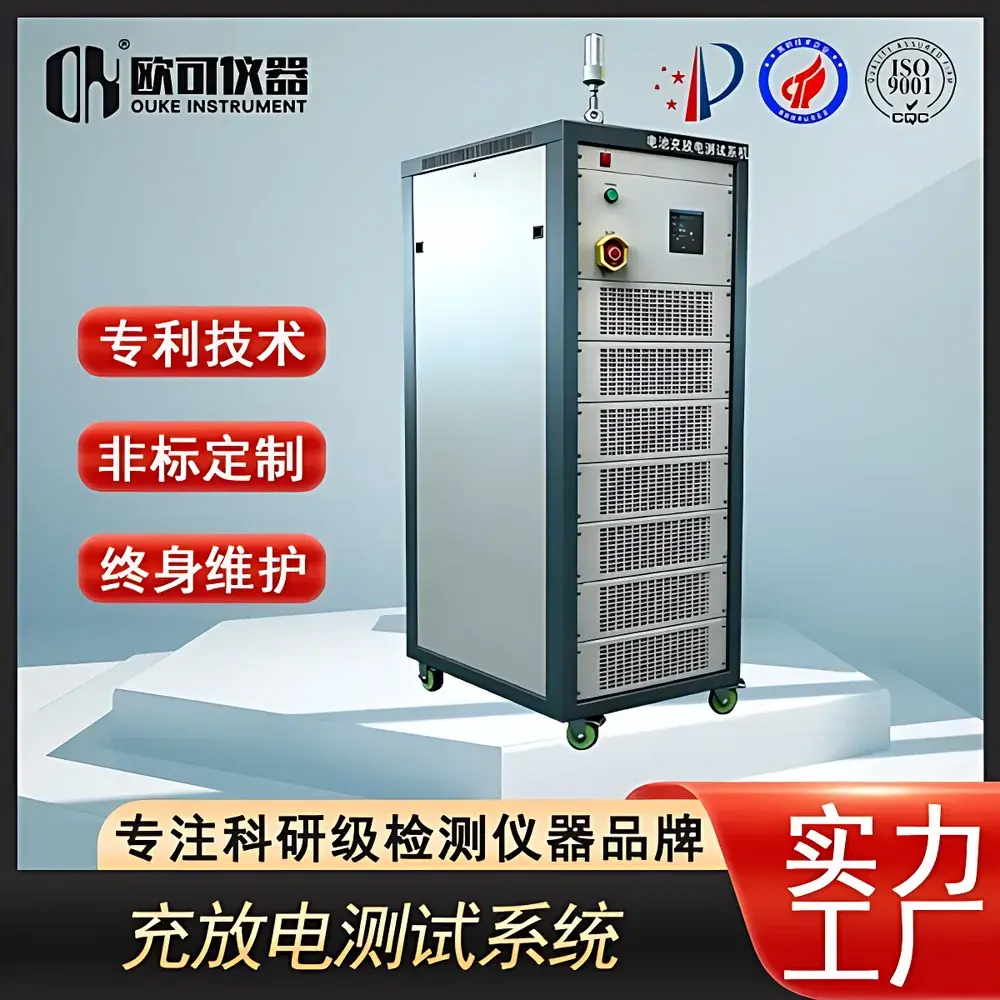
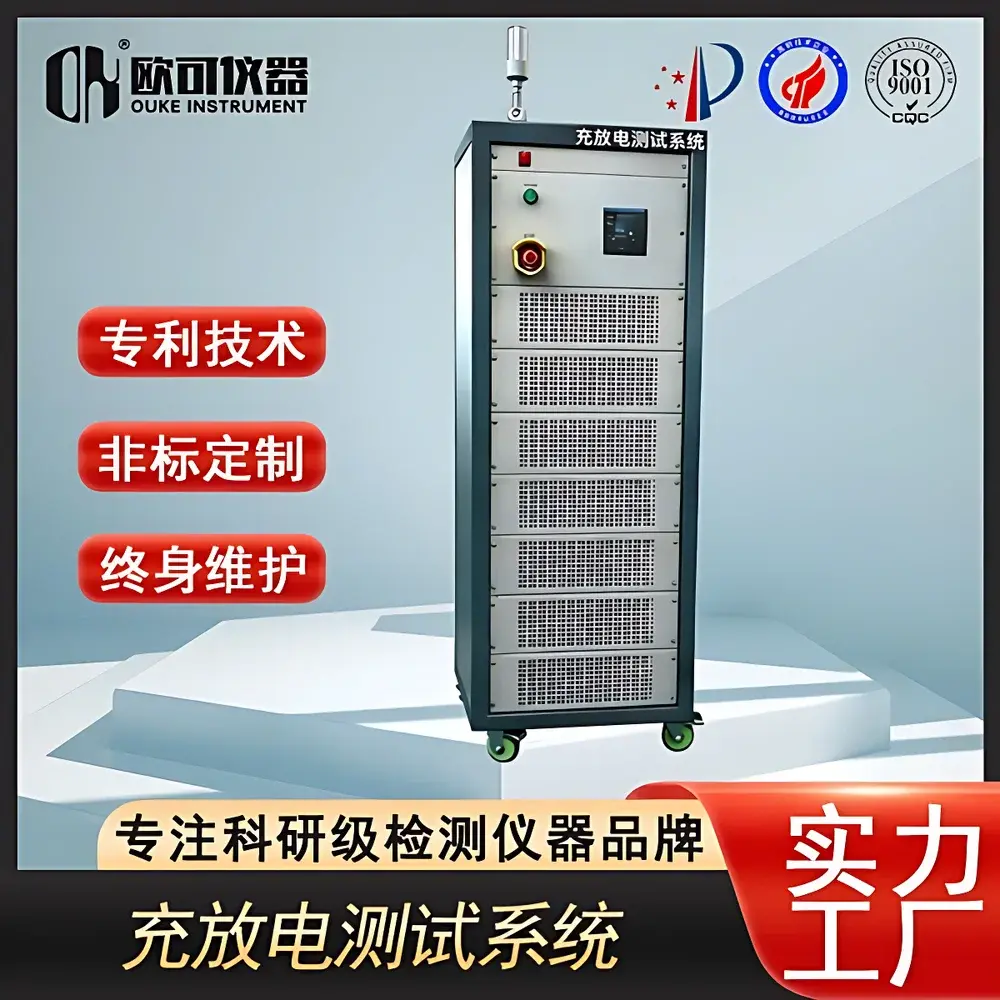
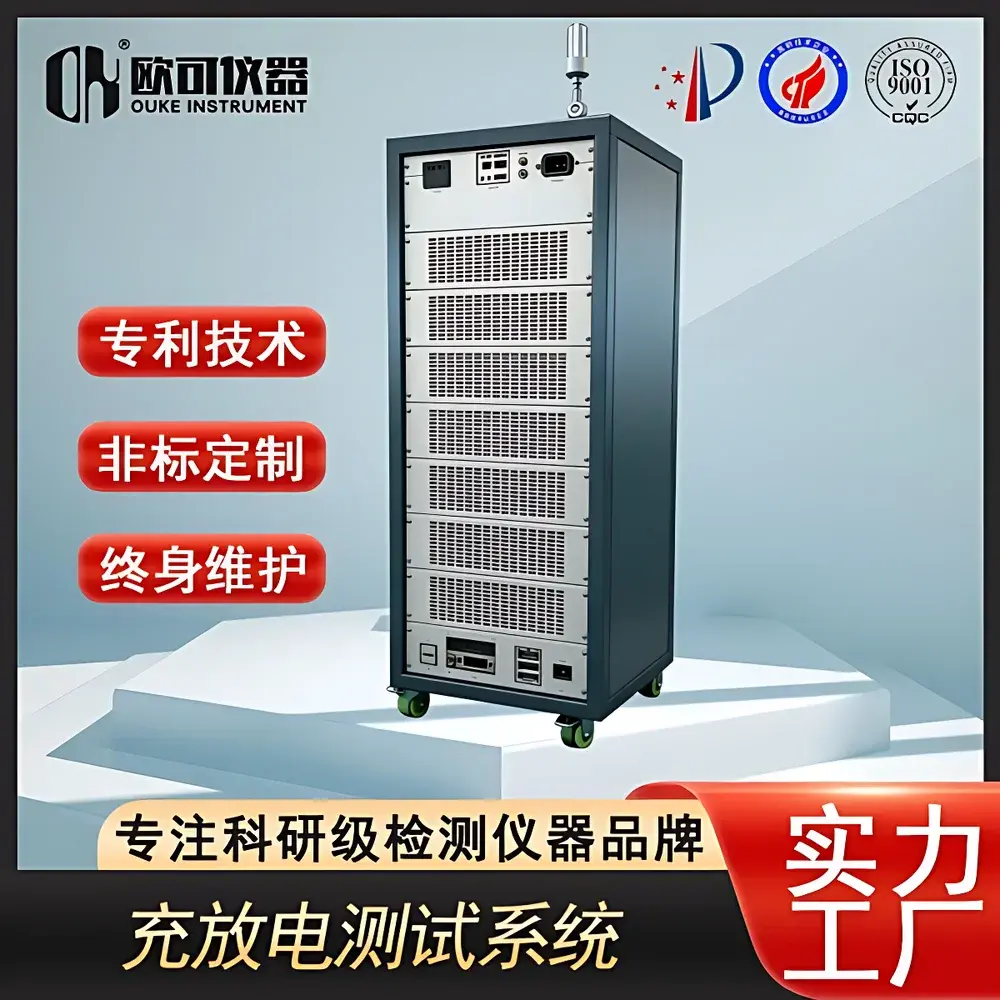
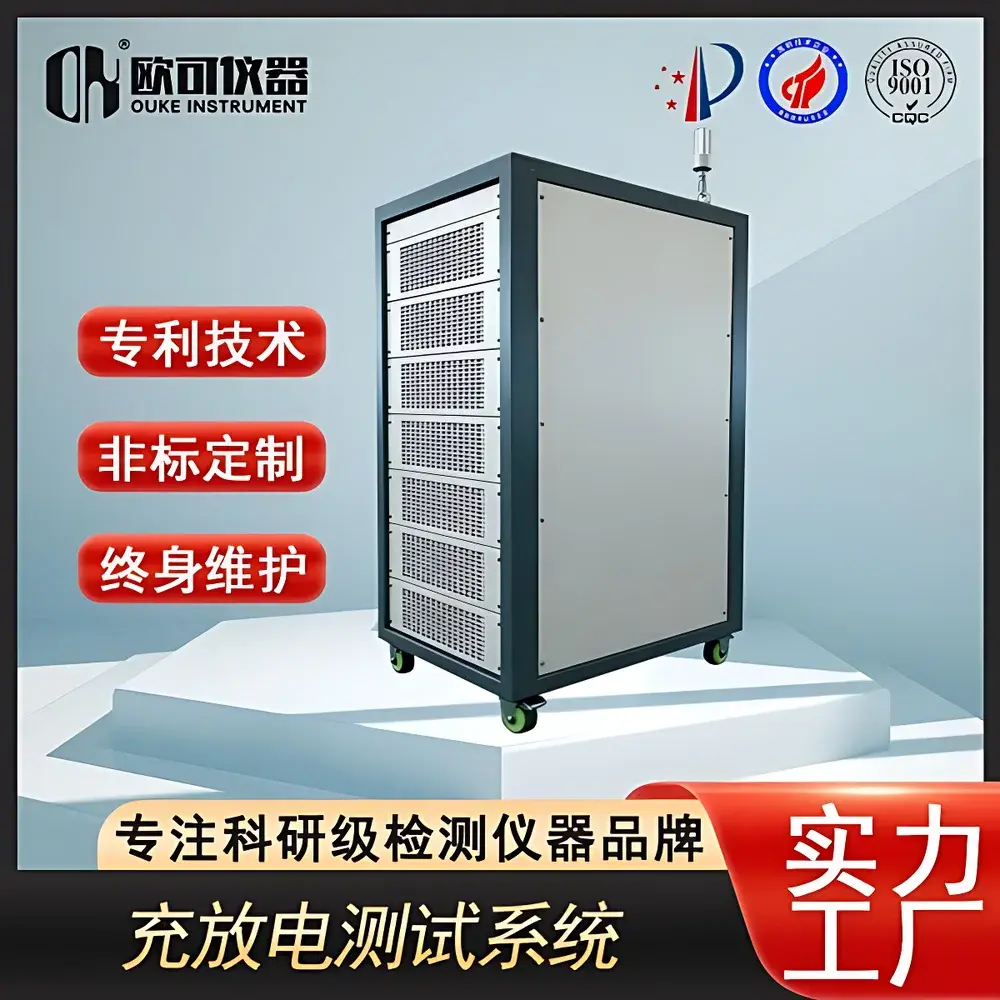
OK Instruments OK-CFDX-3 Battery Charge-Discharge Testing System
| Brand | OK Instruments |
|---|---|
| Origin | Guangdong, China |
| Manufacturer Type | Direct Manufacturer |
| Origin Category | Domestic (China) |
| Model | OK-CFDX-3 |
| Voltage Range | 0–1000 V (expandable) |
| Voltage Accuracy | ±0.05% FS |
| Voltage Resolution | 1 mV |
| Charge Current Range | 0–200 A (expandable) |
| Discharge Current Range | 0–300 A (expandable) |
| Current Accuracy | ±0.05% FS |
| Current Resolution | 10 mA |
| Internal Resistance Range | 0–200 mΩ |
| IR Accuracy | ±1% FS |
| IR Method | AC Impedance at 1 kHz |
| Capacity Range | 0–1000 Ah |
| Capacity Accuracy | ±0.1% FS |
| Test Modes | CC/CV/CP |
| Sampling Rate | 10–1000 Hz (adjustable) |
| Data Storage | ≥1,000,000 records |
| Data Export | Excel, CSV, PDF |
| Communication Interfaces | RS485, Ethernet, USB (CAN/Modbus/PROFINET optional) |
| Enclosure Options | Benchtop or Cabinet |
| Channel Configurations | 2–64 independent channels |
| Power Supply | AC 380 V ±10% / 50 Hz or AC 220 V ±10% / 50 Hz |
| IP Rating | IP30 (IP54 optional) |
| Temperature Chamber Integration | -20 °C to +60 °C (optional -40 °C to +85 °C) |
| Temp Control Accuracy | ±1 °C |
| Compliance | GB/T 31485-2015, GB/T 31486-2015, IEC 62619 |
Overview
The OK Instruments OK-CFDX-3 Battery Charge-Discharge Testing System is a modular, high-fidelity electrochemical test platform engineered for precision characterization of lithium-ion cells, modules, and battery packs across R&D, quality assurance, and production validation environments. Built on bidirectional DC power architecture, the system implements programmable galvanostatic, potentiostatic, and power-controlled charge/discharge protocols with synchronized voltage, current, temperature, capacity, and AC impedance acquisition. Its core measurement principle relies on closed-loop feedback control of solid-state power electronics—combined with calibrated shunt-based current sensing and high-stability voltage dividers—to ensure traceable, repeatable data under dynamic load conditions. Designed for integration into automated test benches and climate-controlled chambers, the OK-CFDX-3 supports full-cycle life evaluation, pulse-power profiling, OCV-SOC mapping, and safety boundary testing in accordance with international regulatory frameworks.
Key Features
- Independent channel architecture: Each channel operates with full electrical isolation, enabling concurrent multi-unit testing without cross-talk or shared resource contention.
- Bidirectional energy flow: Integrated regenerative DC power modules allow efficient energy recovery during discharge phases, reducing thermal load and operational costs.
- High-resolution metrology: Voltage resolution down to 1 mV and current resolution to 10 mA, with factory-calibrated accuracy of ±0.05% FS for both parameters—meeting stringent requirements for cell-level parameter extraction.
- AC internal resistance measurement: Built-in 1 kHz sinusoidal excitation circuitry enables rapid, non-destructive ESR assessment without interrupting DC cycling.
- Configurable sampling infrastructure: Adjustable acquisition rates from 10 Hz (for long-term cycle tracking) to 1000 Hz (for transient pulse analysis), with onboard buffering and timestamp-synchronized storage.
- Multi-layer safety architecture: Hardware-level overvoltage, undervoltage, overcurrent, overtemperature, and short-circuit protection—complemented by software-configurable trip thresholds and fail-safe interlocks with external environmental chambers and explosion-proof enclosures.
Sample Compatibility & Compliance
The OK-CFDX-3 accommodates prismatic, cylindrical, and pouch-format lithium batteries—from single-cell prototypes (e.g., 18650, 21700, LFP soft-pack) to high-voltage traction modules (up to 1000 V) and full EV battery packs. Custom fixture interfaces support low-impedance, four-wire Kelvin connections and thermal sensor integration (e.g., thermocouples, RTDs). The system complies with key national and international standards including GB/T 31485-2015 (safety requirements), GB/T 31486-2015 (performance evaluation), and IEC 62619 (industrial Li-ion secondary cells). All firmware and software modules are structured to support audit-ready documentation workflows aligned with GLP and GMP principles, including user access control, electronic signatures, and immutable audit trails per FDA 21 CFR Part 11 guidelines.
Software & Data Management
The OK-CFDX-3 is operated via OK-BatteryLab™—a Windows-based application supporting graphical step programming, script-driven test sequencing (Python API available), and real-time visualization of up to 64 channels simultaneously. Preloaded templates cover standard protocols such as IEC 61960, UN 38.3, and ISO 12405. Raw data is stored in binary format with metadata tagging (operator ID, batch number, ambient conditions); export functions generate compliant CSV files for third-party analysis tools (MATLAB, Python Pandas) or formatted PDF reports with customizable cover pages and statistical summaries. Historical datasets are indexed for rapid retrieval by test ID, date range, or parameter threshold search. Remote monitoring and control are enabled through secure Ethernet communication using TLS-encrypted RESTful APIs.
Applications
- Cell development: Validation of electrode formulations, electrolyte additives, and SEI stability under accelerated aging protocols.
- Module qualification: Parallel and series configuration testing, including cell-to-cell voltage imbalance analysis and passive/active balancing efficacy verification.
- EV battery pack certification: WLTC, UDDS, and NEDC drive-cycle emulation with synchronized thermal chamber control for low-temperature charge acceptance and high-temperature degradation studies.
- Second-life assessment: Capacity retention, resistance growth, and SOC-OCV hysteresis quantification for retired EV batteries destined for stationary storage applications.
- Quality control: Batch screening for capacity outliers, IR drift, and self-discharge rate deviation prior to shipment.
- Fundamental research: Hybrid pulse power characterization (HPPC), differential voltage analysis (dV/dQ), and incremental capacity analysis (ICA) for mechanistic insight into lithium plating, phase transitions, and aging modes.
FAQ
What is the maximum number of channels supported in a single OK-CFDX-3 system?
Up to 64 fully independent channels can be deployed in a cabinet-integrated configuration; benchtop variants support up to 16 channels.
Does the system support real-time synchronization with external climate chambers?
Yes—via digital I/O triggers and Modbus TCP, enabling coordinated temperature ramping, hold periods, and emergency shutdown based on thermal events.
Can the OK-CFDX-3 perform electrochemical impedance spectroscopy (EIS)?
EIS functionality requires an optional add-on module; the base system performs only 1 kHz AC impedance for rapid ESR estimation.
Is remote firmware update capability available?
Firmware updates are delivered via signed package files through the OK-BatteryLab™ interface, with version rollback and integrity verification.
How does the system handle data integrity during power interruption?
All active tests write to non-volatile memory buffers; upon recovery, the system resumes from the last validated data point with automatic checksum validation.





