
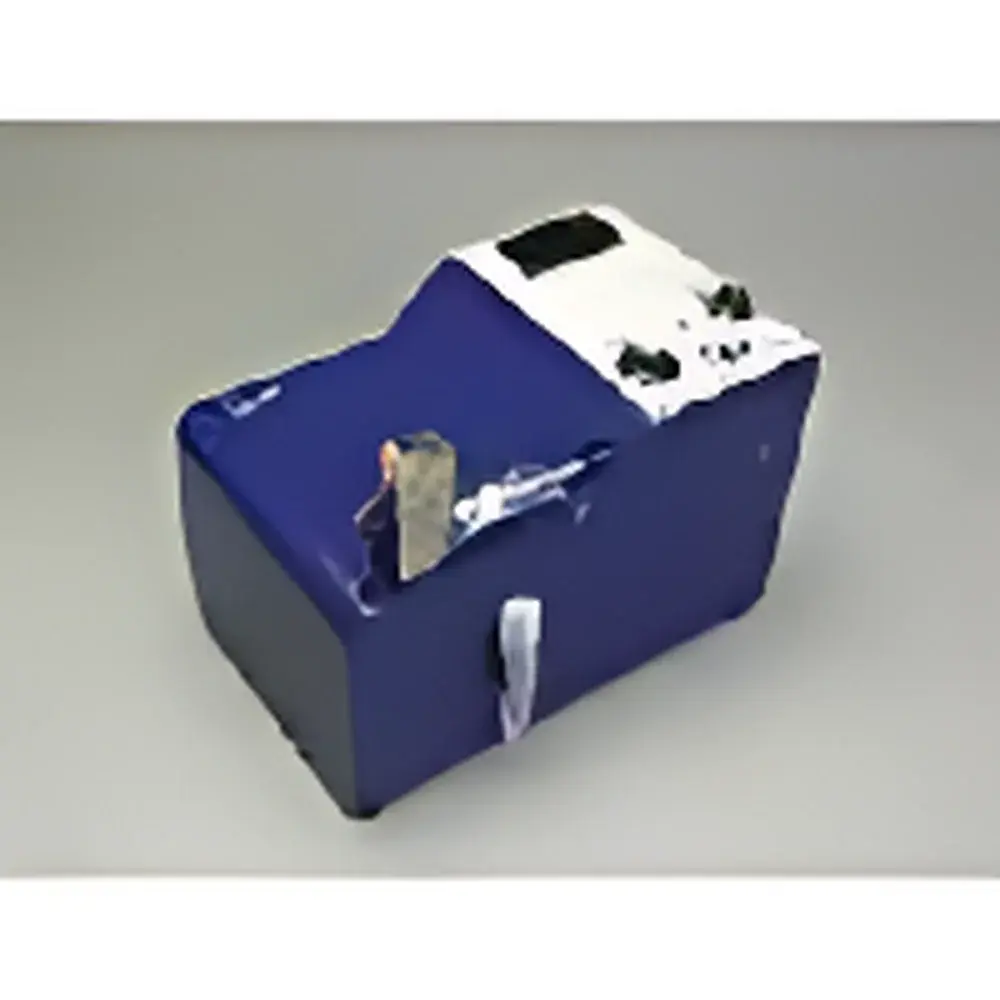
Harvard Apparatus Model 683 Small Animal Ventilator
| Brand | Harvard Apparatus |
|---|---|
| Origin | USA |
| Manufacturer Type | Authorized Distributor |
| Origin Category | Imported |
| Model | Model 683 |
| Price | Upon Request |
| Tidal Volume (Small Cylinder) | 0.5–5 mL/stroke (0.5 mL increments) |
| Tidal Volume (Large Cylinder) | 3–30 mL/stroke (0.3 mL increments) |
| Respiratory Rate | 18–150 breaths/min (adjustable during operation) |
| PEEP Control | Yes |
| Dimensions (H×L×W) | 25 × 32.5 × 15 cm |
| Weight | 8 kg |
| Power Supply | 115/230 VAC, 50/60 Hz |
| Gas Port ID/OD | 3.5 mm / 5 mm (instrument side), 2.2 mm / 4 mm (animal side) |
Overview
The Harvard Apparatus Model 683 Small Animal Ventilator is a precision-engineered positive-pressure ventilator designed for controlled mechanical ventilation of small laboratory mammals weighing between 250 g and 10 kg—including rats, hamsters, rabbits, cats, and juvenile dogs. It operates on a dual-piston, dual-cylinder volumetric displacement principle, delivering highly reproducible tidal volumes without reliance on flow sensors or pressure feedback loops. This architecture ensures intrinsic linearity in volume delivery and eliminates drift associated with pneumatic or servo-controlled systems. The device is intended for use in acute and subchronic in vivo studies conducted under institutional animal care and use committee (IACUC)-approved protocols, supporting both spontaneous breathing support and full ventilatory control modes. Its robust mechanical design, combined with real-time adjustability and integrated PEEP regulation, makes it suitable for physiological monitoring, pharmacological challenge studies, respiratory disease modeling, and preclinical surgical support.
Key Features
- Dual independent piston–cylinder assemblies: one optimized for low-volume delivery (0.5–5 mL/stroke, 0.5 mL increments), the other for mid-range volumes (3–30 mL/stroke, 0.3 mL increments), enabling precise matching to subject size and experimental requirements.
- Permanently etched volumetric scale on each cylinder barrel—resistant to wear, solvent exposure, and repeated sterilization—ensuring long-term calibration stability and operator confidence in manual setting.
- Real-time adjustable respiratory rate (18–150 breaths/min) and tidal volume while the ventilator is actively cycling—no need to pause ventilation for parameter modification during ongoing experiments.
- Integrated positive end-expiratory pressure (PEEP) control circuitry, allowing stable baseline airway pressure maintenance—critical for preventing alveolar collapse during prolonged ventilation and improving oxygenation efficiency.
- Dedicated four-port gas manifold: instrument inlet (gas supply), animal inlet (ventilation line), animal outlet (exhalation path), and instrument outlet (exhaust or CO2 scavenging)—enabling flexible integration with anesthesia machines, capnographs, or humidification systems.
- Digital LED display showing actual respiratory rate; front-panel tactile controls provide intuitive, glove-compatible operation in sterile or low-light environments.
- Full mechanical dead-space minimization: pistons travel to cylinder end-stops, eliminating residual gas volume within the actuation chamber and ensuring maximal delivery fidelity per stroke.
Sample Compatibility & Compliance
The Model 683 accommodates standard small-animal endotracheal tubing and tracheostomy cannulas via its dual-bore port configuration (ID 3.5 mm / OD 5 mm for instrument-side connections; ID 2.2 mm / OD 4 mm for animal-side interfaces). Its operational range supports ISO 10993-compliant silicone, PVC, and polyurethane tubing materials. While not certified as a medical device under FDA 21 CFR Part 820 or EU MDR, the ventilator is routinely deployed in GLP-compliant preclinical research facilities and conforms to ICH S7B and S7A safety pharmacology study guidelines when used in conjunction with validated monitoring platforms. All electrical components meet UL 61010-1 and IEC 61010-1 safety standards for laboratory equipment.
Software & Data Management
The Model 683 operates as a standalone analog-mechanical system with no embedded firmware, network interface, or proprietary software dependency—eliminating cybersecurity concerns and compatibility constraints common in digitally managed ventilators. All settings are manually configured and visually verified, supporting audit-ready documentation in regulated environments where electronic records must comply with FDA 21 CFR Part 11 or Annex 11 requirements. For synchronized data acquisition, analog TTL pulse outputs (rate trigger) and optional analog voltage outputs (pressure or flow, when paired with external transducers) enable seamless integration with commercial data acquisition systems such as LabChart, PowerLab, or Spike2. Raw ventilatory parameters remain fully traceable via physical scale readings and operator logs.
Applications
- Acute cardiorespiratory physiology studies in conscious or anesthetized rodents and lagomorphs.
- Neuromuscular blockade–induced apnea models requiring reliable backup ventilation.
- Pulmonary edema, ARDS, or COPD modeling where PEEP titration and tidal volume precision directly influence outcome metrics.
- Pharmacokinetic–pharmacodynamic (PK-PD) assessment of bronchodilators, neuromuscular agents, or respiratory stimulants.
- Intraoperative support during thoracic, neurosurgical, or metabolic surgery protocols involving extended anesthesia durations.
- Training platform for veterinary and biomedical graduate students in ventilatory mechanics and IACUC-compliant animal handling.
FAQ
Is the Model 683 suitable for mice?
No—the Model 683 is optimized for animals ≥250 g. For mice (typically 20–35 g), Harvard Apparatus recommends the Model 687, which features a single-piston assembly calibrated for 0.1–1 mL/stroke delivery with 0.1 mL resolution.
Can PEEP be measured or logged continuously?
PEEP is manually set via an adjustable valve; the unit does not include an integrated pressure transducer or digital readout. For quantitative PEEP monitoring, users must connect an external differential pressure sensor upstream of the expiratory limb.
Does the ventilator support inspiration-to-expiration (I:E) ratio adjustment?
No—the Model 683 maintains a fixed 1:1 I:E ratio. It is not designed for inverse-ratio or high-frequency ventilation protocols.
What gas sources are compatible?
Medical-grade oxygen, compressed air, nitrous oxide, or custom gas mixtures (e.g., 5% CO2/95% O2) may be supplied at inlet pressures up to 60 psi, provided gas lines are free of particulates and moisture per ISO 8573-1 Class 4 specifications.
Is routine calibration required?
Due to its purely mechanical displacement mechanism and absence of electronic sensors, formal recalibration is not mandated. However, annual verification of volume delivery accuracy using a certified dry-gas meter (e.g., NIST-traceable primary standard) is recommended for GLP/GCP-aligned studies.




