
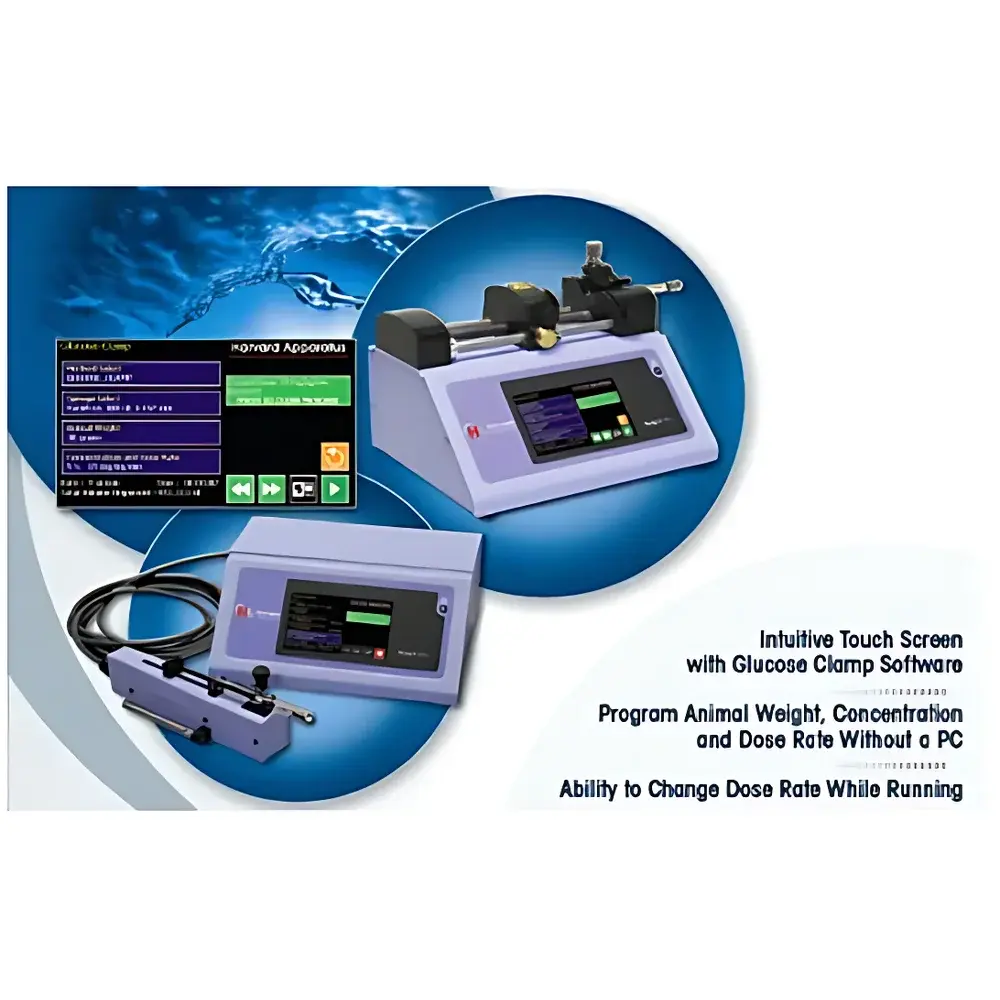
Harvard Apparatus PUMP 11 ELITE GC Glucose Clamp Infusion Pump
| Brand | Harvard Apparatus |
|---|---|
| Origin | USA |
| Model | PUMP 11 ELITE GC |
| Type | Peristaltic Infusion Pump for Glucose Clamp Studies |
| Compliance | Designed for preclinical metabolic research |
| Software | Onboard glucose clamp protocol engine |
| Control Interface | Capacitive touchscreen with dedicated clamp workflow UI |
| Connectivity | USB host/device, RS-232, optional Ethernet |
| Channel Configuration | Single- or dual-channel operation (with optional rotary joint integration) |
| Regulatory Context | Intended for research use only (RUO), compliant with GLP-aligned documentation practices |
Overview
The Harvard Apparatus PUMP 11 ELITE GC is a precision-engineered peristaltic infusion pump specifically optimized for glucose clamp methodology in preclinical metabolic research. Unlike general-purpose syringe or peristaltic pumps, the PUMP 11 ELITE GC integrates a dedicated onboard software architecture that implements the physiological logic of euglycemic and hyperglycemic clamp protocols—including real-time calculation of insulin infusion rates, glucose infusion rate (GIR) adjustments based on measured blood glucose feedback, and dynamic dose-rate recalculation during ongoing experiments. Its design adheres to the biophysical constraints of rodent-scale metabolic studies: low-flow accuracy (0.001–10 mL/h range), pulseless flow delivery via calibrated tubing compression, and mechanical robustness under continuous 24-hour operation. The pump operates independently of external computers, reducing experimental failure points and ensuring deterministic timing—critical for maintaining steady-state glycemia during insulin sensitivity assessments.
Key Features
- Capacitive touchscreen interface with context-aware workflow navigation—idle, run, and pause states mapped to standard clamp experimental phases
- Onboard glucose clamp engine: accepts user-input parameters including animal body weight (g), glucose concentration (mg/mL), target blood glucose setpoint (mg/dL), and initial insulin dose (mU/kg/min); automatically computes and updates infusion rates in real time
- Dynamic dose-rate adjustment: operators may modify infusion parameters—including GIR or insulin rate—during active infusion without interrupting pump operation or resetting calibration
- Dual-channel capability (with optional VAH dual-port rotary joint): enables simultaneous infusion of glucose and insulin through separate lumens while maintaining sterility and minimizing catheter entanglement
- Integrated dose history display: shows previous 5 infusion rate values with timestamps, supporting auditability and intra-experiment troubleshooting
- Modular hardware architecture: compatible with Harvard Apparatus’ full clamp ecosystem—including GC-compatible infusion tubing sets, rodent restraint systems, 3-way and 4-way infusion manifolds, and automated blood sampling interfaces
Sample Compatibility & Compliance
The PUMP 11 ELITE GC is validated for use with standard peristaltic tubing materials certified for aqueous pharmaceutical solutions (e.g., PharMed BPT, Norprene, and Tygon E-3603), ensuring chemical resistance to glucose, insulin, and radiolabeled tracers such as [³H]- or [¹⁴C]-glucose. It supports infusion volumes from 0.1 mL to 50 mL per syringe or tube segment, accommodating both acute (2–4 h) and extended (6–24 h) clamp protocols. While designated Research Use Only (RUO), its firmware logging structure—timestamped parameter entries, rate change events, and system status flags—aligns with Good Laboratory Practice (GLP) documentation requirements. Data export via USB or RS-232 supports traceable record retention in accordance with institutional IACUC and biosafety office guidelines.
Software & Data Management
The embedded microcontroller runs a deterministic real-time operating system (RTOS) with no background processes or OS-level latency. All clamp calculations execute locally using fixed-point arithmetic to guarantee numerical reproducibility across sessions. Parameter inputs are validated against physiologically plausible ranges (e.g., mouse body weight: 15–45 g; insulin concentration: 0.05–1.0 U/mL) to prevent operator-induced dosing errors. Audit logs capture every user interaction—including mode transitions, numeric entry confirmations, and manual rate overrides—with ISO 8601 timestamps. Exported CSV files contain column headers compliant with NIH-supported data repositories (e.g., “Time_UTC”, “GIR_mg_kg_min”, “Insulin_U_kg_min”, “Status_Flag”) and require no post-processing for integration into MATLAB, Python (pandas), or GraphPad Prism workflows.
Applications
- Euglycemic-hyperinsulinemic clamp in C57BL/6, db/db, and diet-induced obese (DIO) mice to quantify whole-body insulin sensitivity (M-value)
- Hyperglycemic clamp for assessment of first- and second-phase insulin secretion dynamics
- Multi-infusate protocols combining glucose, insulin, somatostatin, and tracer infusions in conscious, unrestrained rodents equipped with chronic jugular catheters
- Longitudinal metabolic phenotyping across disease progression timelines (e.g., prediabetes → T2D transition models)
- Pharmacodynamic evaluation of novel antidiabetic agents—including GLP-1 receptor agonists and SGLT2 inhibitors—under controlled glycemic conditions
FAQ
Is the PUMP 11 ELITE GC compatible with non-human primate or large animal clamp studies?
No—the pump’s flow calibration, tubing geometry, and software parameter limits are optimized for murine and rat physiology (body mass ≤ 500 g). For larger species, Harvard Apparatus recommends the ALSET series with higher torque motors and scalable dose algorithms.
Can infusion rate changes be triggered automatically by external glucose meter input?
Not natively—the current firmware does not support analog or digital feedback loops from glucometers. Rate adjustments remain manually initiated by the operator based on discrete blood glucose measurements.
Does the pump meet FDA 21 CFR Part 11 requirements for electronic records?
It is not validated for clinical or regulated manufacturing use. However, its immutable audit log structure, user authentication bypass prevention, and timestamped event recording satisfy foundational ALCOA+ principles for preclinical research data integrity.
What tubing sizes are supported for optimal flow accuracy?
Validated configurations include 0.020” ID × 0.060” OD (for 0.001–0.5 mL/h) and 0.040” ID × 0.080” OD (for 0.1–10 mL/h) peristaltic tubing—both requiring Harvard Apparatus-certified pump heads and roller assemblies.
Is remote monitoring possible via network connection?
Ethernet connectivity is available as an optional module (PUMP 11 ELITE GC-E), enabling TCP/IP-based status polling and log retrieval—but no remote control or real-time parameter modification is permitted for safety and experimental fidelity reasons.
Related Products



