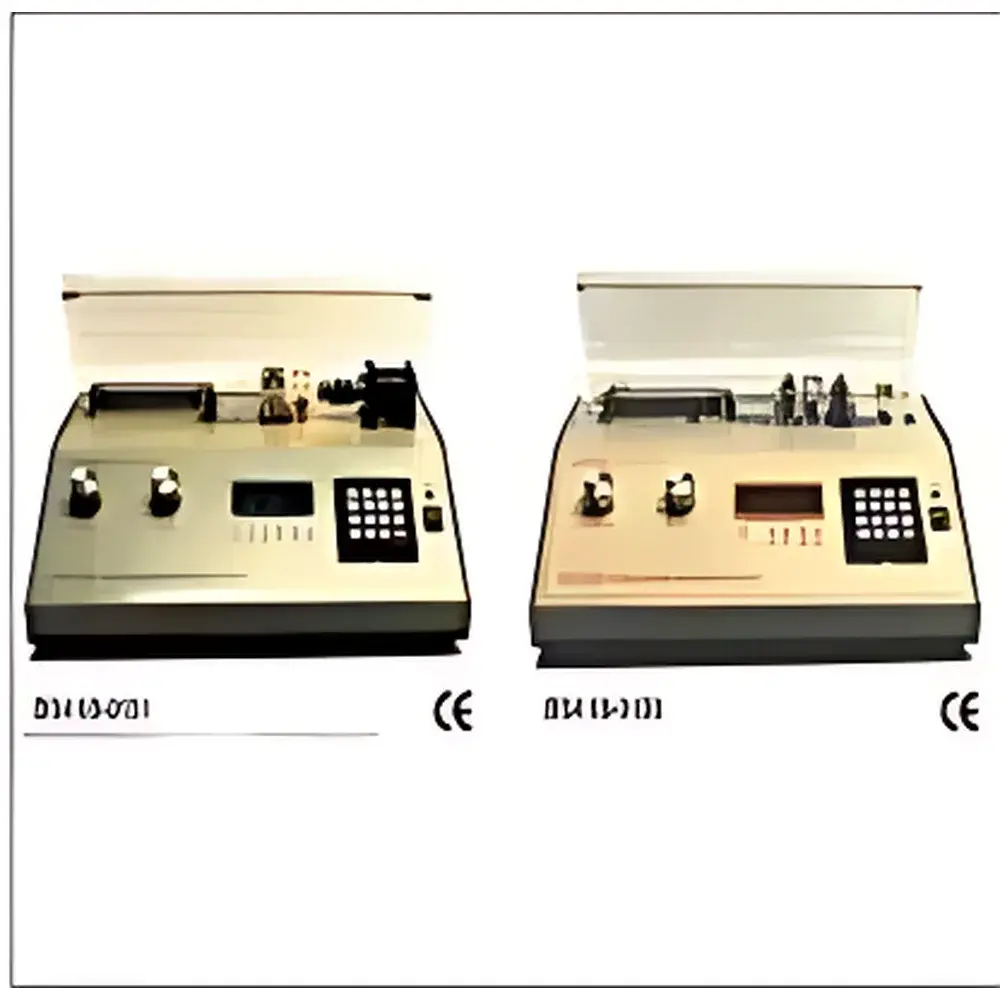
Sutter Instrument PMP-100D Horizontal Capillary Puller
| Origin | USA |
|---|---|
| Manufacturer Type | Authorized Distributor |
| Origin Category | Imported |
| Model | PMP-100D |
| Pricing | Upon Request |
Overview
The Sutter Instrument PMP-100D Horizontal Capillary Puller is a microprocessor-controlled, dual-channel horizontal pipette puller engineered for high-precision fabrication of glass micropipettes used in electrophysiology, microinjection, and single-cell manipulation. Unlike gravity- or magnet-based systems, the PMP-100D employs digitally regulated pneumatic force to generate highly reproducible, consistent axial tension during capillary pulling—enabling precise control over tip geometry, taper angle, and shank diameter. Its horizontal configuration ensures symmetrical heating and uniform thermal gradient distribution across the capillary midsection, minimizing asymmetry and improving batch-to-batch repeatability. The system is optimized for borosilicate (e.g., BF150-86-10) and quartz capillaries (1.0–2.0 mm OD), supporting applications requiring sub-micron tip openings (<0.1 µm) and controlled wall thickness profiles.
Key Features
- Dual-channel horizontal architecture enabling simultaneous, identical pull of two capillaries under identical thermal and mechanical conditions
- Proprietary optical digital caliper system replacing mechanical stops—provides real-time, non-contact measurement and closed-loop feedback control of tip length (±0.5 µm resolution)
- Advanced microcontroller with integrated thermocouple monitoring and adaptive power regulation—maintains stable filament temperature (up to 1200 °C) despite ambient drift or filament aging
- 25 user-programmable pull protocols, each containing up to 18 discrete steps (heating ramp, dwell, pull onset, acceleration profile, deceleration, cooling delay)
- Pneumatic actuation via precision solenoid valves and linear ball-bearing rails—ensures zero-backlash, repeatable draw speed (0.1–20 mm/s range) and force linearity (0.01–2.5 N adjustable)
- 4×4 membrane keypad with backlit LCD display—supports intuitive parameter entry, protocol editing, and real-time status visualization (temperature, pressure, position, step progress)
- Pre-loaded factory protocols for common configurations: patch-clamp electrodes (1.2–1.5 µm tip), intracellular recording pipettes (0.3–0.8 µm), injection needles (2–5 µm beveled tips), and multi-barrel (4- and 7-barrel) assemblies
Sample Compatibility & Compliance
The PMP-100D accommodates standard outer-diameter capillaries from 1.0 mm to 2.0 mm, including thin-walled, thick-walled, and coated variants (e.g., Sutter BF150-86-10, Hilgenberg G150F-4, Narishige GD-1). It supports both single-barrel and multi-barrel (4- or 7-tube) configurations when operated in conjunction with compatible jig fixtures. All firmware and hardware design comply with IEC 61000-6-2 (EMC immunity) and IEC 61010-1 (safety requirements for laboratory equipment). While not FDA-cleared as a medical device, the instrument meets GLP-aligned documentation standards—including full audit trail logging of all pull parameters, operator ID, timestamp, and thermal history—for laboratories operating under ISO/IEC 17025 or CAP-accredited quality systems.
Software & Data Management
The PMP-100D operates autonomously via embedded firmware; no external PC is required for routine operation. However, optional RS-232 serial interface enables connection to host software (e.g., custom LabVIEW VIs or Python-based control scripts) for automated protocol sequencing, remote diagnostics, and long-term parameter archiving. All pull events—including heater voltage, gas pressure setpoint, actual pull displacement, and final tip length—are logged internally with UTC timestamps and retained across power cycles. Exportable CSV logs support traceability per 21 CFR Part 11 Annex 11 requirements when paired with validated third-party electronic lab notebook (ELN) integration.
Applications
- Electrophysiology: Fabrication of high-resistance (>10 MΩ), low-noise patch-clamp pipettes with reproducible tip geometry for voltage- and current-clamp recordings
- Intracellular recording: Production of sharp microelectrodes with fine tapers (≤0.5 µm tip) and minimal shank resistance for stable impalement in neurons and oocytes
- Microinjection: Generation of robust, beveled injection needles (2–5 µm aperture) for pronuclear or cytoplasmic delivery in transgenic model organisms (zebrafish, mouse, C. elegans)
- Multi-electrode arrays: Precise assembly of 4- and 7-barrel pipettes for iontophoresis, pressure ejection, or simultaneous drug application and recording
- Optogenetics & nanoinjection: Custom taper profiles enabling fiber-optic coupling or subcellular delivery of CRISPR ribonucleoproteins
FAQ
What capillary types are compatible with the PMP-100D?
Standard borosilicate (e.g., Sutter BF150-86-10), aluminosilicate, and fused quartz capillaries with outer diameters between 1.0 mm and 2.0 mm.
Does the PMP-100D support multi-barrel pulling out of the box?
The PMP-100D is configured for dual single-barrel pulls. Multi-barrel (4-/7-tube) capability requires optional alignment jigs and is fully supported by its programmable sequence engine.
How is tip length measured and controlled?
Via an integrated optical digital caliper using shadow-edge detection—eliminating mechanical contact, hysteresis, and wear-related calibration drift.
Can pull protocols be exported or shared between instruments?
Yes—protocols are stored in human-readable ASCII format and can be transferred via USB-to-serial adapter or manually re-entered using the keypad interface.
Is firmware update support available?
Sutter Instrument provides periodic firmware updates through authorized distributors, delivered with version-controlled release notes and installation validation procedures.