
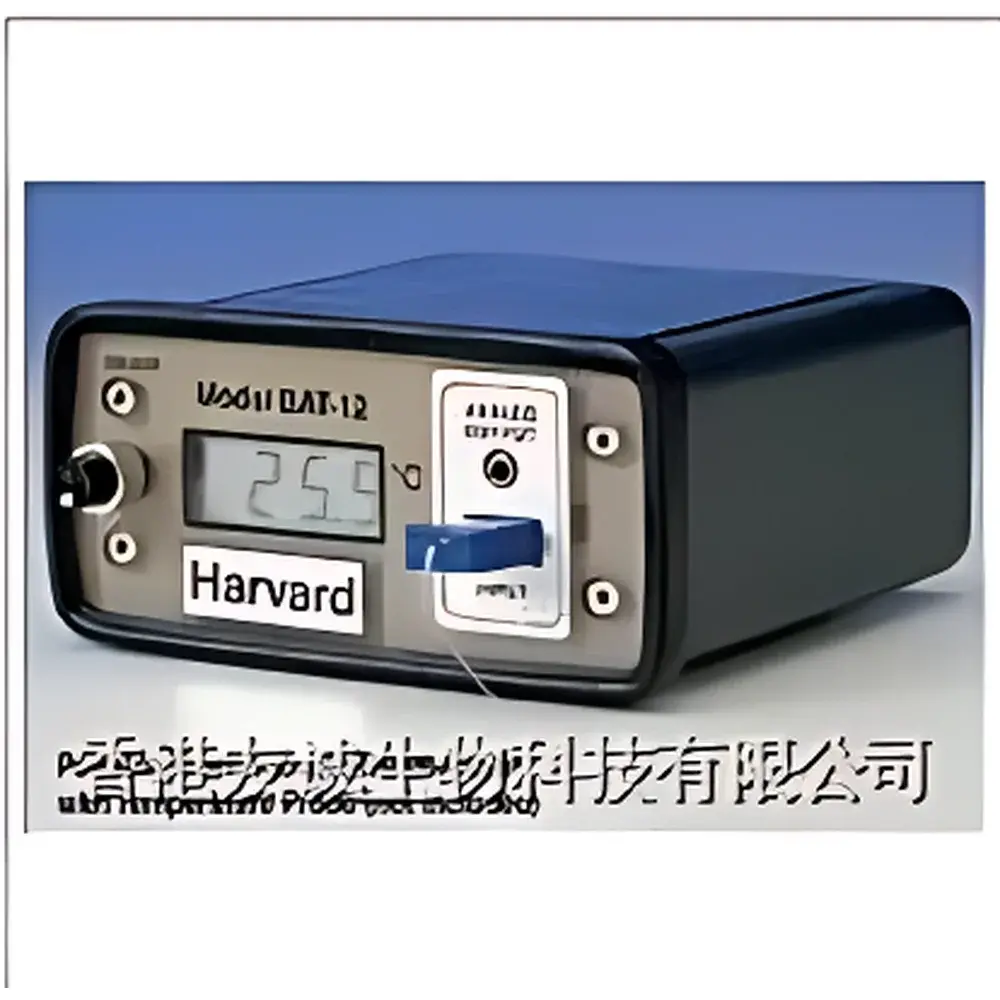
Portable Thermocouple Thermometer Model TC-52130 — Precision Handheld Digital Thermometer with Auto-Compensation
No specifications available.
Overview
The Portable Thermocouple Thermometer Model TC-52130 is a high-accuracy, field-deployable digital temperature measurement instrument engineered for precision across laboratory, clinical, industrial, and quality assurance environments. Based on Type T (copper-constantan) thermocouple sensing technology, it operates on the Seebeck principle—converting thermal potential differences into calibrated voltage signals with traceable linearity. Its design prioritizes metrological integrity: the unit delivers 0.1 °C ±1 digit accuracy within the physiologically critical range of 0 °C to 50 °C, and maintains 0.1% ±1 digit accuracy across its full operational span of –100 °C to +200 °C. Built-in ambient temperature compensation (0 °C to 50 °C) dynamically corrects for thermal drift at the input junction, ensuring stability without manual recalibration. The device meets CE marking requirements for electromagnetic compatibility (EMC Directive 2014/30/EU) and low-voltage safety (LVD Directive 2014/35/EU), supporting compliance with ISO/IEC 17025–accredited calibration workflows.
Key Features
- High-resolution 3½-digit LCD display (13 mm digit height) with clear backlight-independent readability under ambient lab or field lighting conditions
- Auto-compensated cold-junction reference, minimizing measurement uncertainty induced by environmental temperature fluctuations at the connector interface
- Miniature ‘T’ thermocouple input socket with quick-disconnect capability—compatible with standardized copper-constantan probes per ASTM E230/E230M and IEC 60584-1
- Analog output signal of ~10 mV/°C for direct integration with strip-chart recorders, PLC analog inputs, or legacy data acquisition systems
- Dual power architecture: operates continuously for up to 120 hours on a single 9 V alkaline battery; also supports optional AC adapter for benchtop or long-duration monitoring applications
- IP67-rated enclosure—fully dust-tight and submersible to 1 m for 30 minutes—enabling reliable use in wet, sterile, or particulate-laden environments including cleanrooms and food processing lines
- Hands-free operation via integrated heavy-duty mounting bracket, designed for secure attachment to lab coats, tool belts, or instrumentation carts without obstructing probe access
- Intelligent diagnostics: automatic low-battery warning and open-circuit thermocouple detection with on-screen fault indication
Sample Compatibility & Compliance
The TC-52130 is not probe-limited—it interfaces with a broad ecosystem of interchangeable Type T thermocouples (sold separately), including surface-contact sensors, immersion probes, micro-penetrating needles, and flexible sheathed variants suitable for validation of autoclaves, incubators, ovens, and biological sample storage units. Its measurement traceability aligns with NIST-traceable calibration practices and supports documented evidence generation required under FDA 21 CFR Part 11 (when paired with compliant data logging software), ISO 13485 (medical device manufacturing), and HACCP-based food safety protocols. The absence of internal memory or wireless transmission ensures deterministic behavior for GxP-regulated applications where audit trail integrity is paramount.
Software & Data Management
While the TC-52130 operates as a standalone instrument, its analog output enables seamless connection to third-party data loggers (e.g., Omega OM-DAQPRO, Campbell Scientific CR1000X) or SCADA systems configured for voltage-to-temperature linear scaling. For regulated environments, users may integrate the unit into validated electronic records systems using analog-to-digital converters certified to IEC 61000-4-30 Class A standards. No proprietary firmware or cloud dependency is required—measurement integrity remains fully transparent and vendor-agnostic. Calibration certificates—including as-found/as-left data, uncertainty budgets, and temperature point verification reports—can be generated per ISO/IEC 17025 requirements when serviced by an accredited calibration laboratory.
Applications
- Validation and routine monitoring of temperature-controlled equipment (incubators, refrigerators, stability chambers, sterilizers)
- In-process temperature verification during pharmaceutical manufacturing (USP , ) and biologics handling
- Surface and core temperature profiling of food products during cooking, chilling, and freezing cycles (FSMA-compliant hazard analysis)
- Field-based HVAC commissioning and thermal envelope diagnostics
- Educational laboratories requiring robust, entry-level thermocouple instrumentation with real-time analog output capability
- Environmental monitoring in controlled-atmosphere storage facilities and agricultural cold chains
FAQ
Is the thermocouple probe included with the TC-52130 unit?
No. Probes are sold separately and selected based on application-specific requirements—including tip geometry, sheath material (stainless steel, PTFE, glass), response time, and sterilization compatibility. Refer to product pages D22–D25 for full probe catalog specifications.
Can this thermometer be used for sterile or aseptic applications?
Yes—the IP67-rated housing and probe-compatible design allow for alcohol wipe-downs and compatible chemical disinfectants. When used with autoclavable or disposable Type T probes, it meets ISO 14644-1 Class 5–8 cleanroom operational requirements.
Does the unit support data logging internally?
No. Internal memory or USB/Bluetooth connectivity is intentionally omitted to preserve measurement determinism and simplify regulatory validation. Data capture is performed externally via the analog output or through synchronized external loggers.
What is the recommended calibration interval?
Per ISO/IEC 17025 and industry best practice, annual calibration is advised. However, the frequency should be risk-assessed based on usage intensity, criticality of measurements, and organizational quality management system requirements.



