
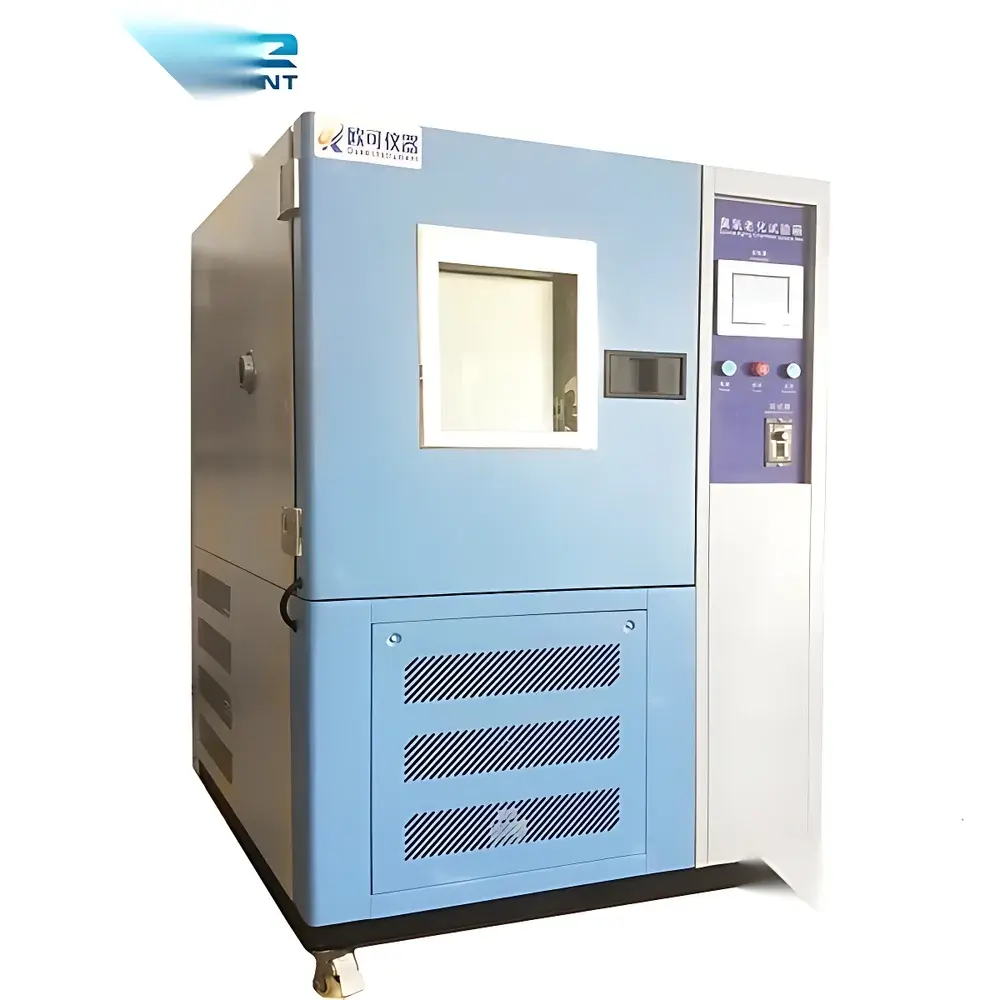
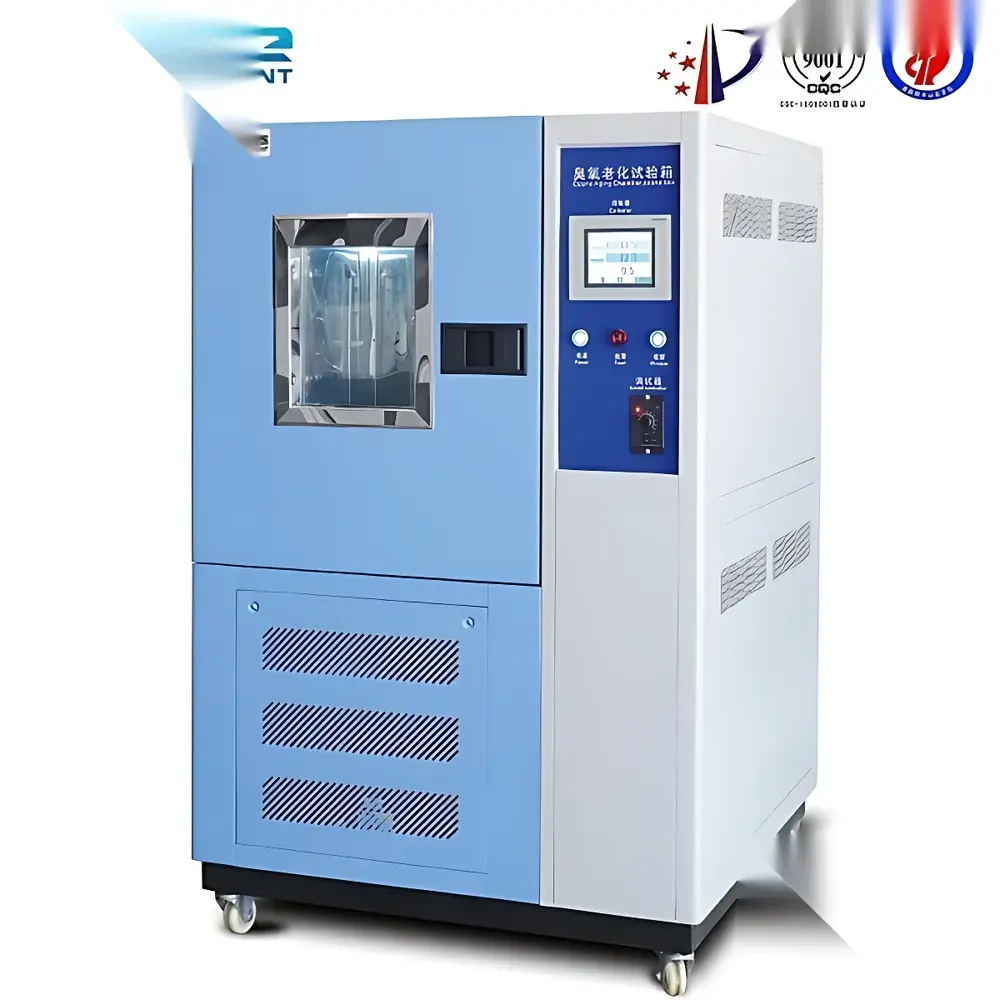
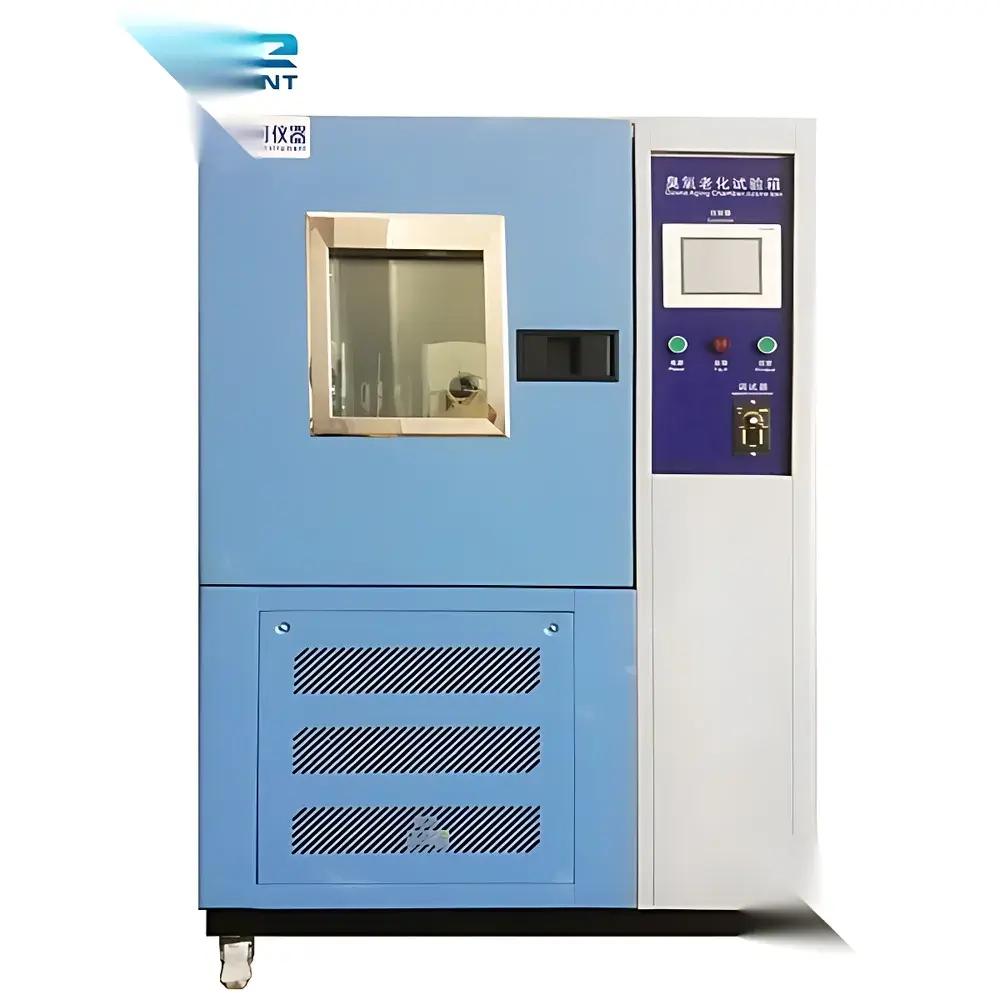
Dynamic Rubber Accelerated Aging Test Chamber – QY Series Ozone Aging Test Chamber
| Brand | Other Brands |
|---|---|
| Origin | Imported |
| Manufacturer Type | Authorized Distributor |
| Ozone Concentration Range | 50–1500 ppm (pphm) |
| Temperature Range | 25–40 °C |
| Humidity Range | 30–65% RH |
| Temperature Uniformity | ±0.5 °C |
| Sample Rotation Speed | 1 rpm (360° continuous rotation) |
| Gas Flow Velocity | 8–16 mm/s |
| Compliance Standards | GB/T 7762–2003, GB/T 2951.21–2008, GB/T 11206–2009, ISO 1431-1:2004 |
| Control System | Siemens PLC + Weintek Color Touchscreen HMI |
| Ozone Generation | Silent Discharge Tube |
| Ozone Detection | Non-Dispersive UV Absorption Analyzer (≥5 yr service life) |
| Safety Features | Leakage protection, short-circuit cutoff, overtemperature shutdown, motor thermal overload protection |
| Power Supply | AC 380 V ±5%, 50 Hz ±0.5 Hz |
Overview
The Dynamic Rubber Accelerated Aging Test Chamber (QY Series) is a precision-engineered environmental test system designed to evaluate the ozone resistance of elastomeric materials under controlled, accelerated conditions. Based on the fundamental principle that atmospheric ozone induces surface cracking in unsaturated rubber compounds—particularly at sites of mechanical stress—the chamber replicates and intensifies real-world ozone exposure while simultaneously applying dynamic strain to specimens. This dual-stress methodology (ozone + mechanical deformation) enables rapid assessment of material degradation kinetics, anti-ozonant efficacy, and service-life prediction—critical for R&D validation, quality assurance, and formulation optimization in tire, sealant, hose, and automotive component manufacturing.
Key Features
- Stainless steel test chamber with fully sealed, recirculating gas loop—ensures operator safety and eliminates ambient ozone leakage.
- Adjustable ozone concentration control from 50 to 1500 ppm (pphm), calibrated and stabilized via non-dispersive ultraviolet (UV) absorption detection with ≥5-year sensor lifetime.
- Dynamic sample actuation system: motor-driven rotating sample rack (1 rpm, 360° continuous rotation) engineered to generate cycloidal strain trajectories—compliant with static and dynamic test modes per ISO 1431-1 and GB/T 7762.
- Integrated climate control: PID auto-tuning temperature regulation (25–40 °C, ±0.5 °C stability) and humidity management (30–65% RH) synchronized with ozone dosing.
- Dual-interface instrumentation: 4–20 mA analog output and RS232 serial communication for traceable data logging and integration into centralized lab monitoring systems.
- Comprehensive safety architecture—including earth-leakage circuit interruption, thermal cut-off for heating elements and drive motors, and overcurrent protection—designed for unattended operation in GLP-compliant laboratories.
Sample Compatibility & Compliance
The QY Series accommodates standardized dumbbell, strip, or molded specimens (per ASTM D1149, ISO 1431-1, and GB/T 7762) across multiple chamber volumes (80 L to 1000 L). Each model supports both static tensile loading (via adjustable clamps) and dynamic flexing (via programmable rotational strain). All configurations meet the physical and metrological requirements of internationally recognized standards: GB/T 2951.21–2008 (cable insulation testing), GB/T 11206–2009 (rubber aging evaluation), and ISO 1431-1:2004 (determination of ozone resistance—part 1: static strain method). The closed-loop ozone generation and destruction pathway ensures full compliance with occupational health regulations (e.g., OSHA PEL and EU Directive 2004/37/EC) and eliminates need for external exhaust ducting.
Software & Data Management
Control and monitoring are executed via a Weintek color touchscreen HMI interfaced with a Siemens S7-1200 PLC. The system logs time-synchronized records of ozone concentration, chamber temperature, relative humidity, and elapsed test duration with timestamped event flags (e.g., alarm triggers, setpoint changes). Data export is supported in CSV format; optional Ethernet/IP or Modbus TCP modules enable connection to LIMS or MES platforms. Audit trails—including user login history, parameter modification logs, and calibration event timestamps—meet FDA 21 CFR Part 11 requirements when deployed with electronic signature-enabled firmware and role-based access control.
Applications
- Accelerated qualification of natural rubber (NR), styrene-butadiene rubber (SBR), nitrile rubber (NBR), and EPDM formulations against ozone-induced crack initiation and propagation.
- Quantitative evaluation of antiozonant additives (e.g., p-phenylenediamine derivatives) under defined strain amplitudes and ozone partial pressures.
- Comparative lifecycle modeling for rubber components subjected to outdoor exposure—supporting ISO 4892-3 and ASTM G154 UV/ozone synergistic aging studies.
- Production line QC screening: batch-to-batch consistency verification of vulcanized extrusions, molded gaskets, and conveyor belt compounds.
- Regulatory submission support: generating reproducible, auditable datasets required for automotive OEM specifications (e.g., VW TL 52352, Ford WSS-M99P1111-A) and medical device elastomer biocompatibility assessments (ISO 10993-12).
FAQ
What ozone concentration accuracy is achievable during long-term testing?
The UV absorption analyzer maintains ±5% full-scale accuracy across its 50–1500 ppm range, verified by NIST-traceable calibration gases prior to shipment and recommended annually thereafter.
Can the chamber operate without dynamic motion for static testing?
Yes—sample rack rotation can be disabled via HMI interface; static clamping fixtures are supplied as standard equipment for GB/T 7762-compliant tests.
Is remote monitoring and control supported?
Standard RS232 allows local PC connection; optional Ethernet module enables secure web-based supervision and alarm notification via SMTP or SNMP protocols.
How is ozone safely decomposed after testing?
All ozone is catalytically converted to oxygen within the sealed recirculation loop using heated manganese dioxide beds—no venting or scrubbing required.
Does the system include validation documentation for IQ/OQ protocols?
Factory-supplied DQ/IQ/OQ templates aligned with ISO/IEC 17025 and ASTM E2500 are provided; on-site performance qualification support is available upon request.



