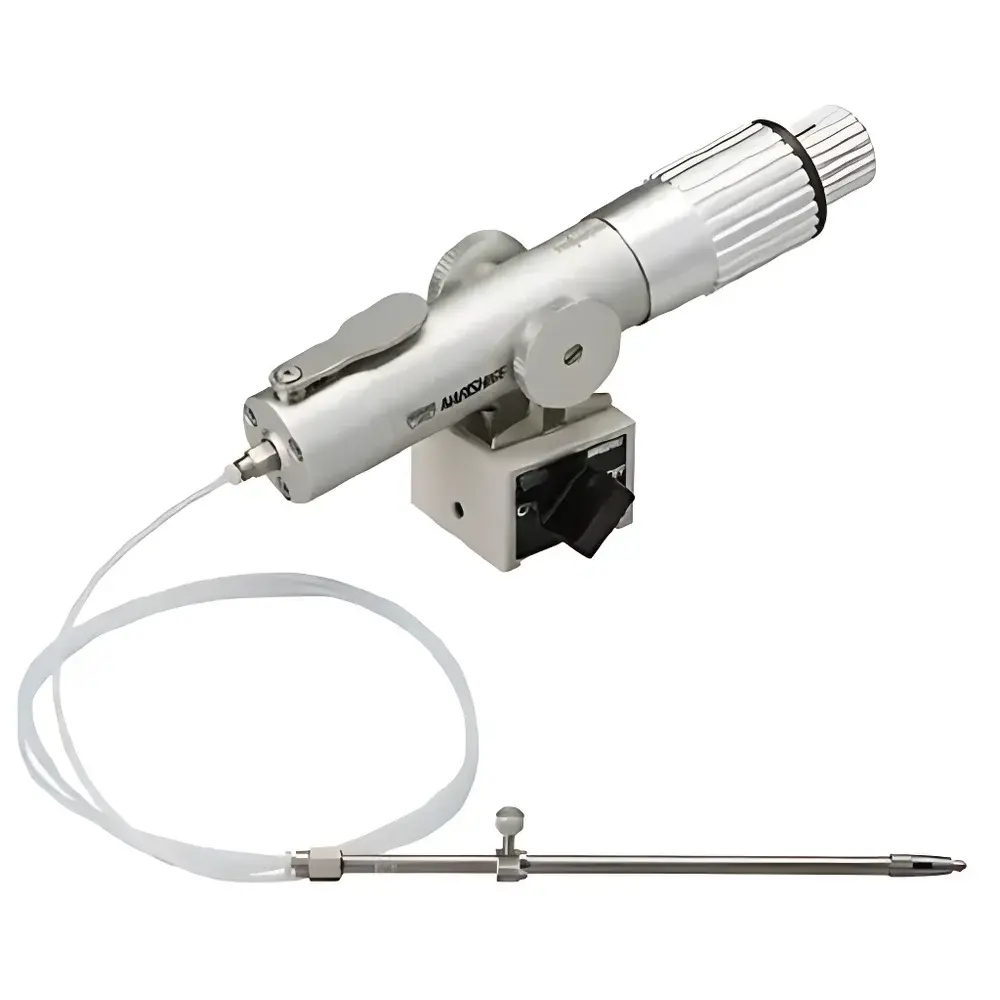
Narishige IM-11-2 Manual Pneumatic Microinjector
| Brand | Narishige |
|---|---|
| Origin | Japan |
| Model | IM-11-2 |
| Actuation Principle | Pneumatic |
| Plunger Stroke | 40 mm |
| Dimensions (W × D × H) | 167–214 × 55 × 78 mm |
| Weight | 680 g |
| Hose Length | 1.2 m |
| Connection Type | Quick-connect pneumatic fitting |
| Pressure Release | One-touch depressurization valve |
| Compatibility | Glass micropipettes via HI-9 holder |
| Accessories Included | HI-9 pipette holder, cleaning rod, CT-1-1.5/CT-4 tubing, IMO10 O-rings, silicone grease, HI01PK01 silicone rubber gasket, hex key |
Overview
The Narishige IM-11-2 Manual Pneumatic Microinjector is a precision-engineered, hand-operated microinjection device designed for controlled aspiration and delivery of nanoliter- to microliter-scale volumes in live-cell manipulation, embryology, oocyte microinjection, and patch-clamp support applications. Unlike motorized or syringe-pump-based systems, the IM-11-2 employs a calibrated pneumatic actuation mechanism—using compressed air or nitrogen—to drive a glass micropipette’s internal plunger with high mechanical reproducibility and minimal hysteresis. Its design eliminates hydraulic fluid dependency, thereby avoiding viscosity drift, thermal expansion artifacts, and seal degradation common in oil-driven injectors. The system operates on a dual-stage coaxial control principle: a coarse adjustment ring governs bulk plunger displacement (e.g., for initial pipette loading), while a concentric fine-tuning knob enables sub-micron incremental motion—critical for delicate intracellular injections without membrane rupture. This architecture delivers accuracy and responsiveness comparable to high-end hydraulic microinjectors (e.g., Narishige IM-9C), yet with improved pressure resolution per rotation and reduced sensitivity to ambient temperature fluctuations.
Key Features
- Dual-range coaxial control: Independent coarse and fine adjustment rings allow rapid positioning followed by precise volumetric delivery.
- Quick-connect pneumatic interface: Standardized push-fit fittings between the main unit and HI-9 glass pipette holder simplify tubing installation, reduce bubble entrapment risk, and facilitate routine maintenance—including safe removal of broken pipette fragments.
- One-touch depressurization valve: Enables immediate release of internal air pressure, permitting safe repositioning of the control knob without residual force transmission to the pipette.
- Bubble-resistant fluid path design: Optimized internal channel geometry and O-ring sealing (IMO10) minimize air entrainment during priming—essential for consistent delivery fidelity in low-volume applications.
- Modular accessory compatibility: Fully interoperable with Narishige’s HI-9 pipette holder, CT-series pressure tubing, and standardized calibration tools (e.g., cleaning rod, hex key).
- Compact, benchtop-ready form factor: Weighing only 680 g with adjustable width (167–214 mm) to accommodate varied microscope stage configurations.
Sample Compatibility & Compliance
The IM-11-2 is validated for use with standard borosilicate or quartz glass micropipettes (tip diameters 0.5–5 µm), commonly pulled using Narishige PC-10 or similar pullers. It supports both forward injection and reverse aspiration modes, making it suitable for pronuclear injection in mouse zygotes, cytoplasmic transfer, organelle isolation support, and electrophysiology electrode filling. While the device itself does not carry CE or FDA clearance as an IVD or medical device, its mechanical design and material selection (anodized aluminum housing, food-grade silicone elastomers, USP Class VI-certified tubing components) align with GLP-compliant laboratory practices. When integrated into workflows governed by ISO 13485 or ISO/IEC 17025, the IM-11-2’s repeatable stroke displacement (40 mm full scale) and documented pressure-response linearity enable traceable volume estimation—particularly when paired with gravimetric or fluorometric calibration protocols per ASTM E2758.
Software & Data Management
As a fully manual, analog pneumatic instrument, the IM-11-2 requires no firmware, drivers, or software integration. This architecture ensures zero electromagnetic interference with sensitive electrophysiological recordings (e.g., whole-cell patch clamp) and eliminates cybersecurity or validation overhead associated with digital controllers. All operational parameters—including applied pressure range, plunger displacement, and dwell time—are set physically via user-controlled knobs and monitored visually through pipette meniscus movement under microscopy. For laboratories requiring audit trails, operators may log settings manually or integrate the IM-11-2 into electronic lab notebooks (ELNs) such as LabArchives or Benchling using standardized SOP templates. No 21 CFR Part 11 compliance features are embedded, as the device produces no electronic records; however, its mechanical simplicity supports straightforward IQ/OQ documentation during GMP-relevant cell therapy process development.
Applications
- Mouse and rat pronuclear microinjection for transgenic model generation
- Cytoplasmic or spindle transfer in assisted reproductive technology (ART)
- Intracytoplasmic sperm injection (ICSI) training and protocol refinement
- Mitochondrial or lysosomal delivery studies in primary neurons and stem cells
- Filling of patch-clamp electrodes with internal solutions containing ATP, Ca²⁺ chelators, or fluorescent dyes
- Microinjection of CRISPR-Cas9 ribonucleoprotein complexes into early embryos
FAQ
Is the IM-11-2 compatible with inverted microscopes equipped with motorized stages?
Yes—the compact footprint and low center of gravity ensure stable placement on most inverted microscope stages, including those with XYZ motorization. Its manual operation avoids electrical noise that could interfere with stage position feedback loops.
Can the IM-11-2 be used with oil-immersion objectives?
Yes, provided the pipette holder (HI-9) is mounted outside the immersion oil path. The pneumatic hose routing allows flexible positioning to prevent oil contamination of fittings.
What maintenance intervals are recommended for long-term reliability?
O-rings (IMO10) should be inspected every 6 months or after 200 injection cycles; silicone grease reapplication is advised before each recalibration session. Tubing (CT-1-1.5) should be replaced annually or if kinking or cloudiness is observed.
Does Narishige provide calibration certificates for the IM-11-2?
No—calibration is performed empirically by the end user using gravimetric or dye-dilution methods. However, Narishige supplies detailed technical notes (TN-IM112-01) outlining ISO/IEC 17025-aligned verification procedures.
Can the IM-11-2 be retrofitted with a pressure sensor or digital readout?
No—its design intentionally omits electronic components to preserve mechanical integrity and avoid regulatory classification as an active medical device. Third-party sensor integration is not supported and voids warranty.