
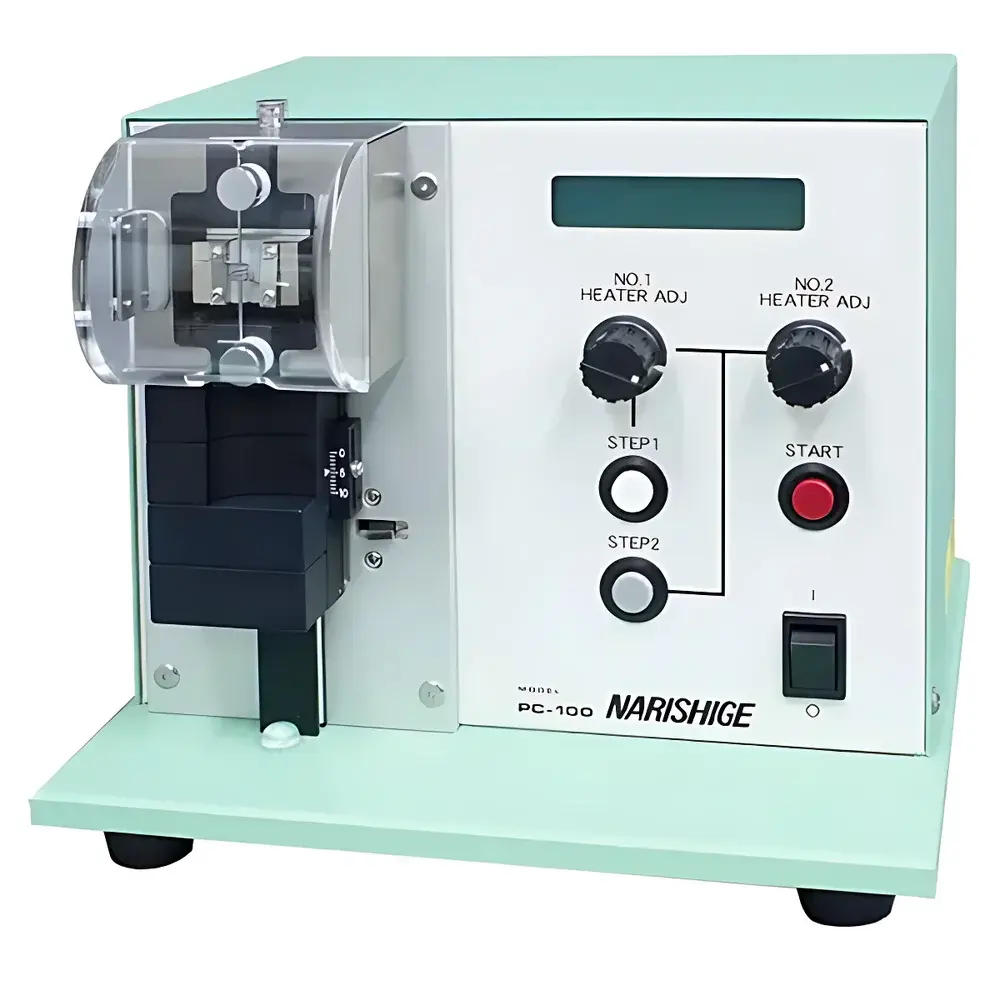
Narishige PC-100 Vertical Glass Micropipette Puller
| Brand | Narishige |
|---|---|
| Origin | Japan |
| Model | PC-100 |
| Capillary OD Range | 1.0–2.0 mm |
| Capillary Length Range | 50–260 mm |
| Heating Element | Cr-Al-Co Resistance Wire |
| Power Supply | AC 100–240 V, 50/60 Hz |
| Power Consumption | ~70 W |
| Max Coil Voltage | 2.5 V |
| Standard Weights | 25 g × 2, 100 g × 2 |
| Dimensions (L×W×H) | 205 × 190 × 185 mm |
| Weight | 3.45 kg |
| Display | Real-time digital readout of heating output (0–100 scale), elapsed time, and operational status |
Overview
The Narishige PC-100 is a vertically oriented, programmable glass micropipette puller engineered for high reproducibility in the fabrication of precision-tapered capillaries used across electrophysiology, microinjection, microfluidics, and nanoscale manipulation. It operates on the principle of gravity-assisted thermal drawing: a vertically suspended glass capillary is heated at its midpoint by a precisely controlled Cr-Al-Co resistance coil, then subjected to calibrated gravitational force via interchangeable weights. As the softened glass yields under heat and tension, it elongates and necks down symmetrically—producing two identical tapered pipettes with defined tip geometry and consistent inner/outer diameters. The PC-100 builds upon the legacy of the PC-10 platform while introducing enhanced thermal control granularity, real-time parameter monitoring, and improved mechanical stability—enabling reliable production of pipettes with tip outer diameters ranging from 10 µm, with typical research-grade targets falling between 1–10 µm.
Key Features
- Two-mode pulling protocol: “One-step” (single thermal cycle) and “Two-step” (dual-stage heating profile) for optimized taper control and reproducibility across diverse capillary geometries and glass compositions.
- Digital display interface showing real-time heating output (0–100 scale, where 100 corresponds to maximum coil voltage of 2.5 V), elapsed process time, and system status—eliminating reliance on analog interpretation.
- Adjustable gravitational force via standardized weight sets (25 g × 2 and 100 g × 2), permitting fine-tuned control over draw speed and final tip sharpness without mechanical recalibration.
- Acrylic safety cover with interlock mechanism ensures operator protection during heating cycles and prevents dust contamination of the sliding carriage assembly.
- Integrated slide unit sealed against particulate ingress, preserving alignment integrity and extending service life in shared laboratory environments.
- Compatible with standard borosilicate (e.g., BF150-86-10) and filamented capillaries (OD 1.0–2.0 mm, length 50–260 mm), supporting both single-barrel and double-barrel configurations.
Sample Compatibility & Compliance
The PC-100 accommodates capillaries fabricated from common electrophysiology-grade glasses—including borosilicate, aluminosilicate, and filamented varieties—with outer diameters from 1.0 mm to 2.0 mm. Its vertical architecture minimizes asymmetry-induced taper deviation and supports consistent fabrication of patch-clamp electrodes (resistance 3–10 MΩ), microinjection needles (tip ID <1 µm), and microfluidic interconnects. While the instrument itself does not carry CE or UL certification as a standalone medical device, its design adheres to general laboratory equipment safety standards (IEC 61010-1). Protocols developed using the PC-100 are routinely referenced in peer-reviewed electrophysiology and developmental biology studies compliant with GLP-aligned documentation practices; users implementing regulated workflows (e.g., preclinical assay development) may integrate puller operation logs into 21 CFR Part 11–compliant electronic lab notebooks via manual timestamping and parameter recording.
Software & Data Management
The PC-100 is a hardware-controlled, microprocessor-driven instrument with no embedded firmware update capability or external software dependency. All operational parameters—including heating intensity (0–100 scale), weight selection, and mode selection—are configured manually via front-panel controls. Critical process metadata—such as start/stop timestamps, selected weight combination, and observed heating output—is visible in real time and must be documented externally for traceability. This architecture ensures deterministic behavior, eliminates version drift, and simplifies validation in ISO 17025-accredited testing laboratories where instrument configuration stability is mandated. For labs requiring audit-ready records, integration with third-party lab information management systems (LIMS) is achievable through manual entry or camera-based log capture of the display screen.
Applications
- Electrophysiology: Fabrication of patch-clamp micropipettes for whole-cell, cell-attached, and perforated-patch recordings; intracellular recording electrodes with sub-micron tip openings.
- Microinjection: Production of injection needles for zygote microinjection, nuclear transfer, CRISPR/Cas9 delivery, and organelle targeting in live cells.
- Microfluidics: Pulling of inlet/outlet connectors and pressure-sensing capillaries compatible with PDMS bonding and fluidic interfacing.
- Single-cell manipulation: Creation of vacuum-held holding pipettes, aspiration probes for cell sorting, and nanoscale pick-up tools for microalgae or synthetic particles.
- Materials science: Preparation of custom probes for scanning probe microscopy (SPM), localized deposition nozzles for aerosol jet printing, and sacrificial templates in 3D-printed microstructures.
FAQ
What capillary types and dimensions are supported?
The PC-100 accepts glass capillaries with outer diameters of 1.0–2.0 mm and lengths of 50–260 mm. Standard borosilicate (e.g., Narishige GD-1) and filamented capillaries are recommended.
How is tip diameter controlled?
Tip geometry is determined by the interplay of heating intensity (0–100 scale), gravitational load (weight selection), capillary wall thickness, and glass thermal transition temperature—not by direct diameter input. Empirical calibration using scanning electron microscopy (SEM) is required for target specifications.
Is the PC-100 compatible with PC-10 accessories and protocols?
Yes—the PC-100 maintains full mechanical and procedural compatibility with PC-10 capillary holders, weight sets, and basic operating sequences. Firmware or software migration is not applicable, as both models are hardware-controlled.
Does the instrument support automated parameter logging?
No. The PC-100 provides real-time visual feedback only. Users must manually record settings and timestamps for quality assurance or regulatory compliance purposes.
What maintenance is required?
Routine cleaning of the heating coil chamber and capillary guide rails is recommended after every 50–100 pulls. Replacement heating wires (Cr-Al-Co) and spare capillaries are available as OEM parts from Narishige-authorized distributors.





