
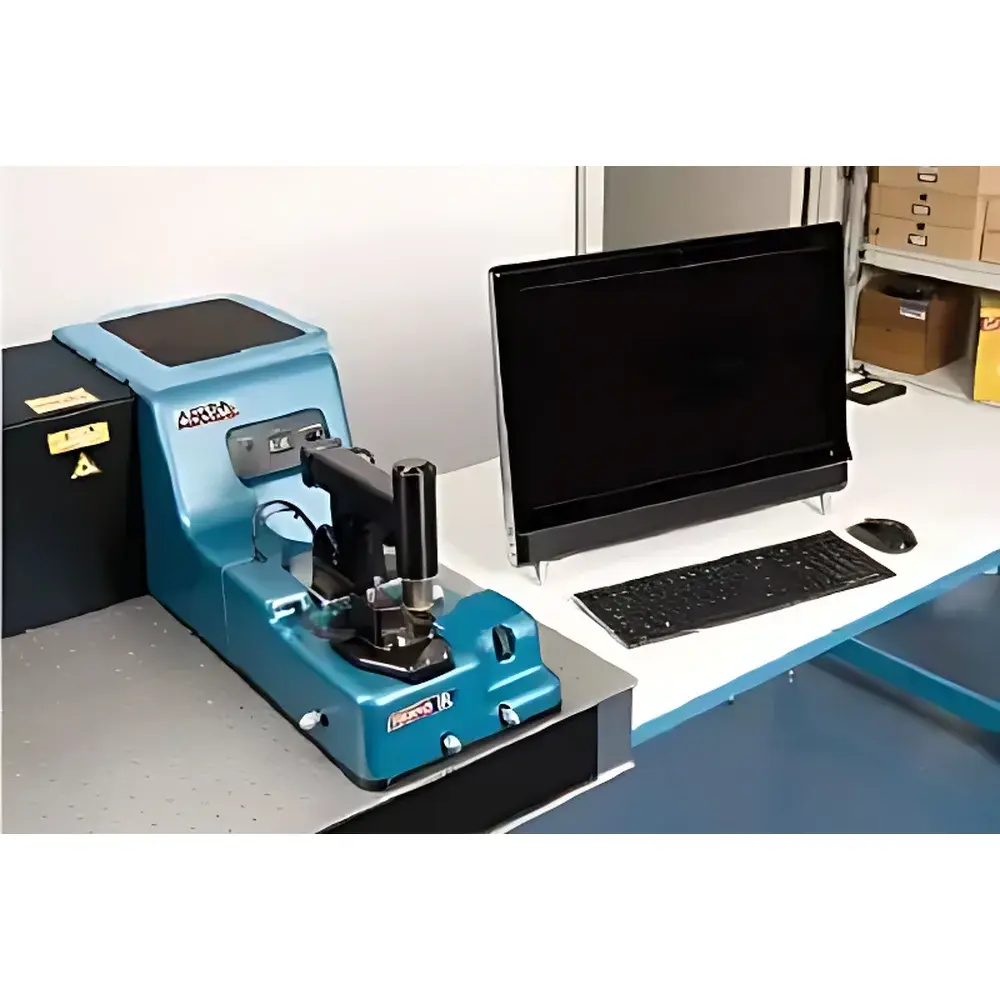
ANASYS Nano-IR Nanoscale Infrared Spectrometer
| Origin | USA |
|---|---|
| Manufacturer Type | Authorized Distributor |
| Origin Category | Imported |
| Model | Nano-IR |
| Pricing | Upon Request |
Overview
The ANASYS Nano-IR Nanoscale Infrared Spectrometer is a hybrid analytical platform that integrates photothermal induced resonance (PTIR) spectroscopy with atomic force microscopy (AFM) to enable label-free, nanoscale chemical identification and thermal property mapping. Unlike conventional far-field infrared techniques—such as Fourier-transform infrared (FT-IR) spectroscopy or attenuated total reflection (ATR-IR)—which are diffraction-limited to ~3–10 µm resolution, the Nano-IR system achieves spatial resolution down to <20 nm by exploiting near-field optical interactions between a tunable pulsed IR laser and a conductive AFM tip. When the laser wavelength matches an intrinsic vibrational absorption band of the sample, localized photothermal expansion occurs at the tip–sample interface, generating a detectable mechanical resonance in the cantilever. This PTIR signal is directly proportional to the local infrared absorbance, enabling quantitative spectral acquisition with chemical specificity at true nanoscale dimensions.
Key Features
- Photothermal Induced Resonance (PTIR) detection mechanism for nanoscale IR spectroscopy without aperture-based near-field constraints
- Integrated high-resolution AFM for simultaneous topographic, mechanical, and thermal imaging
- Tunable mid-infrared quantum cascade laser source covering 1200–1600 cm⁻¹ spectral range
- Spectral resolution better than 16 cm⁻¹, optimized for functional group identification (e.g., C=O, C–H, N–H stretches)
- Automated spectral acquisition across user-defined regions up to 100 µm × 100 µm
- Single-spectrum acquisition time ≤ 60 seconds under standard operating conditions
- Simultaneous acquisition of contact resonance spectra for nanomechanical property mapping (e.g., modulus, adhesion)
- Thermal transport analysis via localized photothermal heating and time-resolved cantilever response
Sample Compatibility & Compliance
The Nano-IR platform supports solid, thin-film, and heterogeneous polymeric, biological, and inorganic samples—including multilayer stacks, phase-separated blends, and nanostructured composites—without requiring metal coating or vacuum environments. It operates under ambient atmospheric conditions and is compatible with standard AFM substrates (e.g., Si, mica, CaF₂). The system adheres to ASTM E2947–21 (Standard Guide for Infrared Microspectroscopy) and ISO 18596:2017 (Nanoscale characterization — Infrared nanospectroscopy) for method validation. Data acquisition and storage support audit trails compliant with GLP and GMP frameworks; optional software modules provide 21 CFR Part 11–compliant electronic signatures and user access controls.
Software & Data Management
The proprietary NanoIR Software Suite provides intuitive workflow-driven operation—from automated tip approach and laser alignment to region-of-interest (ROI) selection, spectral stitching, and multivariate analysis. Spectral libraries (e.g., Hummel Polymer, Sadtler IR) are embedded for rapid peak assignment. All raw interferograms, PTIR amplitude/phase traces, AFM topography, and thermal decay curves are stored in vendor-neutral HDF5 format with metadata tags (wavelength, laser power, dwell time, cantilever parameters). Batch processing supports PCA, cluster analysis, and false-color chemical mapping. Export options include CSV, MATLAB .mat, and standardized JCAMP-DX files for third-party spectral interpretation tools.
Applications
- Identification of chemical heterogeneity in polymer blends, coatings, and microplastics at sub-100 nm scale
- Failure analysis of delaminated interfaces in semiconductor packaging and OLED devices
- In situ thermal conductivity mapping of phase-change materials and thermoelectric thin films
- Structural characterization of amyloid fibrils, lipid rafts, and protein aggregates in cryo-prepared biological sections
- Correlative nanoscale analysis combining IR spectroscopy, nanomechanics, and thermal diffusivity in battery electrode cross-sections
- Quality control of pharmaceutical amorphous dispersions and crystallinity distribution in tablet films
FAQ
What distinguishes PTIR from scattering-type SNOM (s-SNOM)?
PTIR does not rely on scattered near-field signals, eliminating interference from tip geometry and background scattering—making it more robust for quantitative absorption measurements.
Can the Nano-IR perform depth profiling?
While inherently surface-sensitive (~10–50 nm penetration depending on material and wavelength), sequential AFM-based sectioning combined with PTIR enables quasi-3D chemical reconstruction.
Is vacuum operation required?
No—measurements are performed in air or controlled nitrogen environments; no ultra-high vacuum or cryogenic stages are needed.
How is spectral calibration verified?
Calibration is traceable to NIST-standard reference materials (e.g., polystyrene film), with routine verification using characteristic carbonyl and aromatic C–H bands.
Does the system support time-resolved thermal analysis?
Yes—by modulating laser pulse frequency and analyzing cantilever thermal relaxation dynamics, users can extract local thermal diffusivity and interfacial thermal resistance values.



