
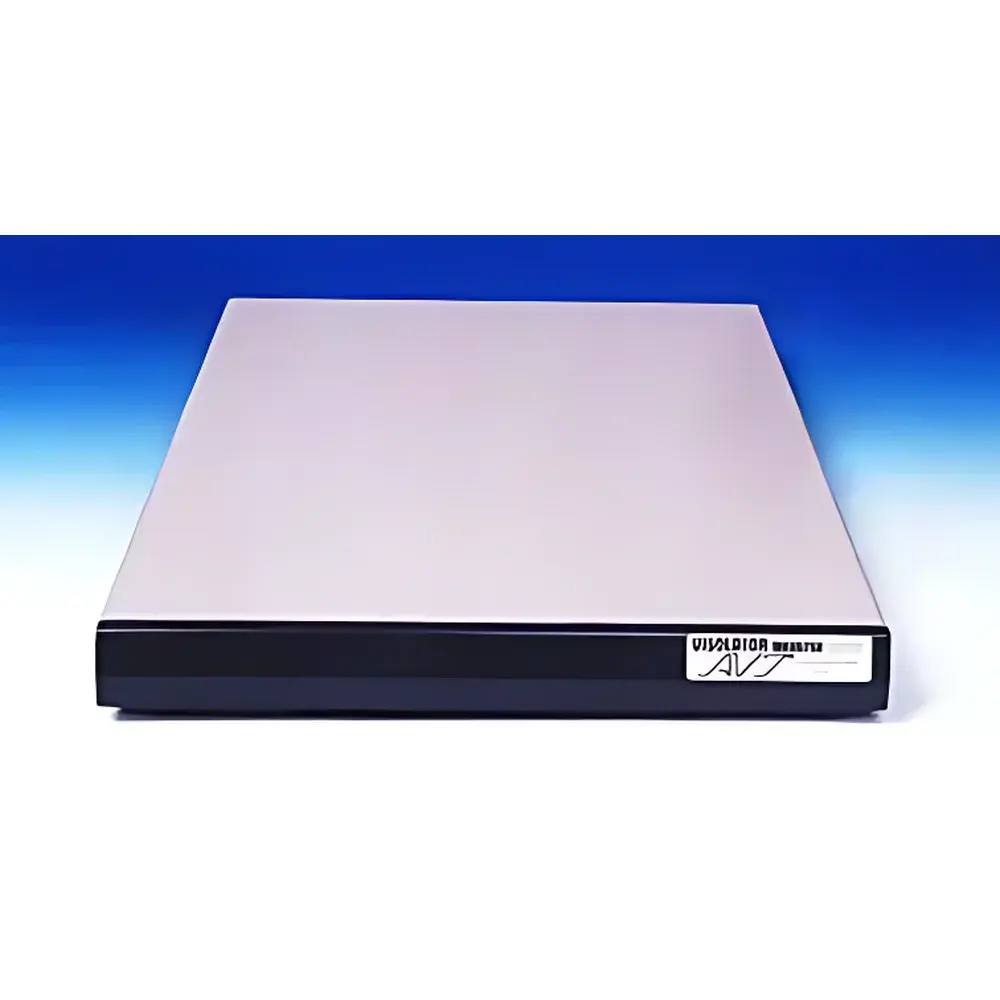
AVT Series Anti-Vibration Table (Japan-Originated Design, China-Assembled)
| Origin | Tianjin, China |
|---|---|
| Manufacturer Type | Authorized Distributor |
| Origin Classification | Domestic Production |
| Model | AVT |
| Pricing | Available Upon Request |
| Natural Frequency | 2.5–2.7 Hz |
| Vibration Isolation Method | Pneumatic Air Spring Isolation |
| Damping Mechanism | Adjustable Orifice Damping |
| Leveling Method | S-Type — Auto-Leveling via Integrated Precision Inclinometer |
| Load Capacity | 55–70 kg |
| Tabletop Dimensions (W × D × H mm) | 430×530×60±3 |
| Unit Weight | 18–32 kg |
| Standard Accessories | S-Type — 3 m PU Air Hose (Ø6 mm) + Quick-Connect Fitting |
Overview
The AVT Series Anti-Vibration Table is an engineered solution for laboratories and precision instrument environments requiring stable mechanical support under low-frequency floor-borne vibrations. Designed with Japanese-originated structural and pneumatic control architecture—and assembled to strict dimensional and functional specifications in Tianjin—the AVT platform leverages passive pneumatic isolation technology based on the principle of low-resonance air spring suspension. Its natural frequency range of 2.5–2.7 Hz enables effective attenuation of ambient vibrations commonly generated by HVAC systems, building sway, footfall, or nearby machinery—particularly critical for optical tables, scanning probe microscopes (SPM), interferometers, electron beam lithography systems, and high-magnification metrology equipment. Unlike rigid mounting solutions, the AVT’s compliant air spring system decouples the tabletop from vertical and horizontal vibrational inputs while maintaining static rigidity sufficient for long-term instrument alignment stability.
Key Features
- Pneumatic isolation core: High-reliability air springs with adjustable orifice damping ensure consistent transmissibility performance across varying load conditions (55–70 kg).
- Intelligent leveling architecture: S-type models integrate a high-sensitivity electronic inclinometer coupled with proportional air valve control—enabling fully autonomous re-leveling after load redistribution or equipment repositioning.
- One-touch locking variants (SC/NC): Provide mechanical immobilization of the air spring chamber post-leveling, eliminating drift during extended measurement cycles or transport preparation.
- Modular footprint scalability: Four standard tabletop dimensions (430×530 mm to 800×600 mm) accommodate diverse instrumentation footprints—from compact laser alignment setups to multi-component optical breadboards.
- Robust mechanical construction: 60 mm-thick reinforced aluminum or steel-composite tabletop with precision-machined flatness (≤15 µm/m), mounted on a welded base frame with integrated air reservoirs and service ports.
- Service-ready interface: All models include standardized pneumatic quick-connect fittings and pressure-rated PU tubing; N-type configurations ship with calibrated hand pump and flow-tuning toolset for field commissioning without external compressors.
Sample Compatibility & Compliance
The AVT Series is compatible with a broad spectrum of vibration-sensitive instruments including but not limited to atomic force microscopes (AFM), confocal laser scanning microscopes (CLSM), Raman spectrometers with CCD detectors, optical coherence tomography (OCT) systems, and semiconductor wafer inspection tools. It conforms to ISO 20483:2017 (Vibration isolation—Performance evaluation of passive isolators) for laboratory-grade passive isolation verification. While not certified to ISO 14644 cleanroom classifications, its non-particulating surface finish and sealed pneumatic circuitry support integration into Class 1000 (ISO 6) and cleaner environments when installed with appropriate grounding and ESD mitigation. No hazardous materials are used in construction; all elastomeric components comply with RoHS Directive 2011/65/EU.
Software & Data Management
The AVT Series operates as a fully passive mechanical system and does not incorporate embedded firmware, IoT connectivity, or proprietary software. Leveling status and pressure equilibrium are monitored visually via analog gauges (N-type) or LED indicators (S-type). For integration into GLP/GMP-regulated workflows, users may document leveling events and load configurations manually within lab notebooks or LIMS entries. The absence of digital control interfaces ensures immunity to electromagnetic interference (EMI) and eliminates cybersecurity or validation overhead associated with FDA 21 CFR Part 11 compliance—making it suitable for regulated QC labs where deterministic mechanical behavior is prioritized over automation.
Applications
- Stabilization of nanoscale imaging platforms where sub-nanometer Z-axis drift compromises resolution.
- Support for laser-based alignment systems in photonics R&D requiring <0.5 arcsec angular stability over 8-hour acquisition windows.
- Isolation of mass spectrometer ion sources and detector assemblies from building-borne microseismic noise.
- Mounting substrate for cryogenic probe stations operating below 4 K, where thermal contraction-induced misalignment must be minimized.
- Temporary deployment in mobile analytical labs (e.g., field-deployable FTIR or LIBS units) where rapid setup and self-leveling reduce operator dependency.
FAQ
Does the AVT Series require an external air compressor?
No—S-type models use internal pressure regulation and do not require continuous air supply; N-type models are operated solely with the included hand pump.
Can the table be relocated and re-leveled without tools?
Yes—S-type units auto-relevel within ±0.1° tolerance after relocation; N-type requires only the supplied hand pump and screwdriver for fine-tuning.
What is the maximum allowable payload eccentricity?
For optimal isolation performance, center-of-gravity deviation should remain within 15% of tabletop radius; detailed load distribution guidelines are provided in the installation manual.
Is calibration traceable to national standards?
While the leveling sensor is factory-calibrated against NIST-traceable inclinometer references, periodic user verification using a Class 0 spirit level or digital autocollimator is recommended per ISO/IEC 17025 maintenance protocols.
Are custom tabletop materials available?
Standard tops are anodized aluminum; stainless steel, granite, or carbon-fiber composite options are available under OEM agreement with minimum order volume.



