
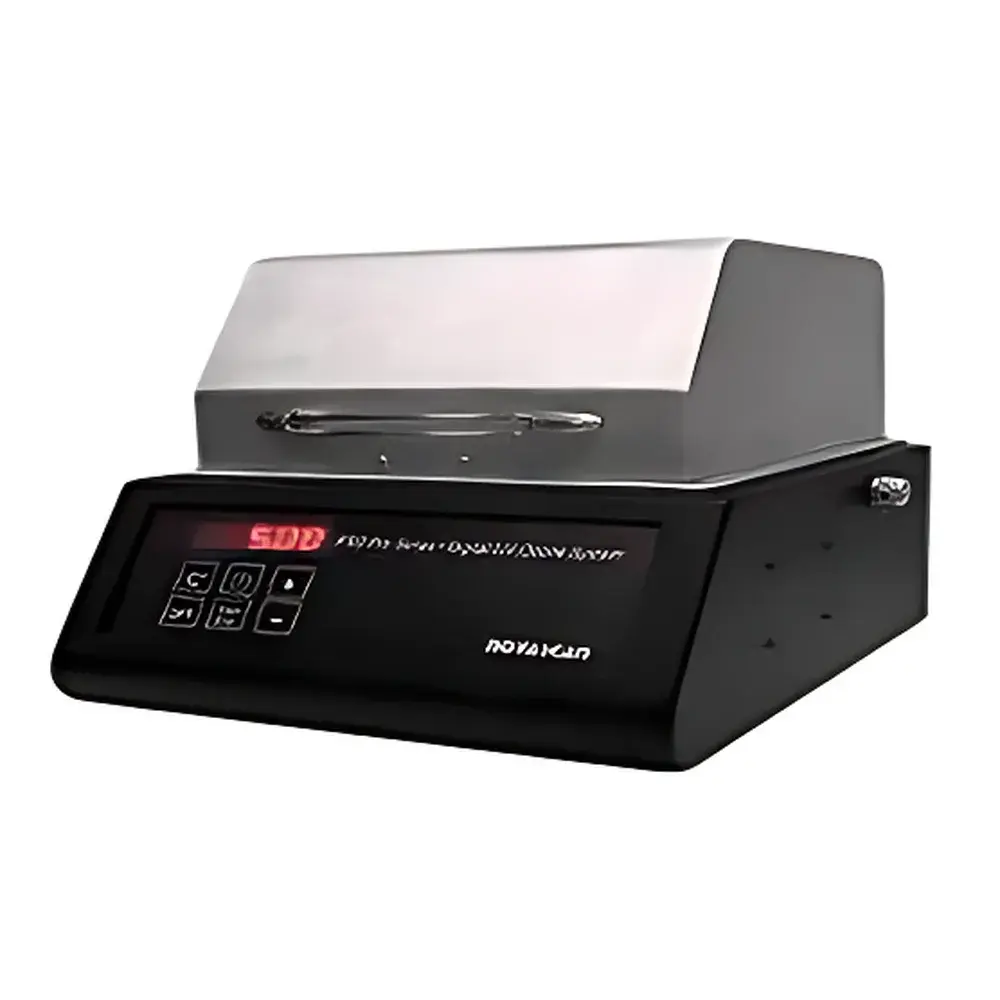
Novascan PSD/PSDP Series UV-Ozone Cleaner
| Brand | Novascan |
|---|---|
| Origin | USA |
| Model | PSD/PSDP Series |
| UV Wavelengths | 185 nm and 254 nm |
| Operating Atmosphere | Ambient air or oxygen |
| Ozone Generation | Yes |
| Adjustable Sample-to-Lamp Distance | Yes |
| Safety Interlock | UV Radiation Shielding Switch |
| Gas Inlet Ports | Multiple |
| Application Mode | Atmospheric-pressure surface treatment |
| Compliance | Designed for ISO/IEC 17025-aligned lab environments, compatible with GLP documentation workflows |
Overview
The Novascan PSD/PSDP Series UV-Ozone Cleaner is an atmospheric-pressure surface treatment system engineered for precision removal of trace organic contaminants, controlled surface oxidation, and functionalization of solid substrates. It operates on the dual-action principle of vacuum ultraviolet (VUV) photolysis and ozone-mediated oxidation: 185 nm photons dissociate ambient O2 to generate atomic oxygen, which rapidly forms ozone (O3); simultaneously, 254 nm UV radiation directly cleaves C–C, C–H, and C–O bonds in hydrocarbon residues while synergistically accelerating ozone decomposition into highly reactive singlet oxygen (1O) and hydroxyl radicals (•OH). This combined photochemical mechanism achieves sub-monolayer organic removal—typically <0.1 nm equivalent carbon thickness—with no ion bombardment, thermal stress, or residue generation. Unlike low-pressure plasma systems, the PSD/PSDP operates at ambient pressure, eliminating vacuum pump requirements and enabling rapid batch processing of fragile or non-vacuum-compatible samples including AFM cantilevers, PDMS microfluidic chips, and biological substrates.
Key Features
- Simultaneous emission at 185 nm (ozone-generating) and 254 nm (direct photolysis) via low-pressure mercury vapor lamps with fused silica envelopes
- Adjustable vertical sample stage (±15 mm range) to optimize photon flux density and radical residence time for diverse substrate geometries
- Multi-port gas inlet manifold supporting controlled introduction of O2, synthetic air, or inert carrier gases for process tuning
- Interlocked safety enclosure with automatic lamp shutoff upon door opening—compliant with IEC 60825-1 Class 3B laser safety principles adapted for UV radiation hazards
- Compact benchtop footprint (W×D×H: 305 × 356 × 254 mm) with integrated cooling fan and thermal cutoff protection
- Front-panel digital controller with programmable exposure time (1–9999 s), real-time lamp hour meter, and status LED indicators
Sample Compatibility & Compliance
The PSD/PSDP accommodates substrates up to 100 mm diameter or 75 × 75 mm square, including but not limited to silicon wafers, fused silica, quartz, sapphire, borosilicate glass, mica, GaAs, gold films, polymer films (PDMS, PET, PC), ceramic substrates, and metallic coupons. Surface treatments conform to ASTM F2237-20 (Standard Practice for Cleaning and Preparing Surfaces for Adhesion Testing) and support ISO 14644-1 Class 5 cleanroom integration when housed in laminar flow hoods. Instrument operation aligns with GLP documentation standards: exposure logs, lamp usage tracking, and operator ID fields can be manually recorded for audit trails; optional RS-232 interface enables integration with LIMS for automated data capture per FDA 21 CFR Part 11 requirements.
Software & Data Management
While the base PSD/PSDP model features standalone hardware control, Novascan provides optional LabVIEW-based remote operation software (UVOC-Link v3.2) supporting script-driven multi-step protocols, exposure time ramping, and timestamped CSV export of operational parameters. All firmware versions undergo annual validation against NIST-traceable UV radiometers (e.g., International Light ILT2400) per ISO/IEC 17025 clause 5.9. Calibration certificates are available upon request. Audit-ready maintenance logs—including lamp replacement dates, intensity decay measurements, and interlock verification records—are maintained per laboratory quality management system (QMS) requirements.
Applications
- Atomic force microscopy (AFM): cleaning and sharpening silicon nitride and conductive diamond probes without tip erosion
- Semiconductor fabrication: pre-deposition cleaning of Si, Ge, and III–V wafers to reduce particle counts below 0.05 µm per ISO 14644-1
- Microfluidics: hydrophilization of PDMS channels for uniform aqueous reagent wetting and reduced protein adsorption
- Optics manufacturing: removal of polishing compound residues from fused silica and CaF2 lenses prior to anti-reflective coating
- Life sciences: activation of tissue culture polystyrene surfaces to enhance fibroblast adhesion and proliferation kinetics
- Surface chemistry: preparation of OH-terminated silica for APTES silanization or thiol self-assembled monolayer (SAM) formation on gold
- LED packaging: cleaning sapphire substrates prior to epitaxial growth to minimize defect nucleation density
FAQ
What is the typical organic removal rate for hydrocarbon contamination?
Removal rates depend on initial contamination thickness and exposure time; standard 10-minute treatments reduce carbon coverage from ~2–5 nm (XPS-measured) to <0.3 nm on silicon, as verified by static secondary ion mass spectrometry (SSIMS).
Can the system operate under pure oxygen atmosphere?
Yes—the gas inlet ports support regulated O2 flow (0–5 L/min), increasing ozone concentration up to 3× ambient air levels and accelerating oxidation kinetics for recalcitrant fluorocarbon residues.
Is lamp replacement a user-serviceable procedure?
Lamp replacement requires calibrated alignment using included collimation tools and should be performed by trained personnel; Novascan provides certified field service or return-to-factory recalibration.
How does UV-ozone compare to argon plasma cleaning for metal surfaces?
UV-ozone avoids sputtering-induced surface roughening and oxide layer disruption on Cu or Al films, preserving nanoscale topography critical for TEM grid preparation and electrical contact integrity.
Does the system meet CE or UL safety certification?
The PSD/PSDP series carries UL 61010-1 certification for electrical safety and complies with EU Directive 2014/30/EU (EMC Directive); CE marking applies to units shipped post-2022 with updated EMI shielding.



