
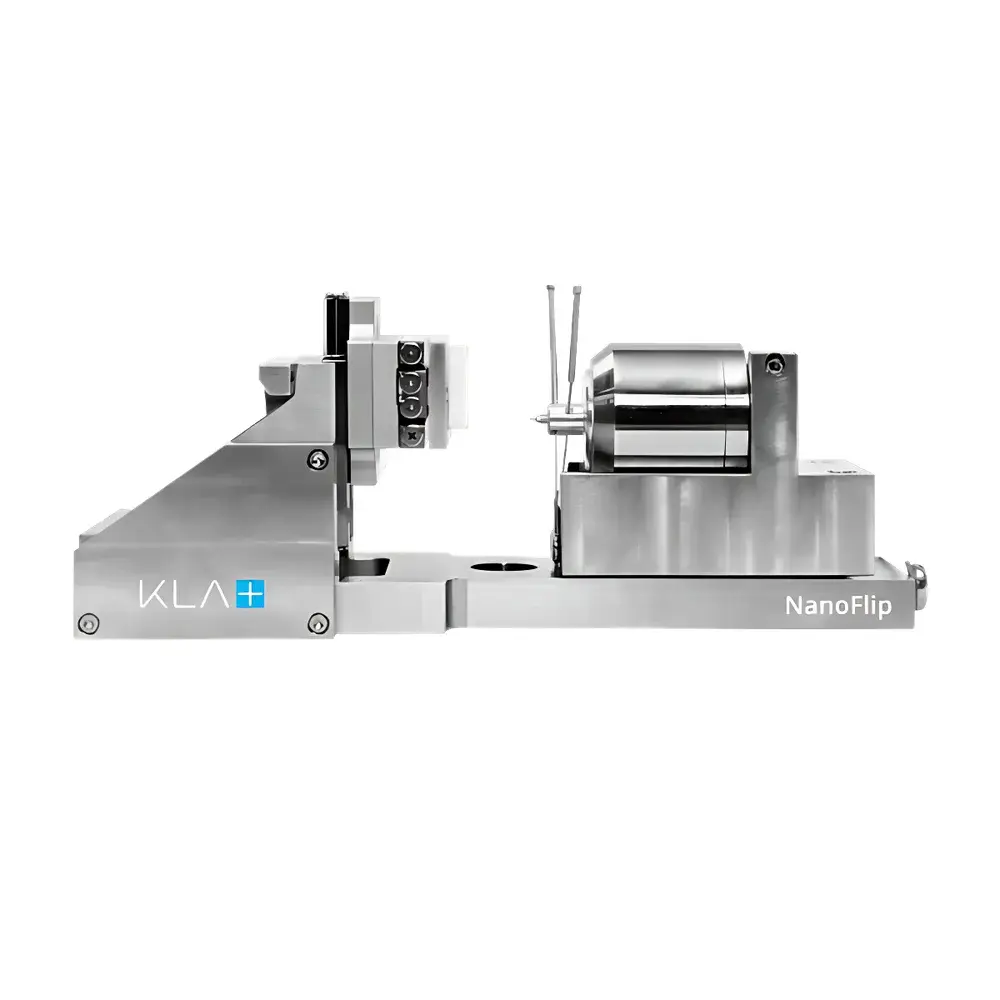
KLA InSEM HT High-Temperature In-Situ Nanoindentation System
| Brand | KLA |
|---|---|
| Origin | USA |
| Model | InSEM HT |
| Instrument Type | High-Temperature In-Situ Nanoindentation and Mechanical Testing System for SEM/FIB Integration |
| Maximum Indentation Depth | 50 µm |
| Effective Load Range | 50 mN |
| Load Resolution | 3 nN |
| Displacement Range (X/Y) | 20 mm, (Z): 25 mm |
| Displacement Resolution | 4 nm |
| Maximum Friction Force | 0.05 N |
| Indenter Type | Diamond Berkovich / Cube-Corner / Spherical |
| Thermal Drift | < 0.05 nm at 800 °C |
| Operating Temperature Range | RT to 800 °C under vacuum |
| Compatibility | Integrated with SEM, FIB, or standalone high-vacuum chamber |
| Standards Compliance | ISO 14577-1/2/3, ASTM E2546, applicable to GLP/GMP-relevant mechanical property validation workflows |
Overview
The KLA InSEM HT is a high-precision, vacuum-compatible in-situ nanoindentation system engineered for quantitative nanomechanical characterization of materials at elevated temperatures—up to 800 °C—within scanning electron microscopy (SEM) or focused ion beam (FIB) chambers. Unlike conventional ex-situ high-temperature testing platforms, the InSEM HT enables real-time, sub-micron spatial resolution observation of deformation mechanisms—including dislocation nucleation, grain boundary sliding, phase transformation, and creep initiation—while simultaneously acquiring load-displacement data with nanonewton force and sub-nanometer displacement fidelity. Its dual-heating architecture independently controls indenter tip and sample temperature, minimizing thermal gradient-induced artifacts and ensuring thermomechanical equilibrium during indentation. The system operates on the fundamental principles of quasi-static and dynamic contact mechanics, where mechanical response is derived from Hertzian and Oliver–Pharr analyses of load–depth curves, augmented by continuous stiffness measurement (CSM) for depth-resolved modulus and hardness mapping.
Key Features
- True in-situ high-temperature nanoindentation (RT–800 °C) under ultra-high vacuum (UHV) or controlled inert gas environments
- Dual-zone resistive heating: independent thermal regulation of diamond indenter and specimen to suppress thermal drift (< 0.05 nm/h at 800 °C)
- High-fidelity actuation: InForce50 electromagnetic transducer with 3 nN load resolution and 4 nm displacement resolution over 25 mm Z-travel
- Multi-axis motion control: X/Y translation stage (20 mm range) synchronized with Z-indenter motion for precise positioning and grid-based mapping
- Integrated CSM technology—patented by the original developers of dynamic nanoindentation—enabling real-time stiffness acquisition during loading via superimposed sinusoidal excitation (1–200 Hz)
- Advanced test modules: ProbeDMA™ for frequency-dependent viscoelastic modulus (storage/loss), AccuFilm™ for substrate-independent thin-film property extraction (Hay–Crawford correction), and NanoBlitz3D for high-throughput statistical nanoindentation (up to 100,000 indents on 300 × 300 arrays)
- Gemini 2D multi-axial sensing capability for concurrent lateral force measurement—supporting coefficient of friction (COF), scratch resistance, shear modulus, and Poisson’s ratio quantification
Sample Compatibility & Compliance
The InSEM HT accommodates a broad spectrum of material classes—including refractory alloys, MAX phases, ceramic matrix composites, metallic glasses, thin-film photovoltaics, and high-entropy oxides—without requiring metallization or conductive coating due to its vacuum-integrated design. Specimen dimensions are compatible with standard SEM stubs (up to Ø25 mm × 5 mm thick), and custom holders support tensile miniaturized specimens for coupled thermo-mechanical testing. All indentation protocols adhere to ISO 14577-1 (General principles), -2 (Testing machines), and -3 (Hardness and modulus measurements), with traceable calibration using NIST-traceable reference materials (e.g., fused silica, sapphire, Si). Data acquisition meets audit requirements for regulated environments: InView software supports 21 CFR Part 11-compliant electronic signatures, ALCOA+ data integrity principles, and full audit trails—including operator ID, timestamp, environmental parameters (vacuum pressure, temperature ramp rate), and raw load–displacement files with metadata embedding.
Software & Data Management
InView software serves as the unified platform for experiment design, real-time visualization, and post-processing. It features modular workflows for CSM, NanoBlitz3D, AccuFilm™, and ProbeDMA™, each with pre-validated parameter templates aligned with ASTM E2546 and ISO 14577 guidelines. Raw data is stored in HDF5 format with embedded metadata (temperature setpoint, vacuum level, scan speed, indenter geometry), ensuring FAIR (Findable, Accessible, Interoperable, Reusable) compliance. Mapping datasets export directly to Python (via h5py), MATLAB, or commercial tools (e.g., ImageJ, Gwyddion) for advanced statistical analysis—including Weibull modulus estimation, spatial autocorrelation, and cluster analysis of modulus heterogeneity. Batch processing scripts enable automated filtering of thermal drift artifacts and iterative Oliver–Pharr fitting across thousands of indents.
Applications
- High-temperature creep and relaxation behavior of turbine blade coatings (e.g., YSZ, Al₂O₃) under simulated service conditions
- Thermally activated dislocation dynamics in nanocrystalline Ni-based superalloys during in-situ annealing in SEM
- Mechanical degradation mapping of solid oxide fuel cell (SOFC) electrolytes after thermal cycling
- Viscoelastic transition temperature (Tg) determination in ultrathin polymer films (< 100 nm) via ProbeDMA™ frequency sweeps
- Interfacial adhesion strength and delamination thresholds of hard coatings (TiN, CrN) on steel substrates using progressive-load scratch tests
- Statistical modulus distribution analysis in additively manufactured Ti-6Al-4V lattices to correlate local microstructure (β-phase fraction, porosity) with nanomechanical response
FAQ
Can the InSEM HT be retrofitted into an existing SEM or FIB system?
Yes—the system is designed as a modular insert compatible with major OEM chambers (Thermo Fisher, Zeiss, Hitachi, Tescan) and includes flange adapters, vacuum feedthroughs, and vibration-isolated mounting kits.
What indenter geometries are supported?
Standard options include Berkovich, cube-corner, spherical (R = 1–10 µm), and flat-punch; custom geometries (e.g., wedge, conical) are available upon request.
Is in-situ heating compatible with EBSD or EDX during indentation?
Yes—integrated thermal shielding and low-emission heater design minimize electromagnetic interference, enabling concurrent EBSD pattern acquisition and elemental mapping without signal degradation.
How is thermal drift corrected during long-duration tests?
In addition to hardware-level thermal stabilization, InView implements real-time drift compensation algorithms based on zero-load hold segments and polynomial baseline fitting of unloading curves.
Does the system support automated grid-based testing across heterogeneous microstructures?
Yes—GIS (Grid Indentation Software) module enables user-defined ROI selection from backscattered electron (BSE) images, followed by autonomous navigation, indentation, and property mapping with positional accuracy better than ±100 nm.



