
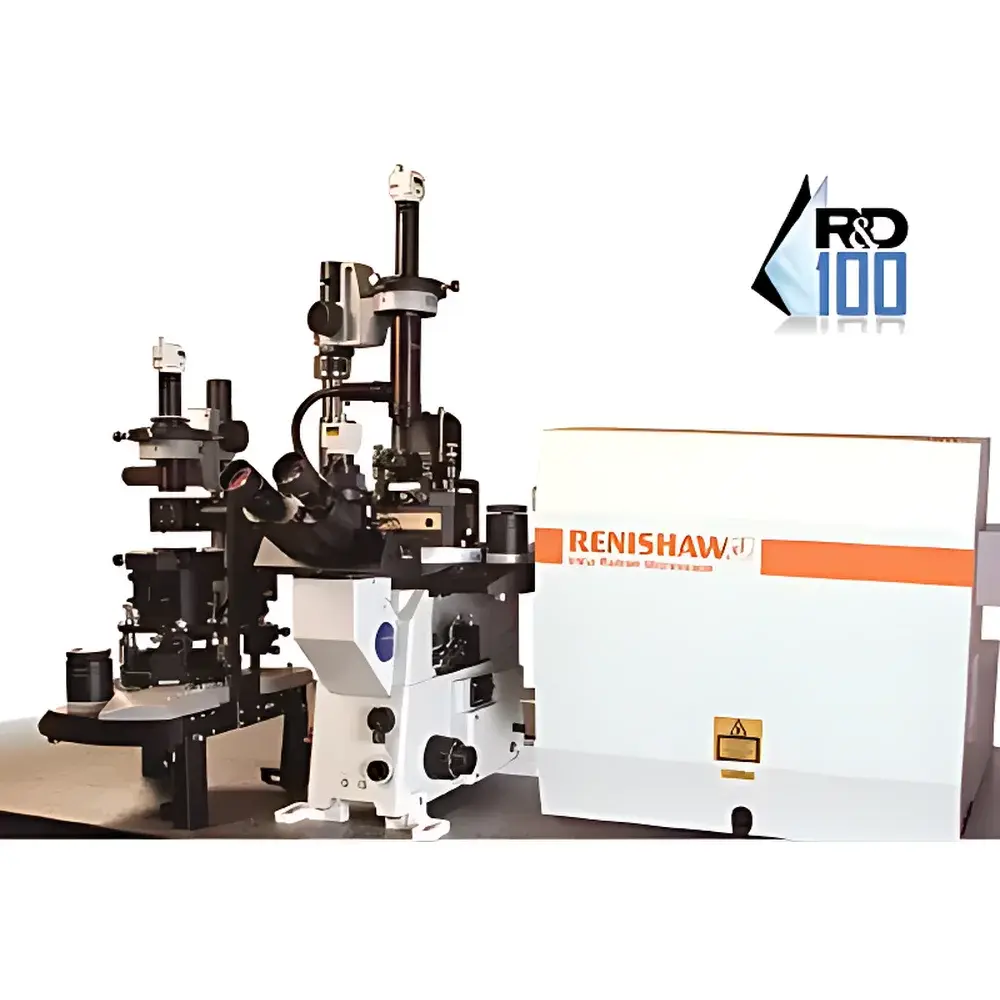
NT-MDT Ntegra Spectra Hybrid Scanning Probe Microscope with Integrated Confocal Raman, Fluorescence, and SNOM
| Origin | Imported |
|---|---|
| Manufacturer Type | Authorized Distributor |
| Model | Ntegra Spectra |
| Pricing | Available Upon Request |
Overview
The NT-MDT Ntegra Spectra is a fully integrated hybrid scanning probe microscope (SPM) platform engineered for multimodal, correlative nanoscale characterization. It combines atomic force microscopy (AFM), scanning tunneling microscopy (STM), scanning near-field optical microscopy (SNOM/NSOM), confocal laser scanning microscopy (CLSM), fluorescence spectroscopy, Raman spectroscopy, and tip-enhanced Raman scattering (TERS) within a single, mechanically stable, and optically aligned instrument architecture. Unlike conventional stand-alone systems, the Ntegra Spectra operates on a unified coordinate framework—ensuring spatial registration accuracy better than 50 nm across all modalities. Its core measurement principles include piezoelectric-based topographic force mapping (AFM/STM), evanescent-field coupling via tapered optical fiber or apertureless probes (SNOM), diffraction-limited and sub-diffraction optical excitation/detection (CLSM/fluorescence), and plasmon-enhanced inelastic scattering at the nanoscale (TERS). Designed for fundamental research and applied materials science, it enables simultaneous acquisition of structural, mechanical, electrical, magnetic, optical, and chemical information from the same region of interest—without sample relocation or re-calibration.
Key Features
- Single-platform integration of AFM, STM, SNOM (transmission/reflection/collection/fluorescence modes), confocal Raman imaging, and TERS—with hardware-synchronized triggering and shared XYZ positioning
- Sub-diffraction optical resolution down to 50 nm enabled by apertureless TERS and polarization-controlled SNOM configurations
- 40+ SPM operational modes including contact/tapping/lateral force/magnetic force/electrostatic force/conductive AFM, force-distance spectroscopy, nanoindentation, nanomanipulation, and nanolithography
- Modular optical path design supporting interchangeable lasers (UV–NIR), spectrometers (e.g., Renishaw inVia, Horiba LabRAM), and detectors (EMCCD, APD, CCD)
- Environmental compatibility: liquid-cell operation, temperature control (−180 °C to +300 °C), controlled atmosphere (inert/vacuum), electrochemical cell integration, and external magnetic field coupling (up to 1 T)
- Unified software platform (Nova) providing real-time cross-modal data fusion, synchronized acquisition, and batch-processing workflows compliant with GLP audit trails
Sample Compatibility & Compliance
The Ntegra Spectra accommodates a broad range of sample types—including conductive and insulating thin films, 2D materials (graphene, TMDCs), biological specimens (fixed cells, membrane proteins), polymer blends, semiconductor heterostructures, and catalytic nanoparticles—without requiring metallization or vacuum preparation for most modes. Its open-access design permits custom sample stages and fluidic interfaces. The system meets mechanical stability requirements per ISO 10816-3 for vibration-sensitive instrumentation and supports compliance with ASTM E2539 (standard guide for SPM performance verification), ISO/IEC 17025 (for metrological traceability in testing labs), and FDA 21 CFR Part 11 when configured with electronic signature and audit-log modules. All optical components comply with IEC 60825-1 for Class 3B laser safety.
Software & Data Management
Nova software serves as the central control and analysis environment, offering native support for multi-dimensional data cubes (x, y, z, λ, V, I, t). It implements automated alignment routines between SPM and optical channels, spectral unmixing for fluorescence-Raman co-localization, and quantitative TERS enhancement factor calculation. Raw datasets are stored in vendor-neutral HDF5 format with embedded metadata (acquisition parameters, calibration files, environmental logs). Export options include TIFF, ASCII, and MSA-compatible formats for third-party analysis (e.g., MATLAB, Python SciPy, OriginLab). Audit trail functionality records user actions, parameter changes, and timestamped raw file generation—fully traceable for GMP/GLP-regulated environments.
Applications
- Nanoscale photonic structure characterization: plasmonic hot-spot mapping, waveguide mode profiling, and exciton diffusion length quantification in perovskites
- Correlative materials failure analysis: simultaneous nanomechanical modulus mapping (AFM) and chemical degradation tracking (TERS/Raman) in battery electrode interfaces
- Single-molecule biophysics: high-resolution topography (AFM) combined with localized fluorescence lifetime (FLIM) and conformation-specific Raman signatures
- 2D material heterojunction engineering: strain mapping (Raman shift), charge transfer visualization (Kelvin probe AFM), and edge-state conductivity (STM)
- Soft matter dynamics: time-lapse SNOM-CLSM of lipid raft formation under physiological buffer conditions
FAQ
Can the Ntegra Spectra operate as a standalone AFM or Raman system?
Yes—the platform supports independent operation of each subsystem (AFM, SNOM, CLSM, Raman) without requiring concurrent activation of other modules.
What is the typical spatial resolution achievable in TERS mode?
Under optimized conditions using gold-coated tips and resonant excitation, lateral resolution reaches ≤50 nm, verified against NIST-traceable nanostructure standards.
Is third-party Raman spectrometer integration supported?
Yes—via standardized optical coupling ports and TTL/USB synchronization protocols; validated integrations include Renishaw inVia, Horiba XploRA, and WITec alpha300 series.
Does the system support in situ electrochemical measurements?
Yes—through dedicated electrochemical AFM (EC-AFM) modules with potentiostat interfacing, enabling simultaneous topographic evolution and redox activity monitoring.
How is data synchronization maintained across modalities?
Hardware-level trigger signals (TTL pulses) and shared encoder feedback from the nanopositioning stage ensure sub-pixel temporal and spatial registration across all detectors and scanners.




