
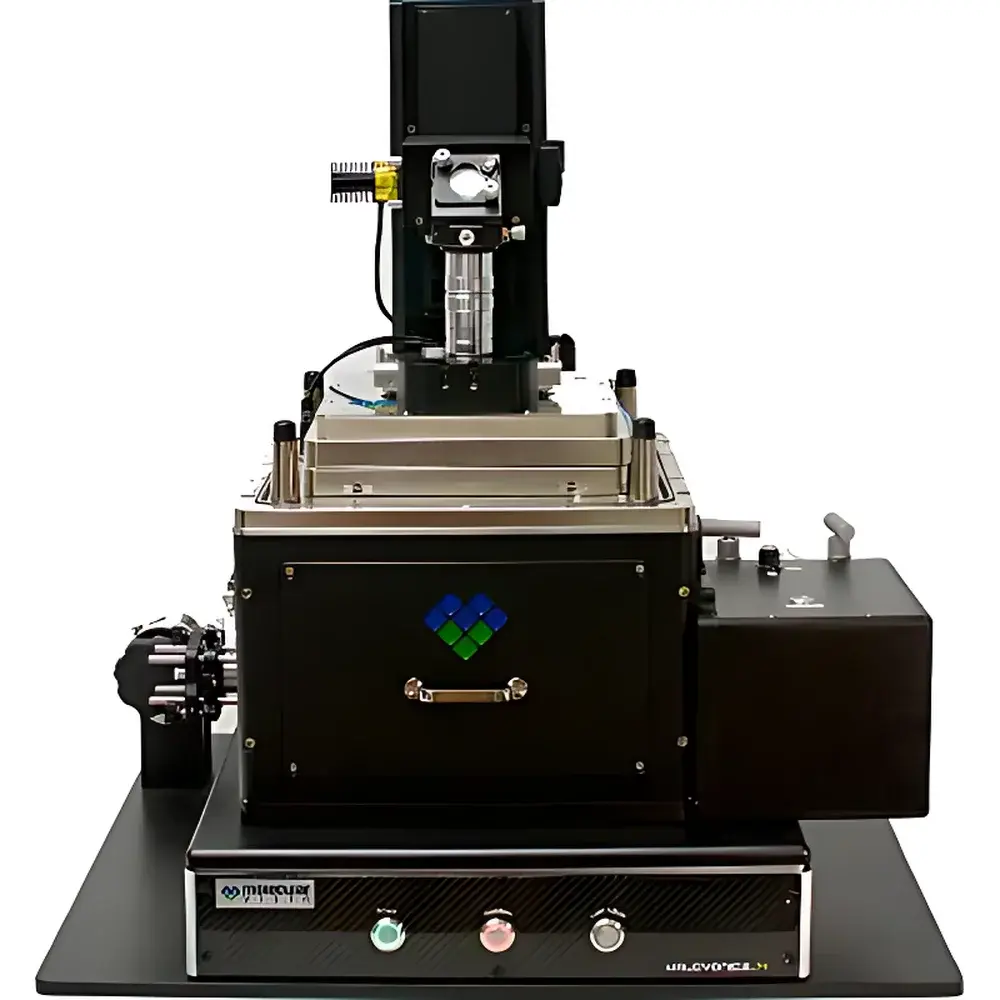
Molecular Vista Vista-SNOM Scattering-type Scanning Near-field Optical Microscope
| Brand | Molecular Vista |
|---|---|
| Origin | USA |
| Model | Vista-SNOM |
| Positioning Detection Noise | ≤ 50 pm RMS |
| Sample Size | Ø ≤ 25 mm, Thickness ≤ 10 mm |
| Sample Stage Travel Range | 6 mm × 6 mm |
Overview
The Molecular Vista Vista-SNOM is a high-performance scattering-type scanning near-field optical microscope engineered for sub-10 nm spatial resolution optical imaging and spectroscopy across the visible to mid-infrared spectral range. Unlike conventional aperture-based or shear-force regulated SNOM systems, the Vista-SNOM implements a dual-mode architecture centered on patented Photo-induced Force Microscopy (PiFM) and traditional scattering-SNOM (s-SNOM). PiFM operates by detecting the gradient force between an optically excited sharp metallic tip and nanoscale electromagnetic field gradients at the sample surface—enabling direct, background-free mapping of local electric field amplitude and phase without reliance on far-field optical collection optics. This principle eliminates diffraction-limited artifacts, detector bandwidth constraints, and polarization-dependent coupling inefficiencies common in s-SNOM. The instrument’s mechanical stability, ultra-low noise positioning (<50 pm RMS), and vacuum-compatible design ensure quantitative reproducibility required for correlative nanophotonic characterization.
Key Features
- Dual operational modes: PiFM (photo-induced force detection) and s-SNOM (scattering-based near-field signal acquisition), enabling cross-validated field mapping
- Sub-10 nm spatial resolution demonstrated in PiFM mode (FWHM = 3.1 nm reported on plasmonic nanostructures)
- Integrated interferometric laser excitation path supporting tunable visible–IR sources (e.g., Ti:Sapphire, OPO, QCL) with polarization control
- High-stability XYZ piezo stage with 6 mm × 6 mm travel range and closed-loop nanometer-level positioning accuracy
- Sample compatibility with flat, conductive or dielectric substrates up to Ø25 mm and 10 mm thickness
- Active acoustic and thermal noise isolation optimized for ambient and controlled-environment operation
Sample Compatibility & Compliance
The Vista-SNOM accommodates standard SEM/TEM-compatible sample holders and supports wafer-scale substrates (up to 25 mm diameter), including Si/SiO₂ wafers, ITO/glass slides, exfoliated 2D materials (graphene, hBN, TMDCs), plasmonic metasurfaces, and van der Waals heterostructures. All mechanical and optical components comply with ISO 14644-1 Class 5 cleanroom handling protocols. System software includes audit-trail logging per FDA 21 CFR Part 11 requirements for GLP/GMP-regulated environments, and raw data formats adhere to the HDF5 scientific data standard for long-term archival and third-party analysis interoperability.
Software & Data Management
Vista-SNOM is operated via VistaControl™ — a Python-based, modular acquisition platform supporting real-time lock-in demodulation (up to 5th harmonic), multi-channel synchronized imaging (topography + PiFM amplitude/phase + s-SNOM scattering), and automated spectral line-scan acquisition. Data cubes are stored in vendor-neutral HDF5 containers with embedded metadata (wavelength, polarization, tip bias, laser power, environmental conditions). Integrated post-processing modules include FFT-based deconvolution, dipole moment reconstruction, and FDTD-comparison overlays using Lumerical INTERCONNECT and Ansys HFSS APIs. Export options support ASTM E2983-22 compliant reporting templates for inter-laboratory validation.
Applications
- Nanoscale mapping of localized surface plasmon resonances (LSPR) in bimetallic heterodimers (e.g., Al–Au, Ag–Au) and plasmonic arrays
- Correlative characterization of exciton–polariton propagation in 2D semiconductor heterostructures
- Quantitative near-field photothermal and photoconductivity contrast imaging of quantum dot assemblies
- Validation of full-wave electromagnetic simulations (FDTD, RCWA) against experimentally resolved field distributions
- Surface-enhanced Raman scattering (SERS) hotspot localization and enhancement factor calibration
- Non-invasive dielectric constant profiling of thin-film organic semiconductors and perovskite absorbers
FAQ
How does PiFM differ from conventional s-SNOM in terms of signal origin and detection mechanism?
PiFM detects optical gradient forces between the tip and sample via AFM cantilever deflection, whereas s-SNOM measures scattered photons collected by far-field optics; PiFM is inherently background-free and polarization-agnostic.
Can the Vista-SNOM operate under ambient conditions or does it require vacuum?
It is fully functional in air or inert gas environments; vacuum compatibility is available as an optional upgrade for cryogenic or UHV applications.
Is the system compatible with external laser sources beyond the standard visible range?
Yes — the optical interface supports fiber-coupled inputs from UV (266 nm) to mid-IR (10 µm), including tunable OPOs and QCLs, with integrated beam conditioning optics.
What level of training and technical support is provided with purchase?
Molecular Vista offers on-site installation, application-specific workflow training (≥3 days), and remote diagnostics with SLA-backed 24/7 engineering support for academic and industrial users.
Does the software support batch processing and scripting for high-throughput experiments?
Yes — VistaControl™ includes a documented Python API, Jupyter notebook integration, and CLI tools for automated spectral acquisition, drift correction, and metadata-tagged dataset curation.



