
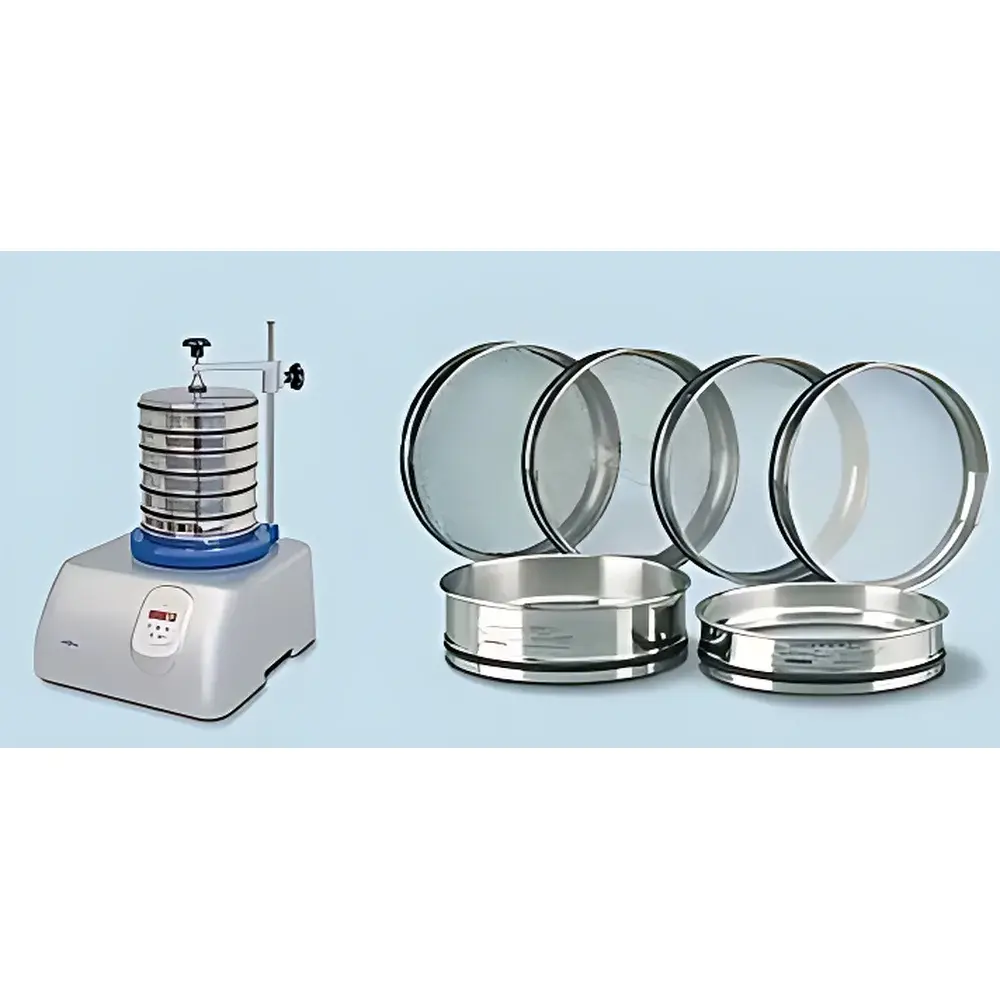
Engelsmann JEL 200-II Mechanical Alloy Sieve Analyzer
| Brand | Engelsmann |
|---|---|
| Origin | Germany |
| Model | JEL 200-II |
| Voltage | 230 V |
| Power Consumption | 0.14 kW |
| Net Weight | 27 kg |
| Dimensions (L×W×H) | 665 × 480 × 800 mm |
| Screening Method | Dry & Wet Sieving |
| Design Feature | Low-Profile Mounting for Ball Mill Integration |
| Filtration | Integrated Magnetic Filter with Pressure Sensor |
| Vacuum System | Suspended Vacuum Pump |
| Sample Handling | Hanging Collector Assembly |
Overview
The Engelsmann JEL 200-II Mechanical Alloy Sieve Analyzer is a precision-engineered, industrial-grade sieving system designed specifically for the particle size distribution analysis of mechanically alloyed powders and other fine granular materials. Operating on the principle of vibratory sieve separation—combined with controlled amplitude and frequency modulation—the instrument ensures high reproducibility in both dry and wet sieving modes. Its mechanical architecture is optimized for compatibility with continuous powder processing workflows, particularly in R&D laboratories and production QA/QC environments where alloy homogeneity, milling endpoint detection, and batch-to-batch consistency are critical. Unlike conventional laboratory shakers, the JEL 200-II integrates structural and functional adaptations—including ultra-low vertical profile and direct under-ball-mill mounting capability—to minimize manual handling, reduce cross-contamination risk, and support inline process monitoring protocols.
Key Features
- Bi-modal sieving operation: Fully validated for both dry sieving (for free-flowing metal alloys, intermetallics, and ceramic precursors) and wet sieving (for agglomerated or electrostatically charged powders requiring dispersion in aqueous or organic media)
- Low-profile mechanical design (800 mm total height): Enables direct installation beneath planetary ball mills or attritors without intermediate transfer stages—reducing sample exposure and operator intervention
- Hanging collector assembly: Modular, gravity-assisted sample recovery system with standardized mounting interfaces; supports rapid exchange of sieve stacks and sealed containment for hazardous or pyrophoric alloys
- Integrated magnetic filtration unit: Equipped with real-time pressure differential sensing to monitor filter clogging during wet sieving; enables automated shutdown or alarm triggering per predefined ΔP thresholds
- Suspended vacuum pump configuration: Decouples vibration transmission from the main frame, preserving sieve alignment integrity and minimizing mechanical drift during extended runs (≥4 h)
- Compliance-ready construction: All electrical components conform to IEC 61000-6-2 (EMC immunity) and IEC 61000-6-4 (EMC emission) standards; housing meets IP54 ingress protection rating
Sample Compatibility & Compliance
The JEL 200-II accommodates sieve diameters of 200 mm and standard ISO 3310-1 / ASTM E11 mesh configurations (from 20 µm to 3.35 mm), with optional stainless-steel or nickel-alloy sieve frames for corrosive or reactive alloy systems. It is routinely deployed in GLP-compliant metallurgical laboratories for ASTM B214 (Standard Test Method for Sieve Analysis of Metal Powders) and ISO 4497 (Metallic Powders — Determination of Particle Size Distribution by Sieving). The wet-sieving module complies with ISO 2591-1 requirements for liquid-phase dispersion stability, and its vacuum-assisted filtration path satisfies material retention criteria outlined in USP for particulate matter assessment in advanced powder formulations.
Software & Data Management
While the JEL 200-II operates as a stand-alone electromechanical system, it supports third-party integration via analog 0–10 V output signals (vibration amplitude, vacuum pressure, elapsed time) and digital RS-485 Modbus RTU interface. These enable synchronization with LIMS platforms (e.g., LabWare, Thermo Fisher SampleManager) and traceable data logging compliant with FDA 21 CFR Part 11 requirements when paired with validated acquisition software. Audit trails for sieve stack usage, cleaning cycles, and calibration verification events can be maintained externally through configurable metadata tagging.
Applications
- Endpoint determination in mechanical alloying processes (e.g., Ni–Al, Fe–Si, Ti–Nb systems)
- Quality control of gas-atomized and plasma-rotating-electrode (PREP) metal powders prior to additive manufacturing feedstock qualification
- Monitoring of cold-welding vs. fracturing balance during high-energy milling of composite powders
- Validation of deagglomeration efficiency following ultrasonic or surfactant-assisted dispersion treatments
- Regulatory submission support for ISO 13320-compliant particle size reports in medical device powder specifications
FAQ
Can the JEL 200-II be used for nanoscale powder characterization?
No—its operational lower detection limit is defined by the finest commercially available 200-mm-diameter test sieve (typically 20 µm per ISO 3310-1); submicron analysis requires laser diffraction or dynamic image analysis instrumentation.
Is wet sieving compatible with organic solvents?
Yes, provided solvent compatibility is confirmed for the magnetic filter housing (standard grade: AISI 316L stainless steel) and vacuum pump seals (FKM fluoroelastomer standard); custom seal materials (e.g., perfluoroelastomer) are available upon request.
Does the system include sieve calibration certification?
Each delivered unit includes a factory-verified dimensional certificate for the base sieve holder; individual sieve meshes require separate NIST-traceable calibration per ISO/IEC 17025-accredited providers.
What maintenance intervals are recommended for the suspended vacuum pump?
Oil changes every 500 operating hours; full bearing inspection every 2,000 hours; pressure sensor zero-point verification before each wet-sieving campaign.
Can multiple sieve stacks be run sequentially without manual reset?
No—stack loading and unloading remain manual operations per ISO 2591-1 procedural requirements; however, the hanging collector design reduces average cycle time to ≤90 seconds per stack.



