
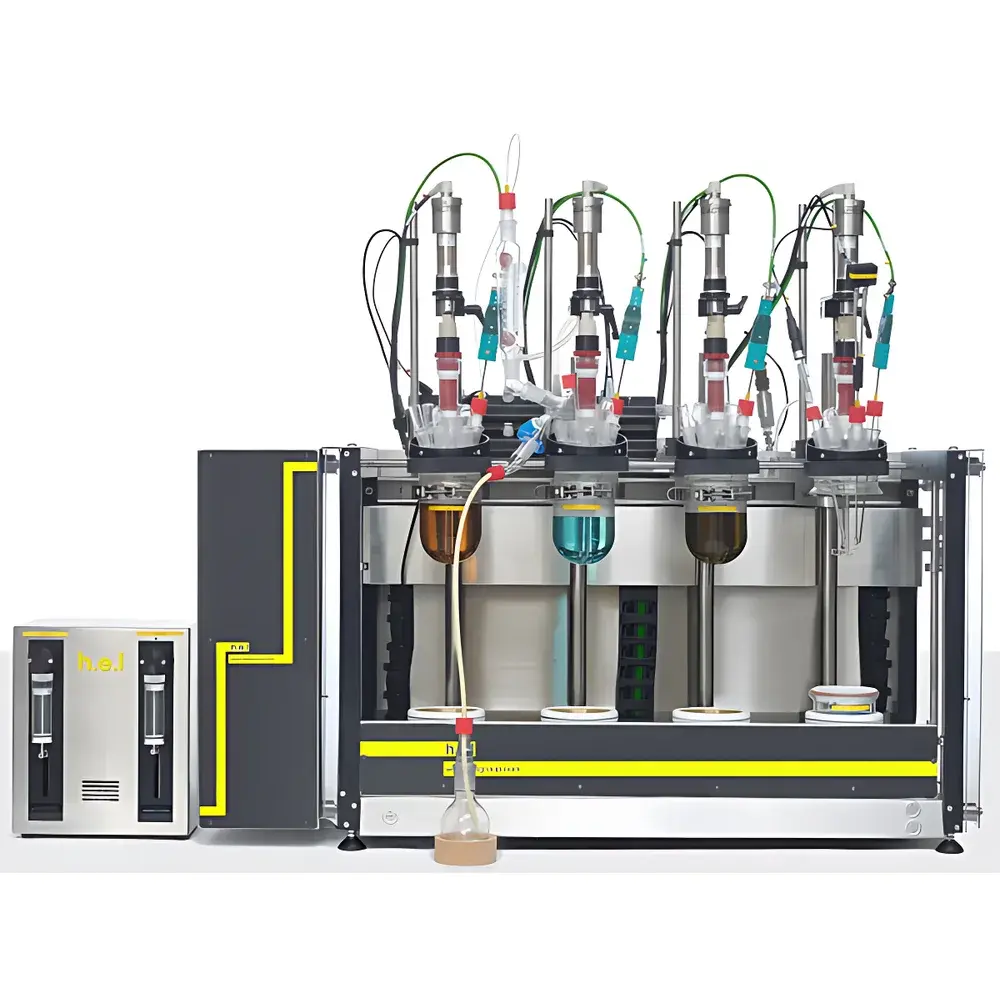
HEL AutoMATE 4 Automated Parallel Synthesis Platform
| Brand | HEL (UK) |
|---|---|
| Origin | United Kingdom |
| Model | AutoMATE 4 |
| Reactor Type | Modular Parallel Reactor System |
| Volume Range | 10–1000 mL |
| Pressure Rating | Up to 200 bar (customizable) |
| Temperature Range | −80 °C to 250 °C |
| Control Precision | ±0.1 °C |
| Stirring Options | Magnetic, Overhead Mechanical, or Dual-mode |
| Liquid Dosing Accuracy | ±0.1% (volumetric), ±0.01 g (gravimetric) |
| Gas Dosing | Mass Flow Controlled |
| Vacuum Capability | Up to 10 MPa (absolute) |
| Construction Materials | 316 stainless steel, Hastelloy®, inert polymer seals, Pyrex® glass vessels |
| Compliance | Designed for GLP/GMP environments |
Overview
The HEL AutoMATE 4 is a fully automated, modular parallel synthesis platform engineered for high-precision, multi-condition chemical reaction development under controlled temperature, pressure, and stoichiometric environments. Based on Couette-type fluid dynamics and closed-loop process control architecture, the system implements simultaneous independent operation across up to eight reaction zones—each configurable as low-pressure, medium-pressure, or high-pressure reactors (up to 200 bar). Its core design principle centers on experimental fidelity: replicating scalable process conditions—from early-stage catalyst screening and kinetic profiling to late-stage process safety assessment and pilot-scale parameter transfer. Unlike conventional batch reactors, the AutoMATE 4 integrates real-time thermodynamic, rheological, and compositional monitoring interfaces (e.g., FTIR, pH, turbidity, particle size) directly into reactor heads, enabling in situ data acquisition without manual intervention or sampling-induced perturbation.
Key Features
- Modular Multi-Zone Architecture: Selectable configurations of 2, 4, 6, or 8 independently controlled reaction stations—each with dedicated thermal management, stirring, dosing, and sensing subsystems.
- Dual Thermal Control Modes: Oil-bath circulation (−80 °C to 250 °C, ±0.1 °C stability) or integrated electric heating jackets (RT to 250 °C, ±0.1 °C), supporting inter-zone ΔT up to 100 °C for comparative reaction studies.
- Multi-Mode Stirring: Programmable magnetic drive (0–2000 rpm, 800 N·cm max torque) and overhead mechanical agitation (0–2000 rpm, 80 N·cm max torque), with dynamic seal integrity verified per ISO 20816-1 for rotating equipment vibration thresholds.
- Redundant Liquid Dosing: Volumetric delivery via HPLC-grade pumps (0.01–50 mL/min, ±0.1% accuracy) and gravimetric delivery using calibrated load cells (1–12 kg range, ±0.01 g resolution), both with isolated channel routing and high-integrity multi-position valves.
- Gas & Solid Feed Integration: Mass flow controllers (MFCs) compliant with ASTM E2654 for reactive gas introduction; screw-fed solid dosing modules (350/500 mL capacity) with feed rate regulation traceable to NIST-traceable torque calibration standards.
- Corrosion-Resistant Construction: Reactor heads in 316SS or Hastelloy® C-276; static/dynamic seals in PTFE, Kalrez®, or Chemraz®; glass vessels conforming to DIN ISO 3585 (Pyrex® borosilicate, Class A volumetric tolerance).
Sample Compatibility & Compliance
The AutoMATE 4 accommodates heterogeneous reaction media—including highly corrosive reagents (e.g., HF, oleum, anhydrous AlCl₃), pyrophoric organometallics, and oxygen-sensitive catalytic systems—through material selection validated per ASTM G152 (accelerated corrosion testing) and NACE MR0175/ISO 15156. All wetted components undergo passivation per ASTM A967 and surface roughness verification (Ra ≤ 0.4 µm). The platform supports compliance workflows aligned with ICH Q5, Q7, and USP analytical instrument qualification (AIQ) protocols. Optional software modules provide electronic signatures, change control logs, and audit trails meeting FDA 21 CFR Part 11 requirements for regulated pharmaceutical and fine chemical development labs.
Software & Data Management
HEL’s proprietary Synthia™ software provides unified control across thermal, mechanical, fluidic, and analytical subsystems. It features deterministic real-time scheduling (sub-100 ms loop cycle), event-triggered action sequences (e.g., “if exotherm > 5 °C/min, activate emergency cooling”), and native export to CSV, HDF5, and ISA-88-compliant S88 recipe formats. Data integrity is ensured through SHA-256 hashing of raw sensor streams and time-synchronized metadata tagging (IEEE 1588 PTP v2). Historical experiment comparison tools support multivariate analysis (PCA, PLS regression) for identifying critical process parameters (CPPs) per ICH Q8(R2). All software updates are delivered via signed firmware packages verified against HEL’s public key infrastructure.
Applications
- Catalyst screening and structure–activity relationship (SAR) mapping across combinatorial ligand libraries
- Reaction calorimetry and thermal runaway assessment per UN GHS Test Series H.2 and ASTM E1981
- Kinetic modeling using in situ FTIR absorbance time-series under varied residence times and concentrations
- Continuous-flow process parameter translation from microreactor to batch scale using dimensionless number matching (Re, Da, We)
- Polymorph screening under controlled supersaturation profiles with integrated turbidity feedback
- Electrochemical synthesis optimization with potentiostatic/galvanostatic integration via optional analog I/O expansion
FAQ
What pressure ratings are available for the AutoMATE 4 reactor vessels?
Standard configurations support 60, 100, and 200 bar; custom designs extend to 350 bar upon engineering review and ASME Section VIII Div. 2 certification.
Can the system operate under inert atmosphere while performing real-time pH monitoring?
Yes—integrated glovebox-compatible gas purging manifolds maintain O₂ < 1 ppm; pH probes feature hermetically sealed reference junctions rated for prolonged exposure to N₂/Ar environments.
Is remote operation supported for unattended overnight experiments?
Fully supported via TLS 1.3–encrypted web interface; includes SMS/email alerting on deviation events and automatic experiment suspension with state preservation.
How is calibration traceability maintained across liquid dosing modules?
Each pump and balance undergoes annual recalibration against UKAS-accredited standards (ISO/IEC 17025); certificates include uncertainty budgets per EURAMET cg-18.
Does the platform support integration with third-party analytical instruments?
Yes—via RS-232, Ethernet/IP, or OPC UA; pre-certified drivers available for Thermo Fisher, Mettler Toledo, and Hamilton devices.
Related Products



