
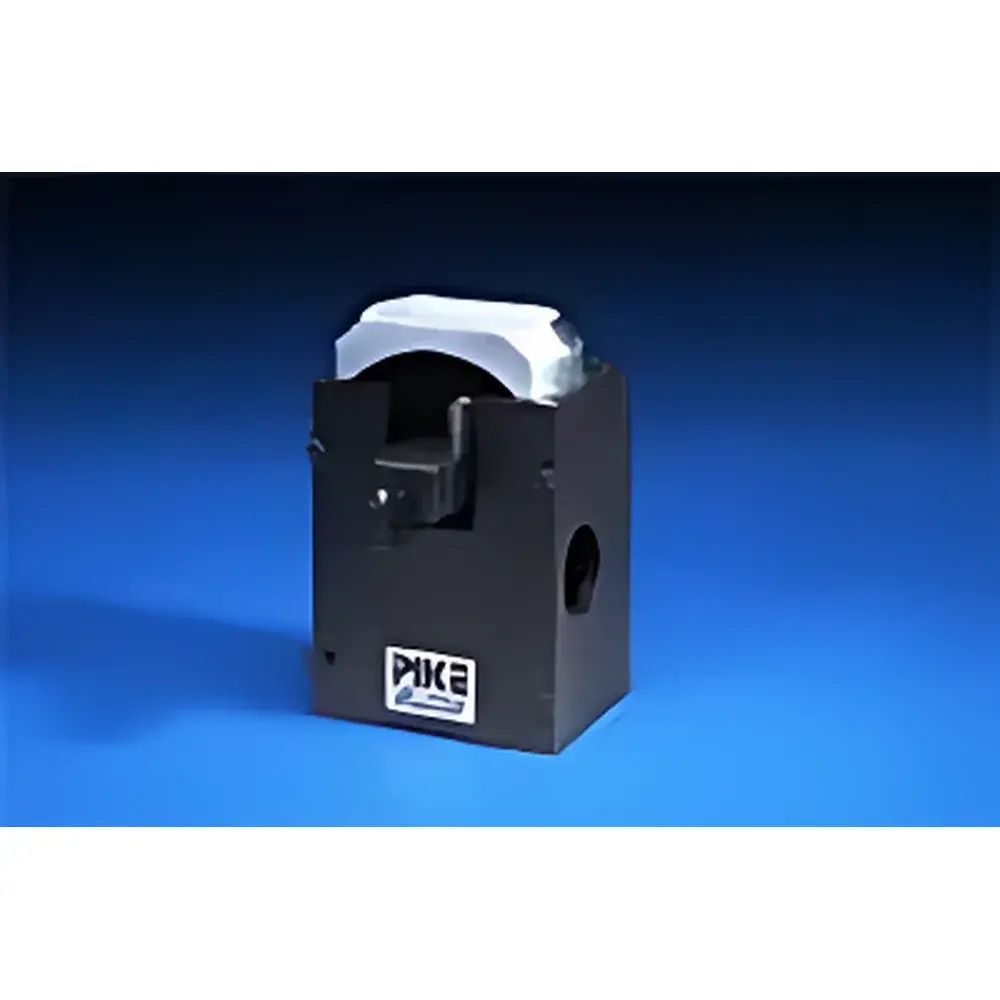
PIKE EasiDiff™ QC Diffuse Reflectance Accessory
| Brand | PIKE |
|---|---|
| Origin | USA |
| Model | P042-1000 |
| Compatibility | Varian, Shimadzu, Bruker, PerkinElmer FTIR spectrometers |
| Mounting | Base-mounted |
| Optical Design | Monolithic mirror construction |
| Adjustment | Micrometer-driven sample cup positioning |
| Performance | Optimized infrared beam path for high throughput and signal-to-noise ratio |
| Optional Variants | Gold-coated, NIR-specific, external large-sample, heated, and automated multi-sample versions |
Overview
The PIKE EasiDiff™ QC Diffuse Reflectance Accessory (Model P042-1000) is an engineered optical interface designed for routine qualitative and quantitative analysis of powdered, granular, or heterogeneous solid samples in Fourier-transform infrared (FTIR) spectroscopy. It operates on the principle of diffuse reflectance—where incident IR radiation penetrates the sample surface, undergoes multiple internal scattering events, and re-emerges as a wavelength-dependent signal proportional to the sample’s molecular absorption characteristics. This technique eliminates the need for KBr pellet preparation or solvent dissolution, significantly reducing sample preparation time while preserving native sample morphology. The accessory is optimized for robustness and reproducibility in quality control (QC) environments where daily instrument uptime, operator consistency, and method transferability are critical.
Key Features
- Base-mounted mechanical design ensures stable integration with major benchtop FTIR platforms—including Varian (now Agilent), Shimadzu, Bruker, and PerkinElmer systems—without requiring optical realignment or custom cabling.
- Monolithic mirror assembly fabricated from high-purity aluminum with precision-machined reflective surfaces minimizes optical aberrations and maintains long-term alignment stability under thermal cycling.
- Micrometer-controlled vertical adjustment of the sample cup enables sub-50 µm positional repeatability, facilitating precise optimization of the incident beam angle and focal spot size on the sample surface.
- Optimized optical path geometry delivers enhanced radiant throughput across the mid-IR range (4000–400 cm⁻¹), directly contributing to improved signal-to-noise performance—particularly critical for low-concentration analytes or weakly absorbing functional groups.
- Modular housing accommodates interchangeable sample cups (standard 13 mm diameter, depth-adjustable), supporting both manual and semi-automated workflows without hardware modification.
Sample Compatibility & Compliance
The EasiDiff™ QC accessory accepts dry, free-flowing powders; pressed pellets; tablets; polymer films; and irregular solids up to 25 mm in lateral dimension. Its non-destructive nature complies with ASTM E1252-98 (Standard Practice for General Techniques for Quantitative Infrared Analysis by Diffuse Reflectance) and supports GLP/GMP-aligned QC procedures. When used with validated FTIR systems compliant with FDA 21 CFR Part 11, the accessory enables audit-trail-capable data acquisition when paired with appropriate software controls. No hazardous solvents or consumables are required, aligning with ISO 14001 laboratory sustainability objectives.
Software & Data Management
The accessory functions transparently within standard FTIR acquisition software suites (e.g., OPUS, Spectrum, Spectrum One, KnowItAll). Spectral collection follows conventional background-subtracted diffuse reflectance protocols (e.g., Kubelka-Munk transformation), with full support for baseline correction, peak integration, and multivariate calibration (PLS, PCA). Raw interferograms and processed spectra retain native metadata—including instrument ID, date/time stamp, operator ID, and accessory configuration parameters—ensuring traceability per ISO/IEC 17025 requirements. Export formats include JCAMP-DX, ASCII, and CSV for integration into LIMS or statistical process control (SPC) platforms.
Applications
- Routine identity verification of raw materials (e.g., excipients, APIs, catalysts) against reference spectral libraries (USP, EP, ATR-FTIR databases).
- Quantitative assay of blend uniformity in pharmaceutical tablet manufacturing using partial least squares regression models.
- Surface oxidation monitoring of polymer films and coatings via carbonyl index tracking (1710 cm⁻¹ / 2920 cm⁻¹ ratio).
- Moisture content estimation in hygroscopic powders through O–H stretch band deconvolution (3600–3200 cm⁻¹).
- Batch release testing of inorganic pigments, clays, and mineral fillers based on characteristic lattice vibration fingerprints.
FAQ
Is the P042-1000 compatible with my existing FTIR system?
Yes—it is mechanically and optically configured for seamless integration with Varian, Shimadzu, Bruker, and PerkinElmer FTIR spectrometers equipped with standard front-access sample compartments.
Does this accessory require special calibration standards?
No proprietary calibration is needed; however, routine verification using NIST-traceable SRM 1921b (polyethylene film) or SRM 2036 (alumina powder) is recommended for performance qualification.
Can I use the same accessory for both mid-IR and near-IR measurements?
The P042-1000 is optimized for mid-IR; for NIR applications (12500–4000 cm⁻¹), PIKE offers a dedicated NIR-optimized variant (Model P042-NIR) with enhanced detector coupling efficiency.
What maintenance is required to ensure long-term performance?
Annual inspection of mirror surface integrity and micrometer backlash tolerance is advised; cleaning should be performed only with spectroscopic-grade methanol and lint-free wipes—no abrasive agents.
Is remote operation or automation supported?
While the base P042-1000 is manually operated, PIKE provides an automated multi-sample carousel version (EasiDiff™ Auto) with programmable stage control and API-level integration into LabVIEW or Python-based control environments.





