
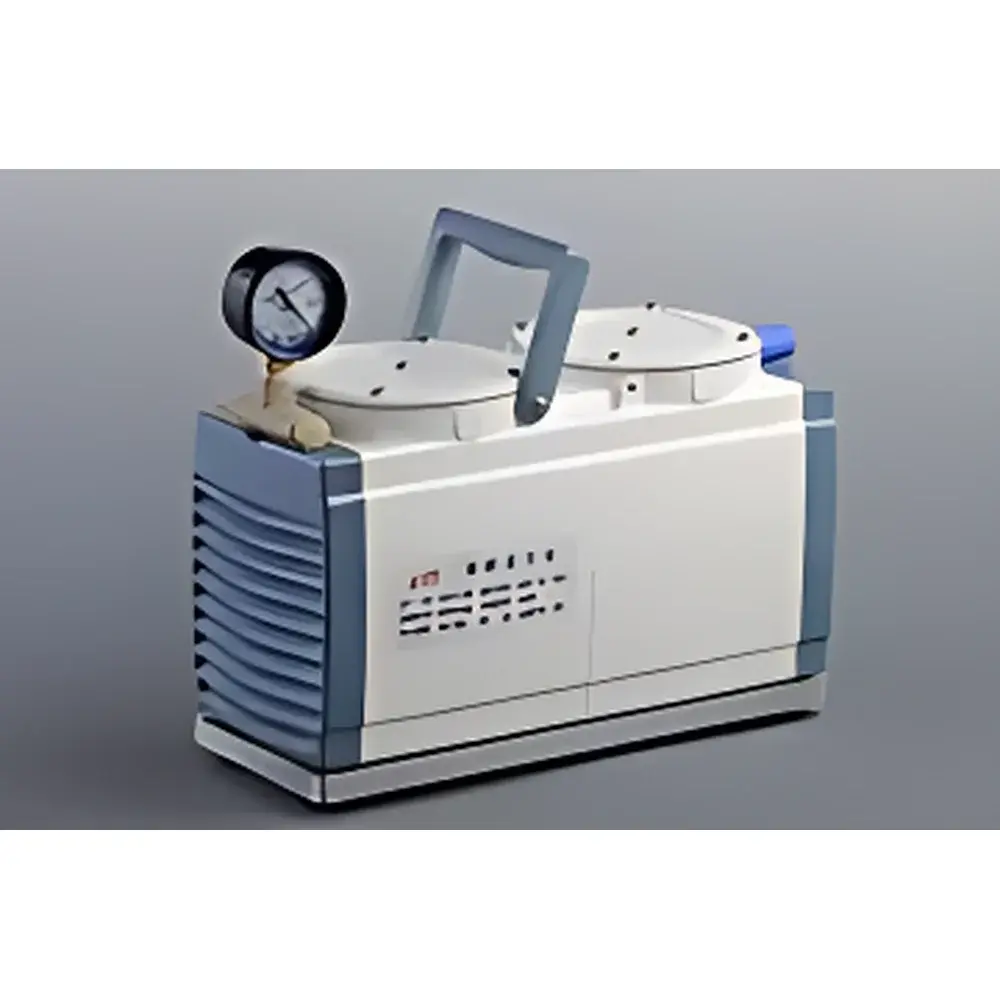
GM-0.33A Diaphragm Vacuum Pump
| Origin | Tianjin, China |
|---|---|
| Manufacturer Type | Distributor |
| Origin Category | Domestic (China) |
| Model | GM-0.33A |
| Quotation | Upon Request |
| Pumping Speed | 20 L/min |
| Operating Temperature (Pump Body) | <60 °C |
| Ultimate Vacuum Pressure | ≤0.08 MPa (200 mbar abs.) |
| Noise Level | <55 dB(A) |
| Inlet Port Diameter | φ6 mm |
| Dimensions (L×W×H) | 235×120×215 mm |
| Motor Power | 160 W |
| Net Weight | 7.5 kg |
| Ambient Operating Temperature | 7–40 °C |
| Configuration | Negative-Pressure (Suction-Only) Type |
Overview
The GM-0.33A Diaphragm Vacuum Pump is a compact, oil-free laboratory vacuum source engineered for reliable, contamination-free operation in analytical, preparative, and quality control workflows. Utilizing a corrosion-resistant PTFE-coated diaphragm and EPDM valve assembly, it generates stable negative pressure via reciprocating mechanical displacement—eliminating the need for lubricating oil and preventing sample or process contamination. Its ultimate vacuum capability of ≤0.08 MPa (200 mbar absolute) and continuous pumping speed of 20 L/min at atmospheric inlet conditions make it suitable for routine vacuum filtration, rotary evaporation support (with appropriate cold trap integration), vacuum drying ovens, and gas sampling applications where hydrocarbon-free vacuum is mandatory. Designed for ambient environments between 7 °C and 40 °C, the pump maintains thermal stability with a maximum housing surface temperature below 60 °C under sustained load, ensuring safe benchtop deployment in shared laboratory spaces.
Key Features
- Oil-free operation ensures zero hydrocarbon backstreaming—critical for GC sample introduction, mass spectrometry auxiliary vacuum stages, and solvent-sensitive applications.
- PTFE-diaphragm and EPDM valve system provides chemical resistance to common organic solvents (e.g., acetone, methanol, ethyl acetate) and mild aqueous acids/bases.
- Low-noise design (<55 dB[A] at 1 m distance) enables quiet operation in open-plan labs and near sensitive instrumentation such as balances or microscopes.
- Compact footprint (235 × 120 × 215 mm) and lightweight construction (7.5 kg) facilitate mobility between fume hoods, gloveboxes, and modular workstations.
- Thermally optimized 160 W brushless motor delivers consistent torque across voltage fluctuations (220–240 V AC, 50/60 Hz), minimizing duty-cycle derating.
- Single-stage, suction-only (negative-pressure) configuration simplifies installation—no exhaust line routing or external muffler required.
Sample Compatibility & Compliance
The GM-0.33A is compatible with standard glassware interfaces including 6 mm O.D. tubing (via φ6 mm inlet port) and B14/B19 ground-glass joints when used with appropriate adapters. It meets general-purpose laboratory safety requirements per IEC 61010-1:2010 for electrical equipment used in measurement, control, and laboratory use. While not certified for explosive atmospheres (ATEX/IECEx), its spark-free diaphragm actuation makes it suitable for non-hazardous area applications. The pump supports GLP-compliant documentation workflows when integrated into validated vacuum-assisted processes—audit trails for vacuum-dependent steps (e.g., filtration time stamps, pressure stabilization logs) may be captured externally via connected data loggers.
Software & Data Management
The GM-0.33A operates as a standalone analog device without embedded firmware or digital connectivity. For traceable vacuum process control, it may be paired with third-party pressure transducers (e.g., capacitance manometers calibrated to 0.1–1000 mbar range) and USB/data-logging systems compliant with FDA 21 CFR Part 11 requirements. Integration with LabArchives, Electronic Lab Notebooks (ELN), or LIMS is achieved via CSV export of time-stamped pressure and runtime data from external acquisition hardware—enabling full auditability of vacuum-critical unit operations in regulated QC/QA environments.
Applications
- Vacuum-assisted gravity filtration of precipitates, cell suspensions, or particulate-laden solutions using Buchner or Hirsch funnels.
- Support vacuum for benchtop rotary evaporators handling low-boiling solvents (e.g., dichloromethane, diethyl ether), particularly when combined with dry ice/acetone cold traps.
- Evacuation of desiccators and vacuum drying chambers operating up to 60 °C chamber temperature.
- Gas-phase sampling for environmental analysis (e.g., VOC collection onto sorbent tubes per EPA Method TO-17).
- Pre-vacuum priming of HPLC degassers and autosampler purge cycles in method development labs.
- Low-vacuum stage in multi-pump vacuum manifolds where roughing is required prior to high-vacuum turbomolecular pumping.
FAQ
Is the GM-0.33A suitable for continuous 24/7 operation?
It is rated for intermittent duty (up to 8 hours per day with ≥30-minute cooldown intervals); extended unattended operation requires external thermal monitoring and pressure interlock circuitry.
Can this pump handle corrosive vapors such as HCl or Cl₂?
No—while the diaphragm and valves resist mild organics and dilute aqueous media, strong oxidizers and halogen acids will degrade EPDM and compromise seal integrity; stainless-steel or fluoropolymer-lined pumps are recommended for such service.
What maintenance schedule is recommended?
Diaphragm and valve kit replacement every 6,000–8,000 hours of cumulative runtime or annually under typical lab usage; inlet filter cleaning weekly if used with dusty or particulate-laden streams.
Does the pump include an internal vacuum gauge?
No—vacuum level must be monitored externally using a calibrated pressure sensor installed downstream of the inlet port.
Is the GM-0.33A compliant with ISO 8573-1 for compressed air purity?
Not applicable—the unit produces vacuum, not compressed air; ISO 8573-1 pertains to pneumatic systems and oil contamination classes for positive-pressure gas delivery.



