
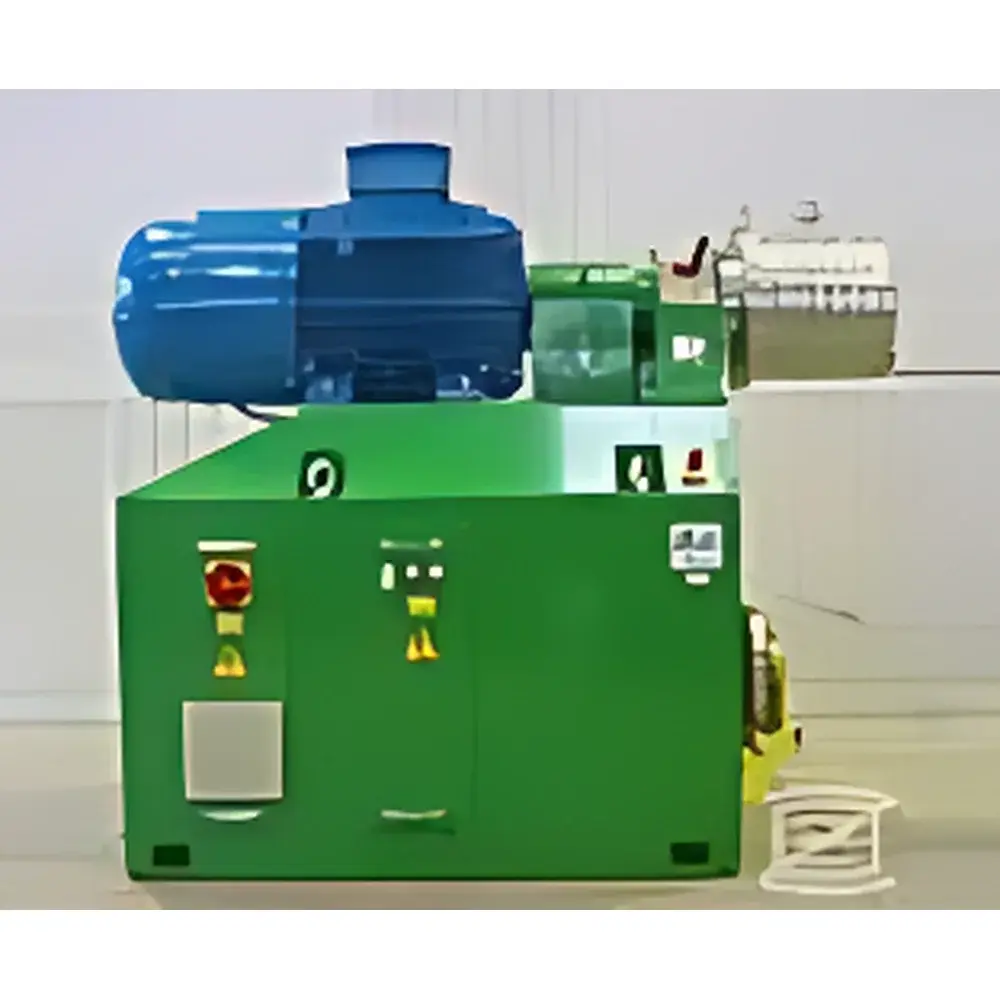
Simoloyer CM02 High-Energy Horizontal Rotational Ball Mill
| Origin | Germany |
|---|---|
| Manufacturer Type | Authorized Distributor |
| Origin Category | Imported |
| Model | Simoloyer CM02 |
| Instrument Type | High-Energy Ball Mill |
| Grinding Chamber Volume | 0.5–900 L |
| Throughput Capacity | 200 g – 250 kg per batch |
| Drive Power | 2.7–220 kW |
| Maximum Feed Size | ~20 mm |
| Final Particle Size | <1 µm |
| Operating Atmosphere | Air, Inert Gas (e.g., Ar, N₂), or Vacuum |
| Temperature Control | Integrated Heating/Cooling Jacket |
| Sealing System | Dual-Rotor Dynamic Seal with Air Lock and Vacuum Compatibility |
| Rotor Speed Range | Up to 3× Higher Than Conventional Planetary Mills |
Overview
The Simoloyer CM02 is a high-energy horizontal rotational ball mill engineered for advanced mechanochemical processing—including mechanical alloying, reactive milling, and ultrafine grinding of metals, ceramics, intermetallics, and composite precursors. Unlike conventional planetary or vibratory mills, the Simoloyer employs a horizontally oriented, high-speed rotating drum with an internal rotor assembly that imparts controlled kinetic energy via centrifugal acceleration and shear-induced collisions. This architecture eliminates gravitational stratification of grinding media, ensuring uniform energy distribution across the entire grinding chamber volume. The system operates on the principle of repeated plastic deformation, cold welding, and fracturing—driving solid-state phase transformations, amorphization, nanocrystallization, and metastable compound formation without thermal input. It is widely adopted in materials science laboratories and pilot-scale R&D facilities where thermodynamically inaccessible phases (e.g., amorphous alloys, supersaturated solid solutions, nanocomposites) must be synthesized under precisely controlled atmospheres and thermal conditions.
Key Features
- Horizontal rotor design eliminates gravity-induced media segregation and ensures homogeneous impact energy distribution throughout the grinding chamber.
- Dual-seal dynamic air-lock system enables full atmosphere control: operation under ambient air, inert gas (Ar/N₂), or high-vacuum (<10⁻² mbar) without cross-contamination.
- Modular, quick-change grinding units support rapid adaptation between dry, wet, cryogenic, or reactive milling configurations.
- Integrated temperature management via jacketed chamber allows precise process cooling (down to −40 °C) or heating (up to +200 °C) during operation.
- High-torque, high-RPM rotor drive (up to 3× faster than standard planetary mills) delivers reproducible specific energy input (kWh/kg) critical for scalable mechanochemical synthesis.
- MALTOZ®-Simoloyer operating system provides fully automated cycle control, real-time logging of torque, power consumption, RPM, temperature, and vacuum level—compliant with GLP/GMP data integrity requirements.
- Batch, semi-continuous, and continuous feed/discharge modes supported; scalable from lab-scale (200 g) to industrial production (250 kg/batch).
Sample Compatibility & Compliance
The Simoloyer CM02 accommodates a broad spectrum of feedstock forms—including elemental powders, flakes (e.g., Cu foil), chips, and pre-alloyed granules—enabling synthesis of nanostructured alloys (Fe–Al, Ni–Ti), oxide-dispersed strengthened steels, metal–organic frameworks (MOFs), battery cathode precursors (LiCoO₂ composites), and catalytic nanoparticles. All wet-milling variants are compatible with common solvents (ethanol, heptane, toluene) and surfactants. The system conforms to IEC 61000-6-2/6-4 (EMC), EN 60204-1 (machine safety), and ISO 12100 for risk assessment. Optional validation packages support IQ/OQ documentation aligned with FDA 21 CFR Part 11 for regulated pharmaceutical and biomedical material development.
Software & Data Management
The MALTOZ® control platform runs on a Windows-based industrial PC with deterministic real-time kernel. Each milling cycle generates timestamped, encrypted binary logs containing ≥12 synchronized process variables. Export formats include CSV, XML, and PDF reports with digital signatures. Audit trails record user login, parameter changes, emergency stops, and calibration events—fully traceable for regulatory review. Remote monitoring and secure cloud backup (via optional TLS-encrypted gateway) enable multi-site process harmonization and long-term trend analysis for DOE-driven optimization.
Applications
- Mechanical alloying of immiscible systems (e.g., Al–Fe, Cu–Ti) into metastable solid solutions or nanocomposites.
- Top-down synthesis of crystalline-to-amorphous transitions in metallic glasses and chalcogenides.
- Reactive milling for in-situ formation of nitrides (e.g., TiN), borides (e.g., MgB₂), and hydrides (e.g., NaAlH₄).
- Grain refinement and defect engineering in high-entropy alloys (HEAs) and ODS steels prior to SPS or HIP consolidation.
- Preparation of functionalized nanocarbons and graphene oxide hybrids for electrochemical applications.
- Pharmaceutical co-milling to enhance dissolution kinetics and bioavailability of BCS Class II compounds.
FAQ
What distinguishes the Simoloyer CM02 from planetary ball mills?
Its horizontal rotor geometry prevents gravitational media settling, enabling uniform energy transfer and eliminating dead zones—critical for reproducible nanocrystallization and avoiding localized overheating.
Can the system operate under oxygen-free conditions?
Yes—integrated vacuum pumping, inert gas purging, and dual-stage air-lock loading/unloading ensure oxygen levels <1 ppm during processing.
Is scale-up from lab to production feasible?
Absolutely—the CM02 series maintains identical kinematic principles across all models (CM01 to CM900); process parameters (specific energy, residence time, media-to-powder ratio) translate linearly with chamber volume.
Does the system support GMP-compliant documentation?
Yes—MALTOZ® includes electronic signature capability, audit trail generation, and 21 CFR Part 11–ready configuration options for validated environments.
What maintenance intervals are recommended for the dynamic sealing system?
Seal inspection is advised every 500 operational hours; replacement intervals range from 1,500–3,000 hours depending on atmosphere and abrasive load—documented in the OEM service manual.



