
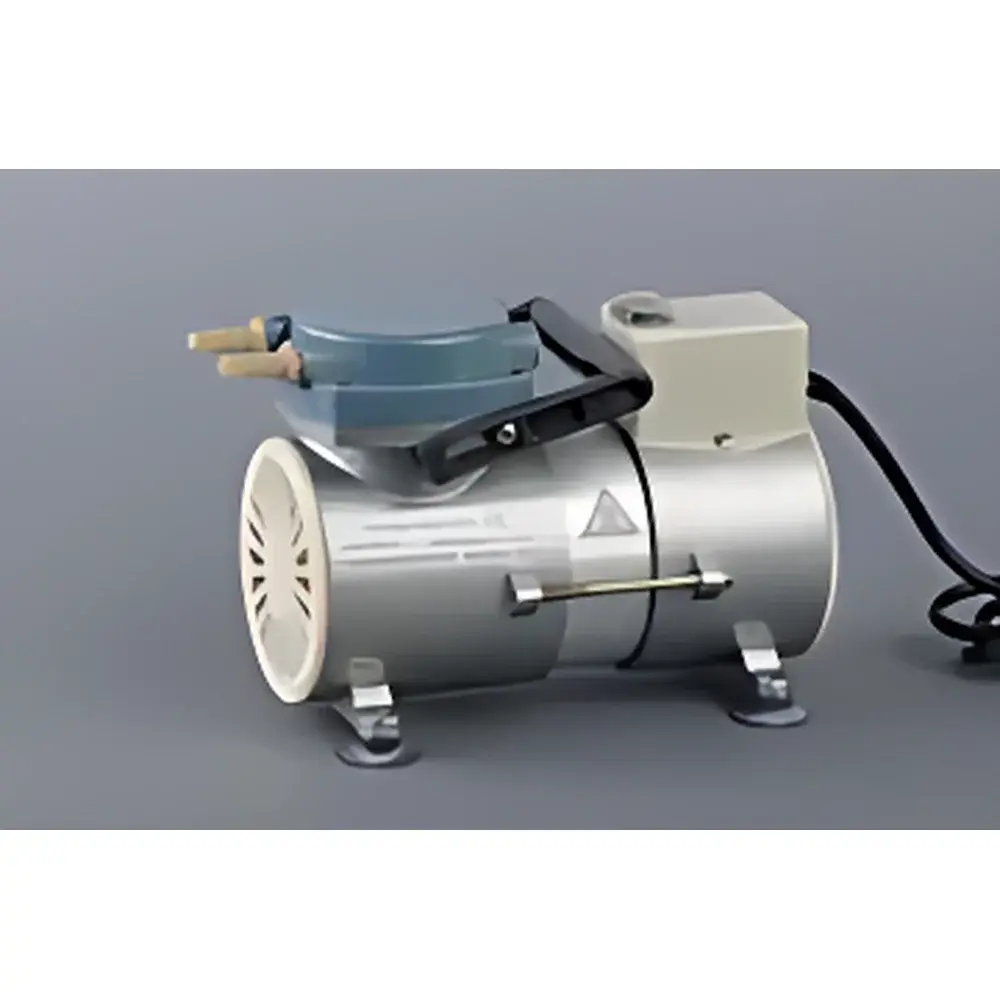
GM-0.20 Diaphragm Vacuum Pump
| Origin | Tianjin, China |
|---|---|
| Manufacturer Type | Authorized Distributor |
| Origin Classification | Domestic (China) |
| Model | GM-0.20 |
| Quotation | Upon Request |
| Pumping Speed | 15 L/min |
| Maximum Operating Temperature | <55 °C |
| Ultimate Vacuum Pressure | 250 mbar (≈30 psi gauge positive, 0.075 MPa) |
| Noise Level | <50 dB(A) |
| Inlet Port Diameter | φ6 mm |
| Dimensions (L×W×H) | 195 × 98 × 156 mm |
| Motor Power | 75 W |
| Net Weight | 4 kg |
| Ambient Operating Temperature Range | 7–40 °C |
| Diaphragm Material | Nylon |
Overview
The GM-0.20 Diaphragm Vacuum Pump is an oil-free, maintenance-light laboratory vacuum source engineered for precision and reliability in low-to-medium vacuum applications. Utilizing a reciprocating elastomeric diaphragm driven by an eccentric cam mechanism, it generates vacuum through positive displacement without internal lubrication—eliminating risk of oil contamination, hydrocarbon backstreaming, or vapor phase interference in sensitive analytical workflows. Designed for continuous duty under ambient conditions, the pump achieves an ultimate pressure of 250 mbar (absolute), supporting applications such as solvent evaporation, filtration, degassing, and vacuum drying where clean, dry, and chemically inert vacuum is required. Its compact footprint (195 × 98 × 156 mm) and lightweight construction (4 kg) make it ideal for benchtop integration in QC labs, academic research settings, and pilot-scale process development environments.
Key Features
- Oil-free operation ensures zero hydrocarbon carryover—critical for GC sample preparation, mass spectrometry interfaces, and pharmaceutical residual solvent analysis.
- Nylon-reinforced diaphragm provides enhanced chemical resistance to common solvents including acetone, ethanol, ethyl acetate, and dilute aqueous acids and bases.
- Low-noise design (<50 dB[A] at 1 m) enables quiet operation in shared laboratory spaces without acoustic shielding.
- Thermally stable architecture maintains consistent pumping performance across ambient temperatures from 7 °C to 40 °C; internal temperature rise remains below 55 °C during extended operation.
- Integrated thermal protection circuitry prevents motor overload and extends service life under variable load conditions.
- Standard φ6 mm inlet port compatible with universal hose barbs and Swagelok®-style fittings for rapid connection to filtration manifolds, rotary evaporators, and vacuum desiccators.
Sample Compatibility & Compliance
The GM-0.20 is suitable for non-corrosive, non-particulate, and non-condensable gas streams. It is not rated for use with aggressive halogenated solvents (e.g., chloroform, carbon tetrachloride), strong oxidizers (e.g., nitric acid vapors), or high-humidity saturated vapor loads exceeding 60% RH without external cold trap integration. While not certified to ISO 8573-1 Class 0 for compressed air purity, its oil-free architecture meets ISO 8573-1 Class 1 requirements for solid particulates and Class 2 for water content when operated within specified ambient limits. The pump complies with IEC 61000-6-3 (EMC emission standards) and IEC 61000-6-2 (immunity), and its electrical safety conforms to IEC 61010-1 for laboratory equipment. Documentation supports GLP-compliant lab audits when paired with validated usage logs and preventive maintenance records.
Software & Data Management
As a standalone mechanical vacuum source, the GM-0.20 operates without embedded firmware or digital control interfaces. It features a single-pole, single-throw (SPST) on/off switch and requires no calibration or software configuration. For traceability in regulated environments, users may integrate it into automated systems via external relay control or PLC-triggered vacuum sequencing. When deployed in FDA-regulated workflows (e.g., USP method validation), the pump’s operational parameters—including runtime, ambient temperature, and inlet pressure trends—can be logged externally using third-party pressure transducers and data acquisition modules compliant with 21 CFR Part 11 requirements (audit trail, electronic signature, and data integrity controls).
Applications
- Vacuum-assisted gravity and pressure filtration in analytical chemistry and environmental testing (e.g., EPA Method 1664, ASTM D892).
- Rotary evaporation support for solvent removal in natural product isolation and synthetic intermediate purification.
- Sample degassing prior to HPLC mobile phase preparation or viscometry measurements to prevent bubble-induced signal drift.
- Desiccator evacuation for moisture-sensitive reagent storage and hygroscopic material handling.
- Gas sampling system priming and purge cycles in headspace-GC and portable FTIR field instrumentation.
FAQ
Is the GM-0.20 suitable for vacuum ovens or freeze dryers?
No—it lacks the ultimate vacuum depth (<0.1 mbar) and pumping capacity required for lyophilization or high-vacuum thermal processing. It is optimized for rough vacuum applications up to 250 mbar.
Can this pump handle acidic vapors from digestion fumes?
Not without supplemental gas scrubbing. While the nylon diaphragm resists mild acidity, prolonged exposure to HCl, HF, or NOx vapors will degrade elastomer integrity and compromise seal longevity.
What is the expected service life under continuous operation?
With proper ambient ventilation and absence of condensable vapors, mean time between failures (MTBF) exceeds 10,000 hours based on accelerated life testing per IEC 60601-1 Annex J protocols.
Does the pump include a built-in vacuum gauge?
No. A separate analog or digital vacuum gauge (e.g., Pirani or capacitance manometer) must be installed downstream for pressure monitoring and process control.
Is CE marking applicable to this model?
Yes—the unit carries CE marking under the EU Machinery Directive 2006/42/EC and Low Voltage Directive 2014/35/EU, verified via third-party notified body assessment (Report No. TÜV-Rheinland-EMC-2023-XXXX).



