
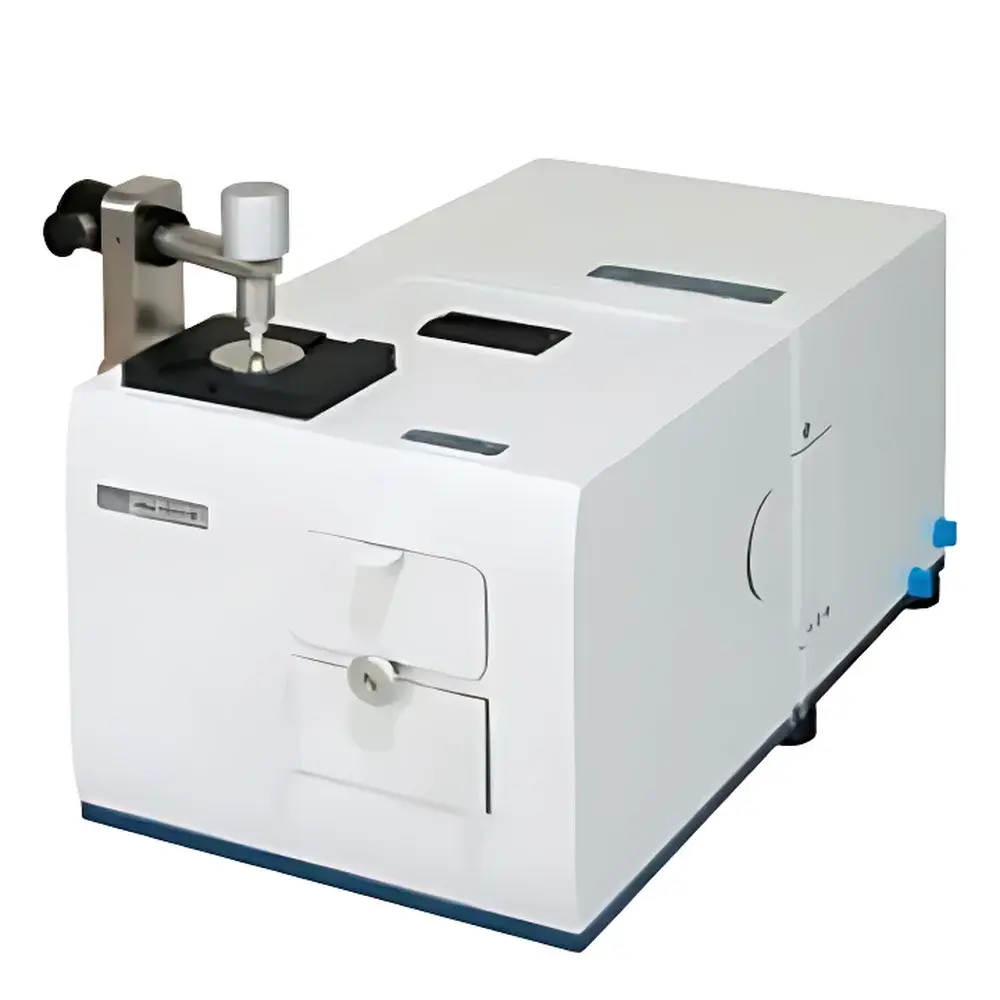
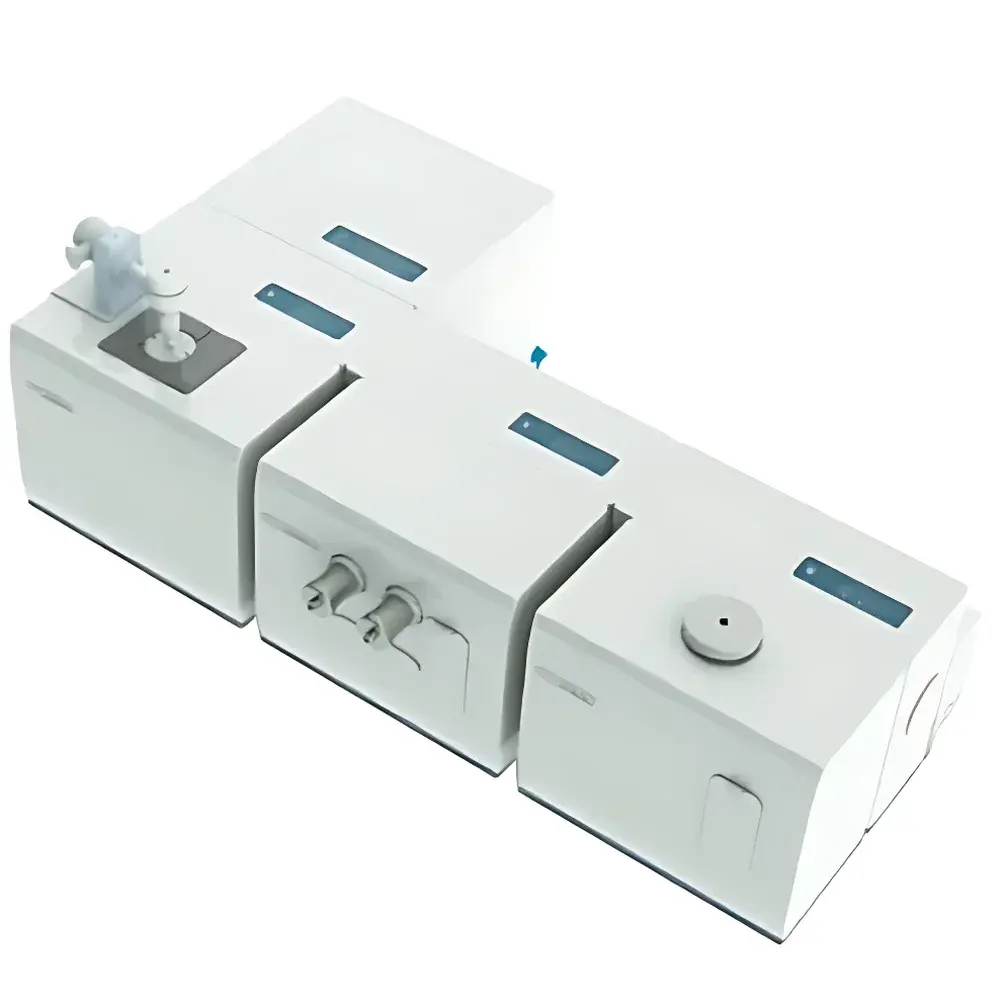
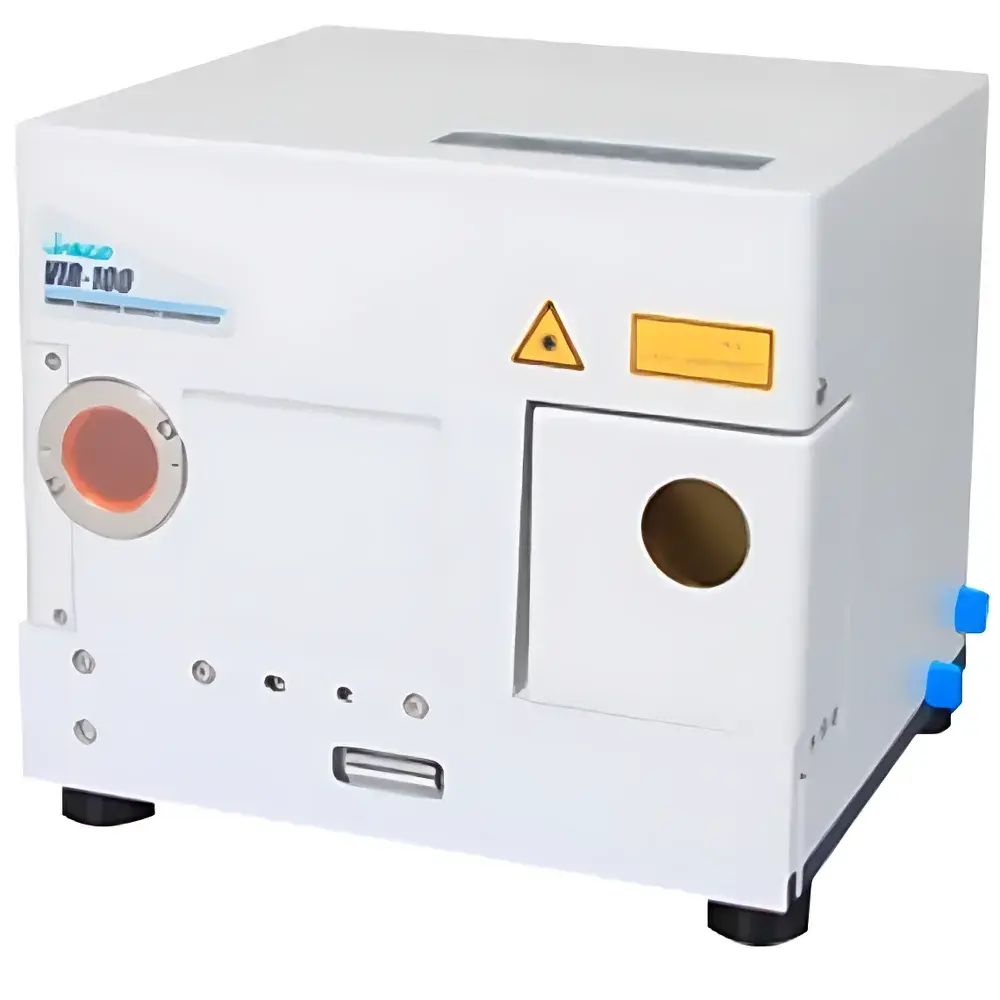
JASCO VIR-100/200/300 Fourier Transform Infrared Spectrometer
| Brand | JASCO |
|---|---|
| Origin | Japan |
| Model | VIR-100 / VIR-200 / VIR-300 |
| Instrument Type | Laboratory FTIR Spectrometer |
| Wavenumber Range | 7,800–350 cm⁻¹ (standard) |
| Spectral Resolution | 0.4–16 cm⁻¹ |
| Interferometer | Sealed, DSP-driven corner-cube retroreflector with auto-alignment and learning-based active stabilization (VIR-200/VIR-300 only) |
| Detectors | Standard DLATGS |
| Scan Speed | Up to 40 Hz (optional) |
| Power Supply | AC adapter or rechargeable battery operation |
| Compliance | Designed for GLP/GMP environments |
Overview
The JASCO VIR-100/200/300 Fourier Transform Infrared (FTIR) Spectrometer is a modular, laboratory-grade analytical platform engineered for high-fidelity molecular identification and quantitative analysis across diverse sample states—solid, liquid, gas, and thin films. Based on Michelson interferometry with a thermally stabilized, hermetically sealed corner-cube interferometer, the system delivers precise spectral acquisition via rapid-scan or step-scan modulation. Its optical architecture employs a permanently aligned, vibration-damped beam path, minimizing drift and enabling reproducible measurements under non-ideal environmental conditions—including field-deployable setups powered by integrated battery modules. The VIR series adheres to core FTIR performance principles: high optical throughput (Jacquinot advantage), inherent wavelength accuracy (Connes advantage), and multiplex efficiency (Fellgett advantage), making it suitable for both routine QC and advanced research applications requiring spectral fidelity and long-term stability.
Key Features
- Modular optical base platform supporting up to three simultaneously connected measurement units via the JASCO Link-Optics System—enabling concurrent ATR, transmission, and diffuse reflectance configurations without manual realignment.
- DSP-controlled corner-cube interferometer with automated alignment and learning-based active stabilization (VIR-200/VIR-300), ensuring consistent optical path difference (OPD) control and minimal phase error over extended operation.
- Multi-detector compatibility: Standard deuterated triglycine sulfate (DLATGS) for broad-range ambient-temperature operation; optional mercury cadmium telluride (MCT) for mid-IR high-sensitivity detection; InGaAs and InSb detectors for extended near-IR coverage (up to 12,000 cm⁻¹).
- Integrated motorized ATR stage with calibrated force feedback sensor (0–50 N range), enabling repeatable contact pressure control across soft polymers, gels, and rigid ceramics—critical for inter-laboratory comparability.
- Battery-powered operation mode (up to 4 hours continuous scanning) and ultra-compact footprint (< 30 L volume), facilitating mobile lab deployment, cleanroom integration, and on-site process monitoring.
- Self-diagnostic firmware with automated validation routines (VIR-200/VIR-300), including interferogram quality assessment, laser frequency stability check, and detector responsivity verification—generating timestamped diagnostic logs compliant with ISO/IEC 17025 documentation requirements.
Sample Compatibility & Compliance
The VIR platform accommodates heterogeneous sample formats through application-specific accessories: single-bounce diamond ATR for viscous liquids and pastes; 10–100 m pathlength gas cells with temperature/pressure control ports; fiber-optic probes (ATR, transmission, and reflection geometries) for in-line reactor monitoring; and micro-FTIR coupling for spatially resolved analysis down to 15 µm spot size. All measurement units are mechanically registered to the base optical axis, eliminating recalibration when switching modalities. The system meets essential regulatory expectations for analytical instrumentation: optical components comply with RoHS directives; electrical design conforms to IEC 61010-1 safety standards; and firmware architecture supports audit-trail-enabled data handling per FDA 21 CFR Part 11 when paired with JASCO Spectra Manager™ II software configured in 21 CFR Part 11 mode.
Software & Data Management
JASCO Spectra Manager™ II provides full instrument control, spectral processing (baseline correction, vector normalization, derivative transformation, peak integration), and chemometric analysis (PCA, PLS regression). Raw interferograms and processed spectra are stored in vendor-neutral JCAMP-DX format (v6.0), ensuring interoperability with third-party tools such as Unscrambler® and MATLAB. The software includes built-in method templates for USP , ASTM E1252, and ISO 18389 compliance testing, and supports electronic signature workflows with role-based access control, session logging, and immutable audit trails. Data integrity is reinforced via automatic checksum generation upon file save and periodic integrity verification during archive retrieval.
Applications
- Pharmaceutical solid-state characterization: Polymorph screening, hydrate/solvate identification, and excipient compatibility studies using variable-temperature ATR and transmission modes.
- Industrial polymer QA/QC: Real-time monitoring of curing kinetics in epoxy resins via fiber-optic NIR-FTIR; quantification of plasticizer migration in PVC films using spectral subtraction algorithms.
- Food authenticity verification: Rapid classification of olive oil adulteration (e.g., hazelnut oil) via PLS-DA models trained on 1,700–1,500 cm⁻¹ fingerprint region.
- Environmental analysis: Quantitative determination of VOCs in ambient air samples collected in Tedlar® bags, using pre-concentrated gas cell measurements at 0.5 cm⁻¹ resolution.
- Materials science: In situ analysis of catalyst surface adsorbates during CO oxidation cycles, enabled by high-speed 40 Hz scanning and synchronized temperature ramping.
FAQ
What distinguishes the VIR-200/VIR-300 from the VIR-100 in terms of interferometer control?
The VIR-200 and VIR-300 incorporate a learning-based active stabilization algorithm that continuously adjusts mirror position based on real-time interferogram feedback; the VIR-100 uses passive thermal compensation only.
Can the VIR system perform quantitative analysis compliant with pharmacopeial methods?
Yes—when configured with validated methods, calibrated reference materials, and Spectra Manager™ II in 21 CFR Part 11 mode, it supports USP , EP 2.2.24, and JP 2.05 protocols.
Is spectral library searching supported natively?
Yes—the software includes searchable libraries (SDBS, POLYMER, NIST 2021) with hit-quality index (HQI) scoring and customizable matching thresholds.
How is measurement repeatability ensured across different operators?
Motorized ATR pressure control, automated background collection, and method-locked parameter sets eliminate operator-dependent variables; all settings are embedded in .smr method files.
Does the battery-operated mode affect spectral resolution or signal-to-noise ratio?
No—battery power delivery is regulated to maintain stable laser diode current and detector bias voltage; SNR remains equivalent to AC operation within ±1.5% across the full wavenumber range.




