
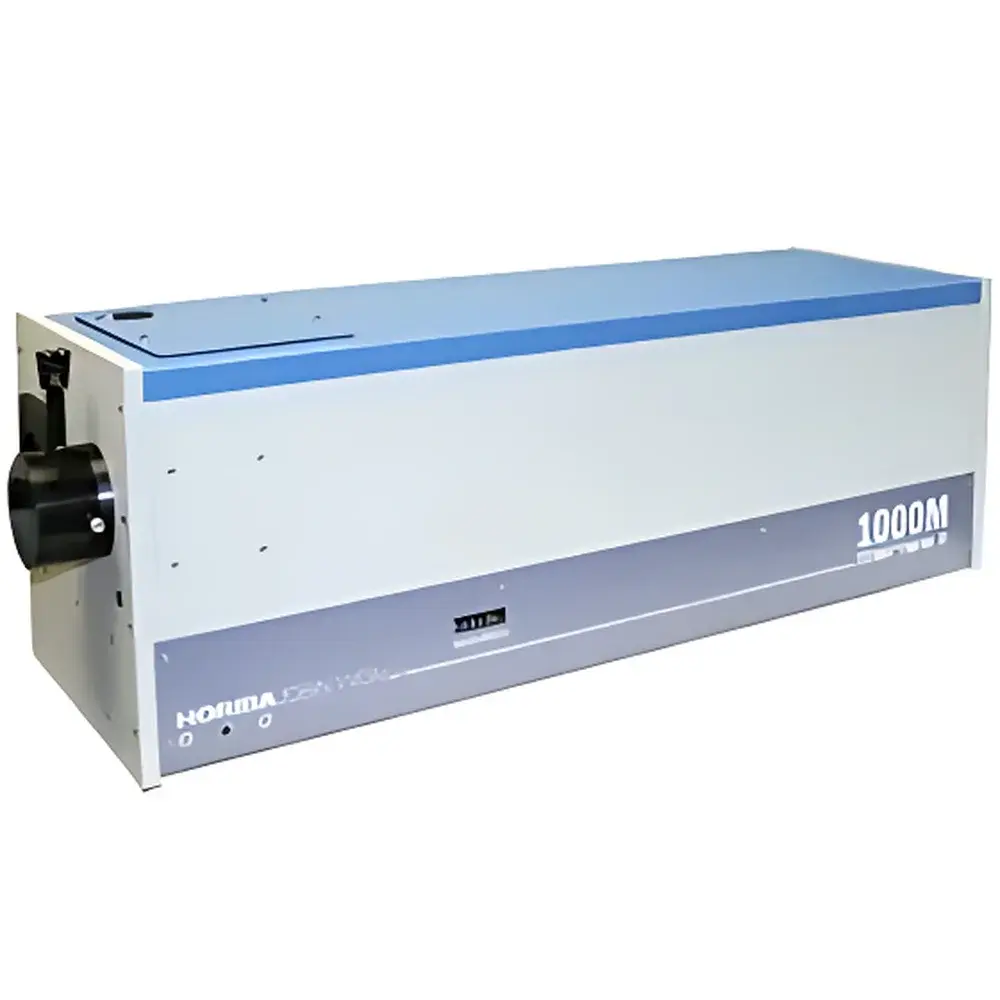
HORIBA JY 1000M / 1250M High-Resolution Czerny–Turner Grating Spectrometers
| Brand | HORIBA |
|---|---|
| Model | 1000M / 1250M |
| Focal Length | 1000 mm / 1250 mm |
| F-number | f/8 / f/9 |
| Spectral Resolution | 0.008 nm (1000M) / 0.006 nm (1250M) |
| Linear Dispersion | 0.8 nm/mm (1000M) / 0.65 nm/mm (1250M) |
| Grating Size | 110 mm × 110 mm |
| Wavelength Accuracy | ±0.05 nm |
| Wavelength Repeatability | ±0.005 nm |
| Slit Adjustment Range | 0–3 mm (2 µm step resolution) |
| Step Resolution | 0.00025 nm |
| Input/Output Ports | Dual entrance & dual exit with motorized mirror switching |
| Grating Mount | Manual or motorized interchangeable grating turret |
Overview
The HORIBA JY 1000M and 1250M are high-performance, research-grade Czerny–Turner monochromators designed for demanding spectroscopic applications requiring exceptional spectral resolution, mechanical stability, and optical fidelity. Engineered for precision wavelength selection and dispersion control, these instruments operate on the principle of angular dispersion via ruled or holographic diffraction gratings mounted in a thermally stable, kinematically aligned optical bench. With focal lengths of 1000 mm and 1250 mm respectively, both models deliver sub-picometer wavelength stepping capability (0.00025 nm), enabling high-resolution emission, excitation, and Raman spectroscopy — particularly where narrow linewidth sources (e.g., single-mode lasers, atomic emission lines) or fine-structure analysis (e.g., isotopic shifts, hyperfine splitting) is required. Their robust mechanical architecture minimizes thermal drift and mechanical hysteresis, supporting long-term measurement reproducibility essential for quantitative spectral metrology.
Key Features
- Sub-0.01 nm spectral resolution: Achieves 0.008 nm (1000M) and 0.006 nm (1250M) resolution under optimal slit and grating conditions — among the highest available in commercially deployed scanning monochromators.
- Precision slit mechanism: Motorized slits adjustable from 0 to 3 mm in 2 µm increments, enabling precise control of spectral bandwidth and signal-to-noise ratio without manual intervention.
- Dual-input/dual-output optical configuration: Integrated motorized flip mirrors allow automatic routing between two independent entrance ports (e.g., lamp source and laser input) and two exit ports (e.g., PMT and CCD detector), facilitating multi-modal experiments without realignment.
- Modular grating platform: Accommodates standard 110 mm × 110 mm ruled or holographic gratings; optional motorized turret supports up to three gratings for rapid, software-controlled spectral range switching.
- High positional fidelity drive system: Stepper-motor-based wavelength scanning with 0.00025 nm step resolution and <±0.005 nm repeatability over repeated scans — critical for spectral mapping and kinetic time-series acquisition.
- Thermally stabilized optical baseplate: Low-expansion alloy construction and passive thermal management ensure minimal focus shift and wavelength drift during extended acquisitions.
Sample Compatibility & Compliance
The 1000M/1250M spectrometers are not sample-contacting instruments but serve as core optical engines within larger analytical platforms — most commonly integrated into fluorescence, photoluminescence, Raman, and laser-induced breakdown spectroscopy (LIBS) systems. As such, they comply with foundational optical instrumentation standards including ISO 14644-1 (cleanroom compatibility for vacuum-compatible variants), ANSI Z80.1 (optical safety for enclosed beam paths), and IEC 61000-6-3 (EMC emissions). When configured with NIST-traceable calibration sources and used in validated instrument setups, data generated supports GLP and GMP workflows per FDA 21 CFR Part 11 when paired with compliant data acquisition software featuring audit trails, electronic signatures, and secure storage protocols.
Software & Data Management
HORIBA’s Synapse™ and LabSpec™ software suites provide native control of wavelength scanning, slit positioning, grating selection, and detector synchronization. All motion parameters are logged with timestamps and metadata (e.g., grating ID, slit width, integration time), ensuring full traceability. Export formats include ASCII (.txt), CSV, and HDF5 — compatible with MATLAB, Python (NumPy/Pandas), and OriginLab for advanced spectral processing. Optional API support (DLL, LabVIEW VIs, Python bindings) enables integration into custom automation frameworks. Data integrity safeguards include checksum validation, write-once archive modes, and user-access-level permissions aligned with ALCOA+ principles (Attributable, Legible, Contemporaneous, Original, Accurate, Complete, Consistent, Enduring, Available).
Applications
- High-resolution atomic and molecular emission spectroscopy — resolving hyperfine structure in rare-earth dopants or transition metal complexes.
- Low-background fluorescence lifetime and anisotropy measurements requiring precise excitation bandpass selection.
- Raman microspectroscopy with notch-filter rejection and narrowband detection, especially for low-frequency phonon modes (<50 cm⁻¹).
- Calibration and verification of tunable lasers, frequency combs, and wavelength references against primary standards.
- Time-resolved photoluminescence mapping in semiconductor heterostructures, where spectral diffusion and Stark-shift dynamics demand sub-pixel wavelength stability.
- UV–Vis–NIR spectral radiometry in synchrotron beamlines, where absolute irradiance accuracy depends on monochromator linearity and stray-light suppression.
FAQ
What is the difference between the 1000M and 1250M models?
The 1250M features a longer focal length (1250 mm vs. 1000 mm), resulting in higher spectral resolution (0.006 nm vs. 0.008 nm) and lower linear dispersion (0.65 nm/mm vs. 0.8 nm/mm), making it preferable for ultra-high-resolution applications where throughput can be traded for resolving power.
Can these monochromators operate under vacuum or purged environments?
Yes — optional vacuum-compatible versions (with stainless-steel housing and Viton® seals) are available for UV applications below 190 nm, including DUV fluorescence and VUV reflectometry.
Is motorized grating switching standard or optional?
Motorized grating turrets are optional accessories; standard configurations include manual grating exchange with kinematic mounts and alignment verification tools.
How is wavelength calibration performed and maintained?
Factory calibration uses Hg/Ar/Ne spectral lamps with NIST-traceable line positions; users may perform routine recalibration using internal or external reference sources via software-guided peak search and polynomial fitting.
Do these instruments support synchronous detection with lock-in amplifiers?
Yes — TTL-compatible trigger outputs and analog modulation inputs enable direct synchronization with chopper wheels, AOMs, and lock-in amplifiers for noise-suppressed signal recovery.






