
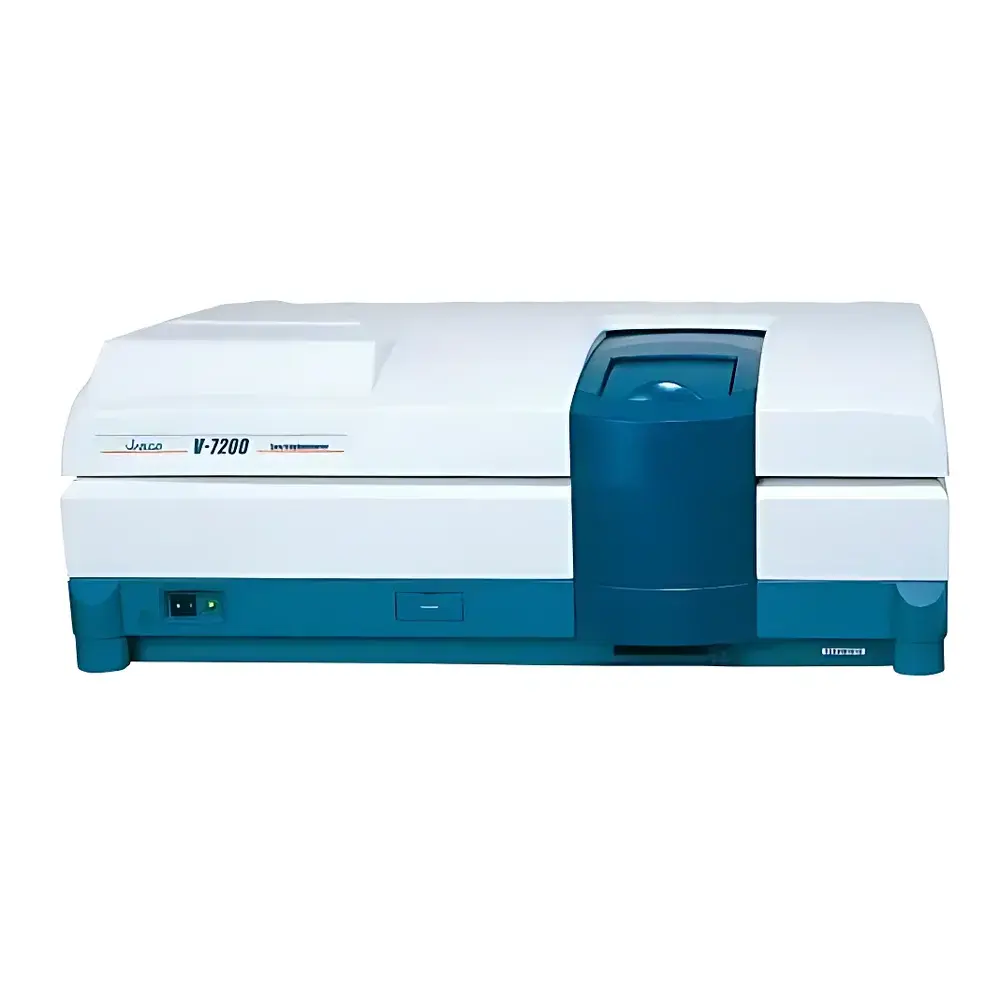
JASCO V-7000 Series UV-Vis-NIR Spectrophotometer
| Brand | JASCO |
|---|---|
| Origin | Japan |
| Manufacturer Type | Authorized Distributor |
| Product Origin | Imported |
| Model | V-7000 Series |
| Optical System | Double-beam |
| Detector | Photomultiplier Tube (PMT) |
| Wavelength Range | 175–3300 nm |
| Wavelength Accuracy | ±0.08 nm |
| Spectral Bandwidth | 0–20 nm (variable, motorized slit control) |
| Stray Light | ≤0.00007% (at 220 nm, NaI |
| Photometric Range | ±8.0 Abs |
| Resolution | 0.049 nm (UV-Vis region, using high-resolution grating mode) |
| Software | JASCO Spectra Manager™ (cross-platform, Windows/macOS/Linux compatible) |
Overview
The JASCO V-7000 Series UV-Vis-NIR spectrophotometer is a high-performance, double-beam optical instrument engineered for precise quantitative and qualitative analysis across the ultraviolet, visible, and near-infrared spectral regions (175–3300 nm). Based on dual monochromator architecture with motorized variable slits and optimized optical path design, the system delivers exceptional photometric linearity, long-term baseline stability, and ultra-low stray light performance—critical for demanding applications such as trace-level absorbance quantification, thin-film characterization, and high-dynamic-range transmission/reflection measurements. Its ±8.0 Abs photometric range enables reliable detection of highly concentrated or strongly absorbing samples without dilution or signal saturation, while the 0.049 nm resolution in UV-Vis ensures accurate peak deconvolution and fine spectral structure analysis. The instrument’s thermally stabilized electronics and precision-machined optical mounts minimize drift and enhance measurement reproducibility over extended acquisition periods.
Key Features
- Double-monochromator optical design with independently adjustable entrance and exit slits for optimized signal-to-noise ratio and spectral resolution
- Photomultiplier tube (PMT) detector for high sensitivity in UV-Vis (175–900 nm); optional InGaAs or PbS detectors extend coverage to 3300 nm (V-7300/V-7200 models)
- Ultra-low stray light performance (≤0.00007% at 220 nm and 340 nm), validated per ASTM E275 and ISO 9001-compliant calibration protocols
- Motorized spectral bandwidth control (0–20 nm), enabling method-specific optimization for resolution vs. throughput trade-offs
- Wavelength accuracy of ±0.08 nm, traceable to NIST-certified holmium oxide and didymium reference filters
- Modular chassis supporting seamless integration of temperature-controlled cuvette holders, integrating spheres, absolute reflectance accessories, and fiber-optic probes
Sample Compatibility & Compliance
The V-7000 Series accommodates standard 10 mm pathlength quartz, fused silica, or CaF₂ cuvettes (UV-grade), as well as custom sample cells for solid, powder, and film analysis. Optional integrating sphere units (e.g., ISN-723) enable diffuse reflectance, total reflectance, and absolute %R measurements per ASTM E1331 and ISO 2813 standards. Temperature-controlled accessories support regulated measurements from –10 °C to 110 °C (±0.1 °C stability), compliant with USP and ICH Q2(R2) guidelines for method robustness assessment. Instrument firmware and Spectra Manager™ software support 21 CFR Part 11-compliant audit trails, electronic signatures, and user access control—facilitating GLP/GMP laboratory workflows.
Software & Data Management
Spectra Manager™ is a vendor-neutral, cross-platform application (Windows, macOS, Linux) that provides unified control of JASCO’s full spectroscopy portfolio. It supports real-time spectral acquisition, multi-point kinetic scanning, time-resolved mapping, and advanced post-processing including baseline correction (Savitzky-Golay, polynomial), derivative spectroscopy, spectral subtraction, and multivariate analysis (PCA, PLS). All raw data are stored in open-format .jws files with embedded metadata (wavelength calibration, slit width, detector gain, date/time stamp), ensuring FAIR (Findable, Accessible, Interoperable, Reusable) data principles. Export options include CSV, ASCII, JCAMP-DX, and PDF reports with customizable templates aligned to internal SOPs or regulatory submission requirements.
Applications
- Pharmaceutical QC/QA: Active pharmaceutical ingredient (API) assay, dissolution testing, excipient compatibility studies, and stability-indicating method development per ICH Q5C
- Materials science: Bandgap determination of semiconductors, optical density profiling of anti-reflective coatings, and thickness calculation of transparent thin films via interference fringe analysis
- Environmental analysis: Quantification of nitrate, phosphate, and heavy metal complexes in aqueous matrices following EPA Method 365.3 and ISO 15681-1
- Life sciences: Protein concentration (A280), nucleic acid purity (A260/A280), enzyme kinetics (NADH/NADPH monitoring), and ligand-binding titrations
- Nanotechnology: Characterization of plasmonic nanoparticle dispersions, quantum dot size distribution estimation, and surface functionalization verification
FAQ
What wavelength ranges do the V-7100, V-7200, and V-7300 models cover?
The V-7100 operates from 175–900 nm (UV-Vis), the V-7200 extends to 3300 nm (UV-Vis-NIR), and the V-7300 covers 175–1800 nm (UV-Vis-SWIR), each optimized for detector quantum efficiency and grating dispersion characteristics.
Is the V-7000 Series compliant with 21 CFR Part 11 for regulated laboratories?
Yes—when used with Spectra Manager™ v3.0 or later and configured with role-based user accounts, electronic signatures, and immutable audit logs, the system meets FDA requirements for electronic records and signatures.
Can the instrument perform absolute reflectance measurements without external calibration standards?
No—absolute reflectance requires a calibrated reference standard (e.g., Spectralon® or aluminum-coated mirror) and an integrating sphere accessory (ISN-723 or ISN-737); the software applies Kubelka-Munk transformation for quantitative analysis.
How is wavelength accuracy verified and maintained?
Accuracy is verified using NIST-traceable holmium oxide (241, 279, 287, 333, 360, 418, 480, 536 nm) and didymium glass filters; automatic wavelength calibration routines are executable before each session or scheduled daily.
What maintenance is required to sustain stray light specifications over time?
Annual optical alignment verification and PMT gain recalibration are recommended; cleaning of entrance/exit slits and grating surfaces should be performed only by certified JASCO service engineers using Class 100 cleanroom protocols.





